
Sepsid fly
Sepsis
Description
How to identify
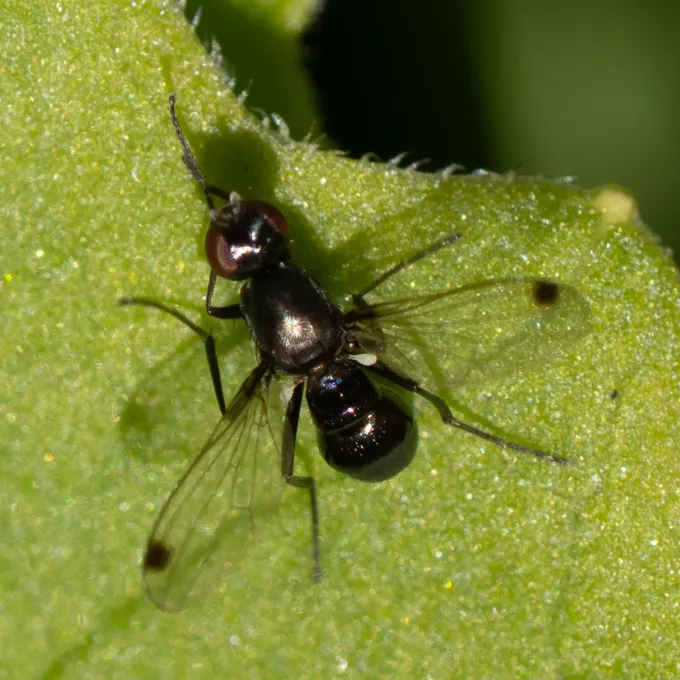
Sepsid flies (family Sepsidae) are small insects with a body length typically ranging from 2 to 6 millimeters. They are often called 'ant flies' due to their appearance and the specific shape of their abdomen, which is constricted at the base.
The adults are usually dark and shiny, sometimes with a metallic sheen. The wings are transparent, but many species have a distinct dark spot at the tip, which is a key diagnostic feature for field identification.
The head is rounded with large eyes that cover most of the lateral surface. The legs are relatively long and often equipped with small spines, which assist the flies in moving actively across various substrates.
Systematically, Sepsid flies belong to the order Diptera, suborder Brachycera. There are several hundred species worldwide, each adapted to diverse ecological niches.
They are frequently found near decaying organic matter, manure, pastures, and rotting plant debris, where the larvae feed as saprophages.
What it damages
The damage caused by Sepsid flies is mostly indirect, as they rarely attack healthy, vigorous plant tissues. They are more likely to target vegetable crops that are already weakened by disease or mechanical injury.
The larvae colonize damaged parts of stems and roots, such as in onions, garlic, or other root vegetables, accelerating decay and reducing the marketability of the produce.
In greenhouses or high-humidity environments, these flies can act as vectors for pathogenic microorganisms, facilitating the spread of fungal and bacterial rot throughout the crop.
Sepsids may also damage seedlings if the seeds or young shoots are in direct contact with decomposing organic matter where the larvae are developing.
The economic impact of this pest is highest in agricultural settings with poor sanitation, where accumulations of organic waste provide ideal breeding grounds.
When it appears
Adult activity begins in early spring as soon as temperatures stabilize above freezing and continues until late autumn.
The population peaks coincide with periods of high humidity and warmth, which trigger intense decomposition of organic matter in the soil.
Sepsid flies can produce multiple generations per season, allowing them to rapidly increase their numbers when conditions for larval development are favorable.
Adult flies are diurnal, preferring well-lit areas where they feed on flower nectar or secretions from organic substrates.
The life cycle consists of the egg, three larval instars, the puparium, and the adult, with the development time taking from two to four weeks depending on environmental conditions.
Signs of infestation
The first sign of infestation is the presence of adult flies hovering over areas with moist soil or manure piles. Their flight behavior often involves specific wing-flicking movements.
Upon inspecting the root collar or the lower stem, one can find clusters of small larvae actively penetrating the softened tissues of the plant.
Affected plants show yellowing and wilting, which is often misdiagnosed as standard root rot, even though the primary cause may be insect damage.
At the site of penetration, plant tissues become watery, dark in color, and emit an unpleasant odor due to secondary bacterial infection.
- Necrotic spots on roots and stems.
- Premature wilting of seedlings.
- Softening of tissues near the soil surface.
- Presence of puparia in the soil around the roots.
Control measures
The primary control measure is maintaining good agricultural practices, such as removing plant debris and incorporating manure into the soil properly to prevent surface accumulation.
Effective preventive measures include controlling soil moisture levels and managing weeds that may serve as alternative breeding sites for the flies.
In cases of high infestation, contact or systemic insecticides approved for specific vegetable crops can be used to manage adult populations.
Biological control options involve using natural predators or attractant traps to reduce the fly population without relying on synthetic chemicals.
Crop rotation is essential, as the accumulation of larvae in the soil during monoculture practices significantly increases the risk of damage to subsequent plantings.
Taxonomy
- Latin name
- Sepsis
- Order
- Diptera (flies)
- Family
- Sepsidae
- EPPO code
- SEPSSP
Discussion
No discussions yet — be the first.