
House centipede
Scutigera forceps
Description
How to identify
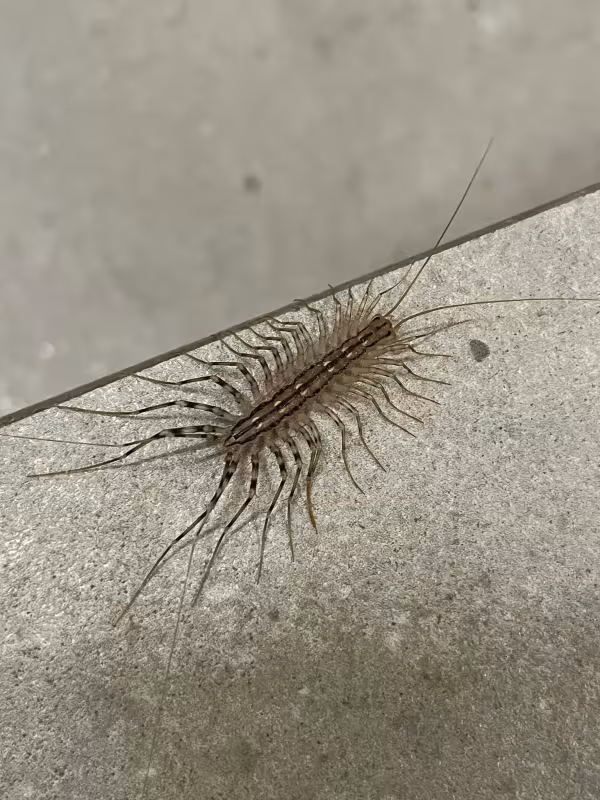
The house centipede (Scutigera forceps) belongs to the order Scutigeromorpha and the family Scutigeridae. It is easily recognized by its long, spindly legs and a distinct body divided into 15 segments.
The body of an adult centipede typically measures 30–35 mm in length, displaying a yellowish-grey color with three characteristic dark stripes running down the length of the back. Its legs are also marked with alternating dark bands.
A striking anatomical feature is the pair of modified front legs known as forcipules, which are equipped with venom glands to immobilize prey. They also possess large compound eyes and long, sensitive antennae.
As one of the fastest moving arthropods, it can navigate complex surfaces with ease, making it a highly effective hunter in both indoor and outdoor environments.
The life cycle begins with larvae that have only four pairs of legs. Through several molting stages, the number of legs increases progressively until the adult stage with 15 pairs is reached.
What it damages
The house centipede is not a plant pest; it is a predator that feeds on other small arthropods. In an agricultural context, it is often classified as a beneficial insect rather than a threat.
Its primary diet consists of aphids, spider mites, thrips, silverfish, and fly larvae, all of which are notorious pests in greenhouse settings. By consuming these, the house centipede helps maintain ecological balance.
There is no evidence that this species causes direct damage to crops by feeding on leaves, stems, or roots. It poses no threat to the commercial yield of vegetables, fruits, or ornamental plants.
Any negative perception usually stems from its appearance and its presence in places where cleanliness is expected, rather than actual economic damage to the agricultural production.
In modern integrated pest management (IPM) programs, the house centipede is seen as a natural ally that provides biological control of small garden pests, reducing the need for chemical interventions.
When it appears
The activity of the house centipede is closely tied to environmental temperature and moisture levels. In temperature-controlled greenhouses, they remain active throughout the entire year.
In the natural environment, they are most active during the warmer months when humidity levels are optimal and their prey population is at its highest.
As temperatures drop during the autumn and winter, these centipedes tend to seek refuge in heated structures, such as greenhouses or storage facilities, to maintain their metabolic functions.
Breeding typically occurs during the warmer seasons when moisture is sufficient to protect eggs from desiccation. They favor damp, dark areas for egg-laying and shelter.
Juvenile activity peaks in the late spring and summer, coinciding with the rapid growth of their insect prey population, ensuring a constant food supply for their development.
Signs of infestation
The most common sign of their presence is the visual sighting of an adult centipede moving rapidly across the floor or wall. They are nocturnal hunters and often move during low-light hours.
Physical evidence of their presence includes shed cuticles (exoskeletons) found in corners, under debris, or near the base of potted plants, as the centipede molts several times throughout its life.
Because they do not feed on plant tissue, you will not observe bite marks, chlorosis, or any other signs of damage on the vegetation they inhabit, which distinguishes them from herbivorous pests.
Finding a cluster of house centipedes may indicate an underlying infestation of other small insects, as they congregate in areas where their prey is abundant.
The absence of characteristic insect frass or sticky residues on leaves confirms that these centipedes are not involved in plant damage, as they ingest their prey entirely.
Control measures
Direct chemical control of the house centipede is generally discouraged in agriculture. Using broad-spectrum insecticides can harm beneficial predators and pollinators, leading to greater long-term issues.
To reduce their numbers, focus on environmental management. Improving drainage to eliminate standing water and removing organic debris or damp wood will make the area less attractive to them.
Preventative measures, such as sealing gaps in greenhouse walls or installing fine screens on vents, effectively prevent these arthropods from entering production zones from the outside.
If physical removal is required for personal or aesthetic reasons, simple manual capture or the use of sticky traps placed in non-cultivated areas is sufficient.
Maintaining a well-sanitized growing environment and managing the populations of their prey (the actual pests) naturally leads to a decrease in the house centipede population, as they will move to areas where food is more plentiful.
Taxonomy
- Latin name
- Scutigera forceps
- Family
- Scutigeridae
- EPPO code
- SCUIFO
Discussion
No discussions yet — be the first.