
House centipede
Scutigera
Description
How to identify
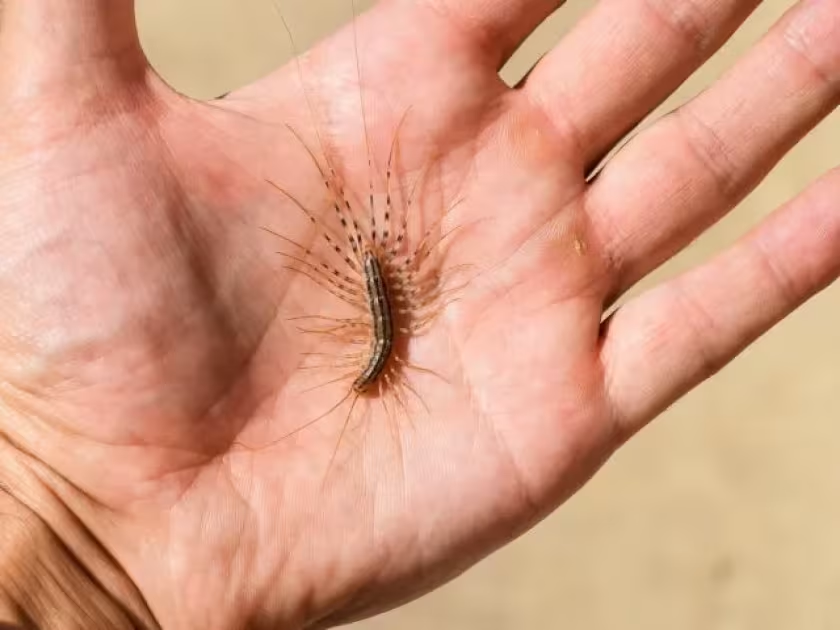
The house centipede (Scutigera coleoptrata) is a fast-moving arthropod belonging to the class Chilopoda. Its body is yellowish-grey, featuring three distinct longitudinal dark stripes on the dorsal side.
It is easily identified by its 15 pairs of long, thread-like legs that increase in length towards the posterior. These legs allow the centipede to move at incredible speeds across various surfaces.
The head possesses large, well-developed compound eyes and long, sensitive antennae. Unlike many other centipede species, Scutigera relies heavily on its vision to locate and hunt prey.
These organisms prefer dark, humid environments such as basements, crawl spaces, and greenhouses, where they can find both shelter and an abundance of food sources.
Their life cycle involves incomplete metamorphosis, where young centipedes emerge from eggs with fewer leg segments, gradually acquiring them through successive molting stages.
What it damages
From an agronomical perspective, the house centipede is not a plant pest. It does not feed on plant tissue, sap, leaves, or roots, and therefore poses no direct threat to crop health.
On the contrary, the house centipede is a highly efficient beneficial predator. It feeds on various greenhouse pests, including aphids, mites, silverfish, and fly larvae, acting as a natural pest controller.
The perceived "damage" is strictly related to human discomfort caused by its intimidating appearance. Growers often mistake it for a pest and apply unnecessary chemicals, which can disrupt the natural balance.
High populations of house centipedes should be interpreted as a sign of high prey activity. It is the prey species that require attention, not the centipede itself.
Integrated Pest Management (IPM) strategies typically favor the presence of such predators as they help reduce reliance on synthetic pesticides, supporting sustainable agricultural practices.
When it appears
The activity of the house centipede is closely tied to ambient temperature and moisture levels. In heated greenhouses, they can remain active throughout the entire year.
In outdoor or unheated settings, they emerge in the spring once temperatures consistently exceed 10–12 degrees Celsius, seeking areas with moderate warmth and high humidity.
Population peaks typically occur during the warmer summer months, coinciding with the breeding cycles of their prey insects, which provide the primary food source.
As temperatures drop in autumn, house centipedes migrate into structural cracks, basements, and greenhouses to seek refuge from the cold and survive the winter months.
Humidity is a critical environmental requirement; therefore, they avoid arid conditions and prefer microclimates within greenhouses that offer consistent moisture.
Signs of infestation
The primary sign of their presence is direct observation, as they are most active at night when they hunt for prey along greenhouse walls and structural supports.
Discarded exoskeletons (molts) found in dark, hidden cracks are indicators of a established population living within the structure of the facility.
An indirect sign of their activity is a decline in pest insect populations, such as aphids, without any recent chemical interventions, indicating predation by natural enemies.
Because house centipedes do not leave feeding marks on crops, there are no specific plant damage symptoms associated with them, which distinguishes them from typical herbivores.
Visual identification of rapid movement near the base of structures or within irrigation channels is the most common way workers confirm their presence.
Control measures
Active control of the house centipede is rarely necessary as they provide free pest control services. Chemical extermination is discouraged to preserve beneficial populations.
To reduce their numbers if they become a nuisance, focus on habitat modification by sealing cracks in foundations and walls where they hide and breed.
Management of greenhouse moisture is the most effective cultural method; improving drainage and ventilation reduces the humidity levels that they depend on for survival.
- Sealing entry points such as gaps in walls and foundations.
- Reducing excessive humidity through better airflow.
- Clearing debris and organic matter that shelters prey and centipedes.
- Prioritizing biological control agents for primary crop pests.
If population levels are perceived as excessive, address the core issue by controlling the pest populations (aphids, mites) that serve as their food source.
Taxonomy
- Latin name
- Scutigera
- Family
- Scutigeridae
- EPPO code
- SCUISP
Discussion
No discussions yet — be the first.