
House centipede
Scutigera coleoptrata
Description
How to identify
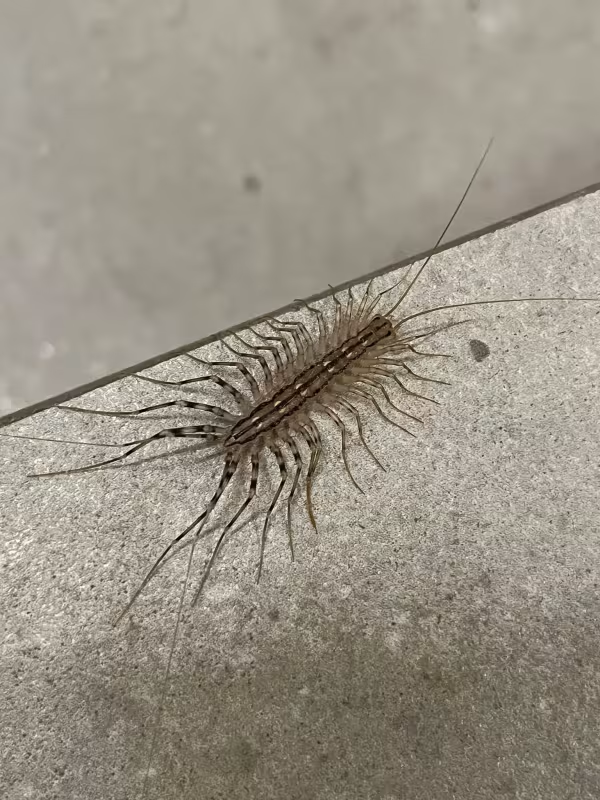
The house centipede (Scutigera coleoptrata) is a member of the class Chilopoda, order Scutigeromorpha, and the family Scutigeridae, characterized by its unique morphology.
It possesses a rigid body divided into 15 segments and is equipped with 15 pairs of long, fragile, and rapidly moving legs that allow it to traverse varied surfaces.
The adult centipede typically displays a yellowish-grey to brown coloration with three distinct dark, longitudinal stripes running along the dorsal side of its body.
Unlike many other centipede species, Scutigera coleoptrata features well-developed compound eyes, which contribute to its superior agility and predatory hunting success.
These creatures are nocturnal and prefer habitats with high humidity and limited light, often utilizing organic debris or construction crevices as daytime refuges.
What it damages
In agricultural and greenhouse settings, the house centipede is primarily a predator that feeds on various insects rather than a herbivorous pest of crops.
Direct damage to plants is negligible; however, in high densities, they may disrupt the soil surface around sensitive seedling roots during their active foraging.
Their presence can be a concern in commercial settings due to the nuisance factor, especially if the population size becomes unmanaged and visible to personnel.
They do not consume foliage or fruit, but their hunting habits may inadvertently lead to mechanical damage in nursery environments if the population density is high.
Often, their presence acts as a bio-indicator of a larger insect population within the greenhouse that provides a food source for these carnivorous arthropods.
When it appears
The activity levels of Scutigera coleoptrata are heavily influenced by environmental temperature and moisture, typically peaking during the warmer months of the year.
In temperature-controlled environments like industrial greenhouses, they can maintain activity cycles year-round due to the stable microclimate and constant humidity.
Springtime often marks the period when adults emerge from overwintering sites, such as wall voids, foundations, or piles of decaying vegetative matter.
As temperatures begin to drop in autumn, these centipedes tend to seek shelter in warmer indoor spaces, which may lead to aggregations near equipment and storage.
Frequent irrigation and soil moisture management are key drivers that sustain local populations by providing both shelter and prey availability.
Signs of infestation
The most common sign of a house centipede infestation is the visual observation of active adults roaming across walls or floors during night checks.
Evidence of molting, identified by the discovery of shed, translucent chitinous skins (exuviae) left behind in damp or dark corners of a growing area.
Slight disturbances in loose, damp soil or mulch that may indicate their search for prey, particularly near the base of young or delicate plants.
A reduction in populations of other common small greenhouse insects can sometimes serve as an indirect indicator of the centipede's predatory activity.
Reports from staff about quick-moving, multi-legged organisms in irrigation zones or storage areas confirm their established presence within the facility.
Control measures
Sanitation is the most effective preventative measure; removing decaying organic matter, loose leaves, and general debris eliminates essential hiding spots.
Reducing moisture levels in non-planted areas, such as walkways and storage rooms, makes the environment significantly less hospitable for these arthropods.
Strategic placement of sticky traps along greenhouse perimeters and foundation lines is a non-toxic method to monitor and reduce local centipede numbers.
Sealing structural gaps, cracks, and crevices in greenhouse floors and walls prevents new individuals from entering the interior space from the outside.
While chemical interventions are rarely necessary for this species, targeted spot treatments with insecticides can be considered if populations exceed manageable levels.
Taxonomy
- Latin name
- Scutigera coleoptrata
- Family
- Scutigeridae
- EPPO code
- SCUICO
Discussion
No discussions yet — be the first.