
Scolia dubia
Scolia dubia
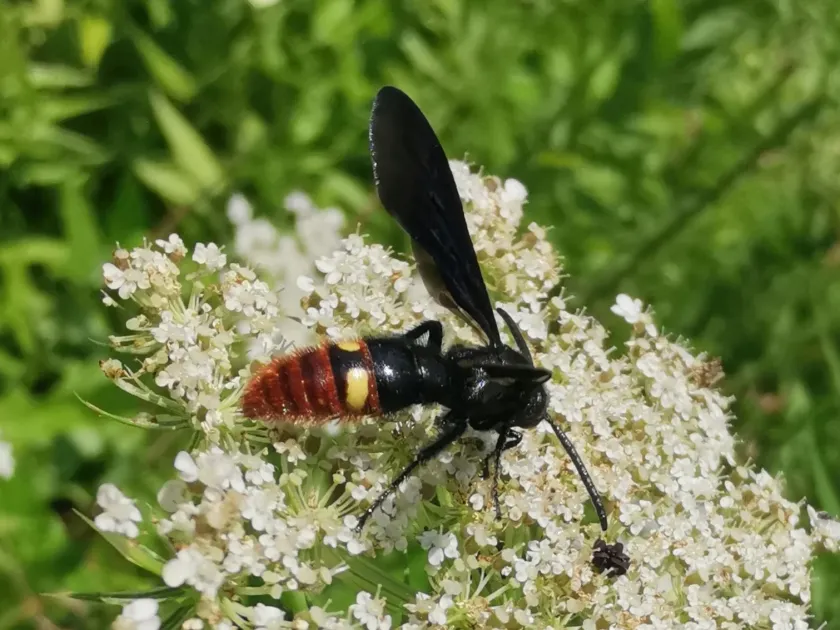
Description
How to identify
Scolia dubia, commonly referred to as the blue-winged wasp, belongs to the family Scoliidae within the order Hymenoptera.
These large, robust wasps are easily identifiable by their dark bodies and characteristic reddish-orange patches located on the abdominal segments.
The wings of Scolia dubia have a distinct blue or dark metallic sheen, which makes them stand out when they are in flight or resting on plants.
Females are generally larger and equipped with a powerful stinger, which they use to paralyze the larvae of scarab beetles, their primary hosts.
Males are typically smaller and lack stingers, spending much of their time searching for nectar in various flowers throughout the garden.
What it damages
While often classified as beneficial due to their parasitic nature, these wasps can cause damage by disturbing the soil while searching for beetle larvae.
In vegetable gardens and lawns, the digging activity of the females can lead to the exposure and drying of delicate root systems of young plants.
The tunnels created during the search for hosts can compromise soil stability and interfere with the nutrient uptake of various agricultural crops.
Indirect damage may occur if the wasps aggregate in high numbers, causing aesthetic damage to lawns and potential concern for gardeners working in the soil.
Although the wasps are not aggressive toward humans unless directly provoked, their presence can be alarming, potentially restricting garden maintenance activities.
When it appears
The adult activity of Scolia dubia typically occurs during the warmest months of the year, spanning from mid-summer through early autumn.
They are most active during sunny, hot days, frequently hovering low over the ground where host larvae are likely to be found buried in the soil.
The breeding season is synchronized with the availability of scarab beetle grubs, ensuring that the next generation has adequate food resources for development.
By the end of the season, the offspring reach the pupal stage, encased in tough, earthen cocoons deep within the soil profile, where they overwinter.
Local temperature and humidity levels play a crucial role in the timing of their emergence, with hotter years often resulting in earlier and longer activity.
Signs of infestation
The most visible sign of their activity is the presence of small, irregular holes in the ground, which indicate where females have burrowed in search of hosts.
Gardeners may observe large, dark-winged wasps hovering or crawling across the surface of the soil, particularly in areas with significant beetle larvae populations.
Sudden wilting or stunted growth of garden plants without obvious signs of surface insects often points to root-level disturbance caused by burrowing wasps.
The discovery of oval, leathery cocoons while digging into the soil is a definitive sign that a population of Scolia dubia is established in the area.
A noticeable decrease in the population of common lawn pests, such as white grubs, may indicate the wasps are actively controlling beetle numbers in the vicinity.
Control measures
In most landscapes, Scolia dubia is considered a beneficial biological control agent, and active management to eliminate them is generally not recommended.
If their presence is problematic, focus management efforts on reducing the underlying beetle grub population, as this removes the primary food source.
Regular cultivation and maintenance of garden beds can disturb their nesting sites, encouraging the wasps to relocate to areas with less soil activity.
Avoid excessive use of broad-spectrum insecticides, which can harm these natural predators and disrupt the delicate balance of your local ecosystem.
- Maintain healthy soil to prevent high densities of host beetle larvae.
- Wear protective footwear when walking in areas with high wasp activity.
- Use mulch to reduce the attractiveness of soil surfaces for nesting females.
Taxonomy
- Latin name
- Scolia dubia
- Order
- Hymenoptera
- Family
- Scoliidae
- EPPO code
- SCOIDU
Discussion
No discussions yet — be the first.