
Scoliid wasp
Scolia
Description
How to identify
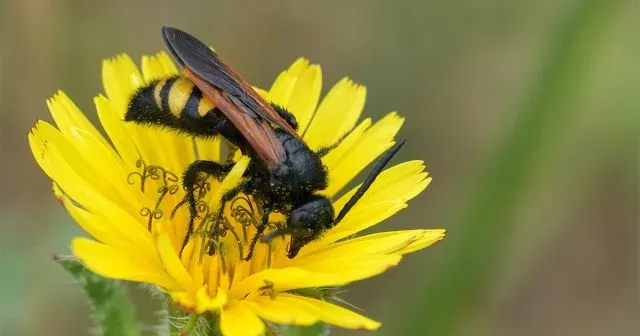
Scoliid wasps (genus Scolia) belong to the order Hymenoptera and the family Scoliidae. These are large, often brightly colored wasps known for their robust bodies and distinct markings on the abdomen.
Adults are solitary insects frequently seen on flowering plants, where they feed on nectar. Females possess powerful mandibles and an ovipositor adapted for burrowing into the soil in search of prey.
Imagoes are highly active, especially during sunny days. Depending on the species, their body size ranges from 10 to 40 millimeters in length.
The biology of these insects is strictly tied to the presence of scarab beetle larvae in the soil, which serve as the essential hosts for their eggs.
It is important to note that adult scoliids are parasitoid entomophages, and labeling them as "pests" is technically incorrect as they provide significant ecological benefits.
What it damages
Adult scoliid wasps do not cause direct damage to cultivated plants, as they rely on nectar and pollen for nutrition. They do not feed on roots, foliage, or fruits of agricultural crops.
Any perceived "harm" is largely due to human discomfort caused by their large size and intimidating appearance during flight.
Their primary biological impact is directed at soil-dwelling larvae of beetles, such as the May beetle or the rhinoceros beetle, which reside in soil or compost piles.
After hatching, the scoliid larva paralyzes the host and feeds on its tissues, effectively eliminating the beetle larva during its developmental cycle.
Therefore, from an agronomic perspective, scoliid wasps function as natural regulators of soil-borne pest populations.
When it appears
Scoliid activity begins in late spring and continues throughout the summer, peaking during the months of June and July.
The emergence of adults is directly influenced by soil temperatures and ambient air warmth, which trigger their activity after winter dormancy.
Females actively search for hosts for their offspring during the period when larval populations of scarab beetles are most abundant and vulnerable in the soil.
The life cycle of adults typically concludes by August, coinciding with the decline of available flowering plants that provide them with food.
They have a univoltine life cycle, meaning they produce one generation per year, with the larvae overwintering inside a protective cocoon buried deep in the substrate.
Signs of infestation
The presence of scoliid wasps is indicated by their active, hovering flight over open soil, lawns, or compost heaps.
Females are frequently observed landing on the ground and exploring surface cracks or loosened soil in a determined search for beetle larvae.
A high density of these insects may suggest that your garden has a significant infestation of May beetle or rhinoceros beetle larvae in the soil.
Visual observation of their flight patterns is the most reliable method for monitoring their presence in an orchard or garden environment.
Atypical behavior, such as swarming near areas with high organic matter accumulation, is also a sign of their hunting activity for potential host larvae.
Control measures
In most instances, control measures against scoliid wasps are unnecessary and discouraged, as they serve as beneficial natural predators of garden pests.
If their presence is a cause for personal discomfort, one may limit access to their breeding sites by moving compost heaps away from frequently used recreational areas.
Chemical intervention is highly inadvisable, as it disrupts the local ecosystem and risks eliminating the natural biological controls of destructive scarab beetles.
To prevent attracting them to specific areas, maintain general garden hygiene, remove plant debris promptly, and avoid excessive accumulation of uncomposted organic matter.
The best strategy is to adopt a tolerant approach toward these beneficial entomophages, which provide free pest control services by reducing the population of root-damaging beetle larvae.
Taxonomy
- Latin name
- Scolia
- Order
- Hymenoptera
- Family
- Scoliidae
- EPPO code
- SCOISP
Discussion
No discussions yet — be the first.