
Marsh beetle
Scirtes hemisphaericus
Description
How to identify
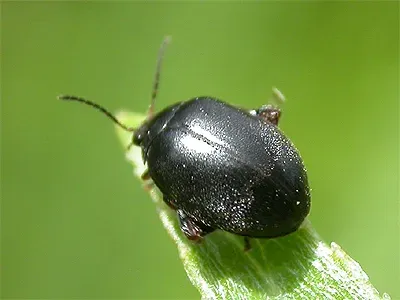
The marsh beetle (Scirtes hemisphaericus) belongs to the Scirtidae family, which are known for their distinct hemispherical, round-shaped bodies.
These beetles are generally small, measuring between 3 to 4 millimeters in length, with a smooth, shiny exoskeleton that is typically dark brown or black.
A key anatomical feature of this beetle is its enlarged hind femora, which grant the insect powerful jumping abilities when threatened or disturbed.
The larval stage of Scirtes hemisphaericus is predominantly aquatic, as they develop in stagnant water, wetlands, or saturated mud near agricultural fields.
Adult beetles are commonly observed on aquatic vegetation or plants located in damp environments, frequently near ponds, ditches, or poorly drained lowlands.
What it damages
While not classified as a major agricultural plague, this beetle can cause significant damage to crops located in marshy or water-logged areas of a farm.
The damage is primarily caused by adult beetles feeding on the leaves, where they create irregular-shaped holes, often referred to as shothole damage.
When populations reach higher densities, this feeding behavior can lead to a reduction in the leaf surface area, thereby impacting the photosynthesis of the plant.
Young seedlings are particularly vulnerable, as even minor tissue damage can slow their growth and lead to increased susceptibility to other stressors.
Economic damage is most often localized to specific parts of a field that remain overly wet throughout the growing season, attracting the beetles.
When it appears
The biological cycle of the marsh beetle is intricately linked to humidity levels, as the larvae require an aquatic or semi-aquatic habitat to survive.
Adult emergence typically occurs in late spring, with the peak of activity usually recorded during the summer months of June and July in the Northern Hemisphere.
Throughout the warmer months, the larvae go through several developmental instars within the water before pupating in the moist soil nearby.
The adult stage is highly active during the summer, migrating to lush vegetation to feed and mate before the onset of the colder season.
As temperatures drop in the autumn, the adults seek out hibernation sites in leaf litter, debris, or the upper layers of the soil to survive the winter.
Signs of infestation
The most prominent sign of an infestation is the presence of small, irregular holes on the leaves of plants, particularly in the lower canopy.
Farmers can identify the pest by using a sweep net or by shaking the plants, which usually triggers the beetles to jump away quickly into the foliage.
The damage often appears in patches, concentrated in areas of the field with poor drainage or proximity to standing water sources like ponds or irrigation canals.
Leaf yellowing or necrosis around the feeding sites may occur in sensitive plants if the beetle population remains high for an extended period.
Reduced plant vigor and stunted growth in affected patches are often observed, serving as a secondary indicator of the beetle's presence.
Control measures
Management of the marsh beetle is primarily achieved through landscape modification and improved field drainage to eliminate breeding habitats.
Weed management, especially around water sources and field margins, is crucial to reducing the population of adult beetles and larvae.
Deep autumn plowing of fields can disrupt the hibernation sites of the adults, thereby lowering the population density for the following spring season.
Insecticide application is generally reserved for severe outbreaks where physical control measures fail to keep the population below economic damage thresholds.
- Improve land drainage.
- Remove vegetation near ponds.
- Monitor damp field zones.
Taxonomy
- Latin name
- Scirtes hemisphaericus
- Order
- Coleoptera (beetles)
- Family
- Scirtidae
- EPPO code
- SCISHE
Discussion
No discussions yet — be the first.