
Grape flea beetle
Scelodonta lewisi
Description
How to identify
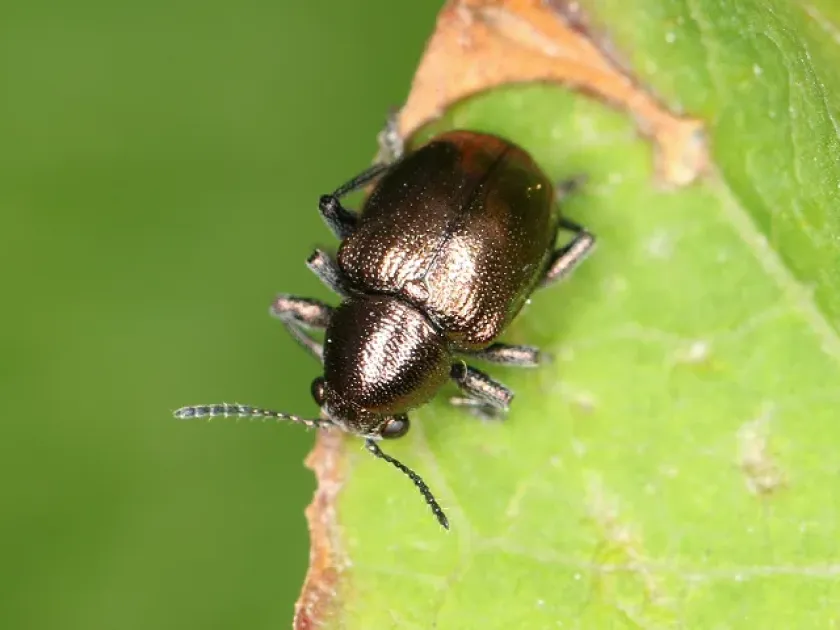
The grape flea beetle (Scelodonta lewisi) belongs to the Chrysomelidae family, commonly known as leaf beetles. Adult beetles are small, typically ranging from 4 to 6 mm in length, and possess a distinct metallic sheen on their elytra, often displaying bronze or greenish hues.
The insect's body is oval and compact, covered with fine scales. The head and pronotum are characterized by distinct coarse punctation, which is a key diagnostic feature used by entomologists for precise species identification.
Larval development takes place primarily underground, where they feed on the root systems of grapevines. Adults remain above ground, being most active during the spring when they migrate to host plants to feed.
The life cycle encompasses egg, larval, pupal, and adult stages. In many regions, the pest typically completes one generation per year, with adults often serving as the overwintering stage in the soil or under plant debris.
Field monitoring is best conducted by visual inspection of buds during the bud-break stage and by using the "shaking method" early in the morning, as these beetles tend to drop from the vines when disturbed.
What it damages
The primary host for Scelodonta lewisi is the grapevine (Vitis vinifera). The beetle is highly specialized, preferring young, tender tissues of the plant, which makes the early spring period particularly critical for crop protection.
The most severe damage occurs when adult beetles feed on swelling and opening buds. By hollowing out the buds, the pest destroys the potential for future fruit-bearing shoots, leading to significant yield losses.
Larval feeding on small feeder roots undermines the overall vigor of the grapevine. This root damage inhibits the plant's ability to absorb water and essential nutrients, thereby weakening the entire vine's health.
Leaves that manage to develop from partially damaged buds often show irregular holes or ragged edges. These lesions not only reduce the photosynthetic area but can also serve as entry points for various fungal and bacterial pathogens.
In cases of high population density, entire shoots may fail to develop properly, leading to deformed growth and a noticeable reduction in the quality and quantity of the final harvest.
Signs of infestation
The primary sign of infestation is the appearance of hollowed-out or excavated buds in early spring. These buds often turn brown, desiccate, and eventually fall off, failing to produce leaves or clusters.
Young foliage may exhibit characteristic "shot-hole" damage. These small, irregular perforations are a clear indicator of adult beetle feeding activity occurring shortly after the buds have opened.
When inspecting the vines, if small, metallic-colored beetles are observed on the leaves or shoots, it is a definitive sign of Scelodonta lewisi presence, especially if they drop to the ground upon disturbance.
Feeding lesions on young green shoots may appear as superficial scabs or shallow pits. If these lesions are numerous, they can cause the shoot to become stunted or, in extreme cases, lead to shoot breakage.
General vine decline, characterized by poor growth vigor and late-season chlorosis, may indirectly indicate that the root system has been compromised by a significant population of soil-dwelling larvae.
Control measures
Effective management begins with cultural practices. Deep tillage and cultivation of the soil within the vineyard rows during the autumn and early spring can disrupt the life cycle by exposing overwintering adults and larvae to predators and desiccation.
Chemical control involving systemic or contact insecticides is often necessary during the bud-swell and bud-break stages. Timely application is crucial to protect the buds before significant feeding occurs.
Maintaining a clean vineyard environment by removing crop residues and controlling weed cover near the vine trunks reduces the availability of sheltered sites for the beetles to overwinter and congregate.
In organic or integrated pest management (IPM) systems, the application of biological agents, such as entomopathogenic fungi targeted at the soil-dwelling larval stages, can help maintain populations below economic thresholds.
- Use pheromone traps for early population detection.
- Ensure balanced vine nutrition to improve recovery from herbivory.
- Rotate insecticide modes of action to prevent the development of chemical resistance.
Taxonomy
- Latin name
- Scelodonta lewisi
- Order
- Coleoptera (beetles)
- Family
- Chrysomelidae
- EPPO code
- SCELLE
Discussion
No discussions yet — be the first.