
Crepe myrtle aphid
Sarucallis kahawaluokalani
Description
How to identify
The Crepe myrtle aphid (Sarucallis kahawaluokalani) is a host-specific pest belonging to the family Aphididae. It exclusively targets species within the genus Lagerstroemia.
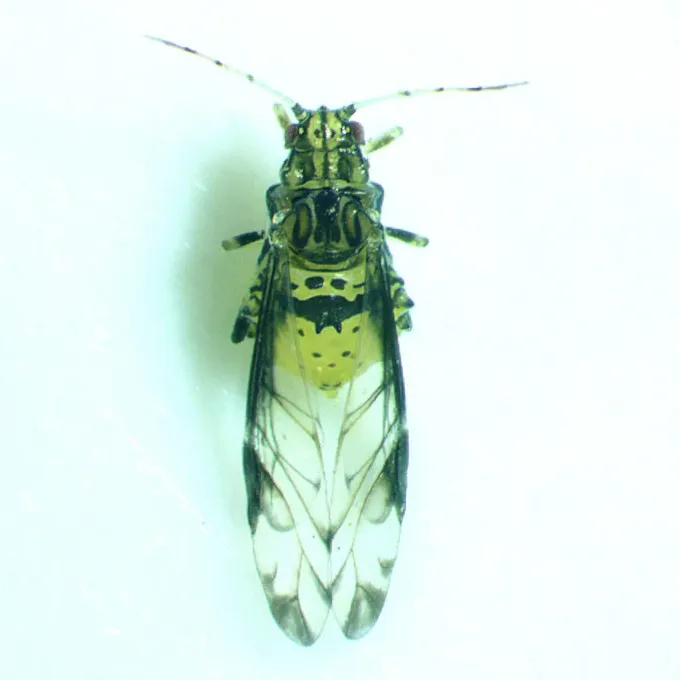
These insects are very small, typically measuring between 1.5 and 2 millimeters. Adults are characterized by a yellowish-green body and distinct dark spots on their wings, which is a key trait for accurate field identification.
Their life cycle includes both winged and wingless forms. The winged adults are highly mobile, allowing the colony to spread rapidly across different parts of a plant or to neighboring shrubs.
Reproduction is extremely fast during warm weather, enabling the development of multiple generations throughout the growing season.
Overwintering occurs primarily in the egg stage, with eggs deposited in bark crevices or near leaf buds, ensuring survival through the winter months until the spring emergence.
What it damages
The primary host for this pest is the crepe myrtle, a popular ornamental shrub or tree frequently found in gardens and urban landscaping.
Aphids feed by piercing the surface of leaves and young shoots to extract phloem sap, which deprives the plant of vital nutrients required for healthy development.
Heavy feeding leads to stunted growth, leaf curling, and potential dieback of succulent terminal shoots, significantly reducing the aesthetic value of the plant.
Furthermore, the extraction of sap weakens the plant's natural defenses, making it more susceptible to environmental stress and secondary pathogen infections.
If left unmanaged, chronic infestations can cause a long-term decline in the vigor and flowering capacity of the crepe myrtle tree.
When it appears
Active development typically begins in late spring, as temperatures rise consistently above 18-20 degrees Celsius, triggering egg hatching.
The population density usually reaches its peak during the mid-to-late summer months (July and August), coinciding with the most vigorous growth phase of the crepe myrtle.
Ongoing monitoring is essential throughout the summer months, as the aphid population can explode within just a few weeks under favorable conditions.
The life cycle begins to slow down as temperatures drop in autumn, at which point the insects focus on reproducing the next generation of eggs for overwintering.
Local climate variations significantly influence the duration of the active infestation period, with warmer regions experiencing longer cycles.
Signs of infestation
The most prominent sign of an infestation is the accumulation of sticky honeydew on the foliage beneath the aphid colony.
This honeydew serves as a substrate for sooty mold, a fungus that covers leaves in a black, powdery layer, which inhibits photosynthesis and weakens the plant further.
Infested plants often show clear evidence of leaf curling, yellowing, or deformation of the tender new growth at the tips of the branches.
The presence of ants is a common secondary indicator, as they are attracted to and protect the aphids to harvest the sugar-rich honeydew secretions.
Close inspection of the underside of leaves usually reveals dense clusters of aphids along with their white shed skins, which are remnants from their molting process.
Control measures
Effective management of the Crepe myrtle aphid involves a combination of mechanical, biological, and chemical control measures.
Recommended strategies include:
- Application of systemic insecticides that are translocated throughout the plant tissues for long-lasting protection.
- Encouraging natural predators such as lady beetles, lacewings, and parasitic wasps, which can drastically reduce aphid numbers.
- Washing the plant with a mild soap solution to remove honeydew and suppress the sooty mold growth.
- Applying dormant oil sprays in early spring to eliminate overwintering eggs before they hatch.
- Ensuring proper plant health through adequate fertilization and pruning to improve air circulation and sunlight penetration.
It is important to rotate insecticide modes of action to prevent the development of resistant populations, which can occur with frequent chemical use.
Regular visual inspections of the foliage, especially in late spring, allow for early intervention before the aphid population reaches damaging levels.
Taxonomy
- Latin name
- Sarucallis kahawaluokalani
- Order
- Hemiptera (bugs, aphids, leafhoppers)
- Family
- Aphididae
- EPPO code
- TINCKA
Discussion
No discussions yet — be the first.