
Sagra femorata
Sagra femorata
Description
How to identify
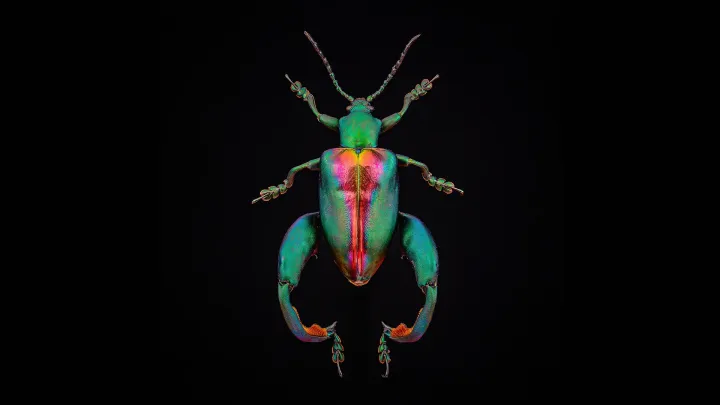
Sagra femorata is a prominent beetle species belonging to the leaf beetle family (Chrysomelidae) within the order Coleoptera.
Adults are notable for their large size, typically ranging from 20 to 30 mm in length, and their brilliant metallic color scheme.
The species exhibits remarkable sexual dimorphism, with males featuring disproportionately large, thickened, and curved hind femora equipped with distinct teeth.
The body is elongated and sturdy, with a downward-oriented head possessing robust mandibles adapted for feeding on tough plant tissues.
Larvae are typically whitish, fleshy, and exhibit a specialized body structure that enables them to thrive inside the stems of their host plants.
What it damages
This beetle is primarily recognized as a pest of various legumes, showing a strong preference for kudzu (Pueraria montana).
Adult beetles cause damage by feeding on the leaves, leaving irregular ragged edges and holes that significantly reduce the plant's photosynthetic capacity.
The larvae are internal feeders, boring tunnels into the stems and succulent shoots of the plants, which disrupts the vascular system.
Heavy larval infestation leads to weakened stems, reduced vegetative growth, and eventual wilting or collapse of the plant parts.
By damaging the integrity of the host plant, the beetle makes the crop more susceptible to secondary infections and environmental stresses.
When it appears
The seasonal activity of Sagra femorata generally aligns with the warmer months when their host plants are in a state of vigorous growth.
Their life cycle consists of complete metamorphosis: the egg stage, larval stage, pupal stage, and the adult stage.
Females lay their eggs on the stems or leaves of host plants, ensuring that larvae have an immediate food source upon hatching.
Pupation typically occurs in sheltered areas, often within the damaged stems or by dropping to the soil, providing protection from predators.
Adult beetles overwinter in leaf litter or the top layer of soil, emerging in the spring as soon as temperatures become favorable.
Signs of infestation
The most evident sign of infestation is the presence of adult beetles on the foliage, often seen basking in sunlight on kudzu plants.
Ragged leaf margins are the primary indicator of adult feeding activity during the peak of the growing season.
Wilting of entire stems, unrelated to drought, suggests internal larval damage within the structural tissues of the plant.
If the stems are cut open, one can find internal tunnels or larval galleries packed with frass, confirming the presence of the pest.
Yellowing or stunted growth in specific patches of the field is a clear indicator that the population density of the beetle has reached harmful levels.
Control measures
Effective management of this pest requires an integrated approach that focuses on both physical and chemical control methods.
Early detection through field monitoring is critical to prevent the population from reaching economic thresholds that threaten the crop.
- Mechanical removal and destruction of heavily infested stems during the early stages.
- Application of selective insecticides directed at adult populations during peak emergence.
- Implementation of crop rotation to break the life cycle of the beetle in the field.
Biological control, including the use of natural predators or pathogens, is currently being studied as a long-term strategy for population suppression.
Maintaining clean field borders and managing wild host plants can significantly reduce the risk of re-infestation in agricultural settings.
Taxonomy
- Latin name
- Sagra femorata
- Order
- Coleoptera (beetles)
- Family
- Chrysomelidae
- EPPO code
- SAGRFE
Discussion
No discussions yet — be the first.