
Rhoptromeris
Rhoptromeris
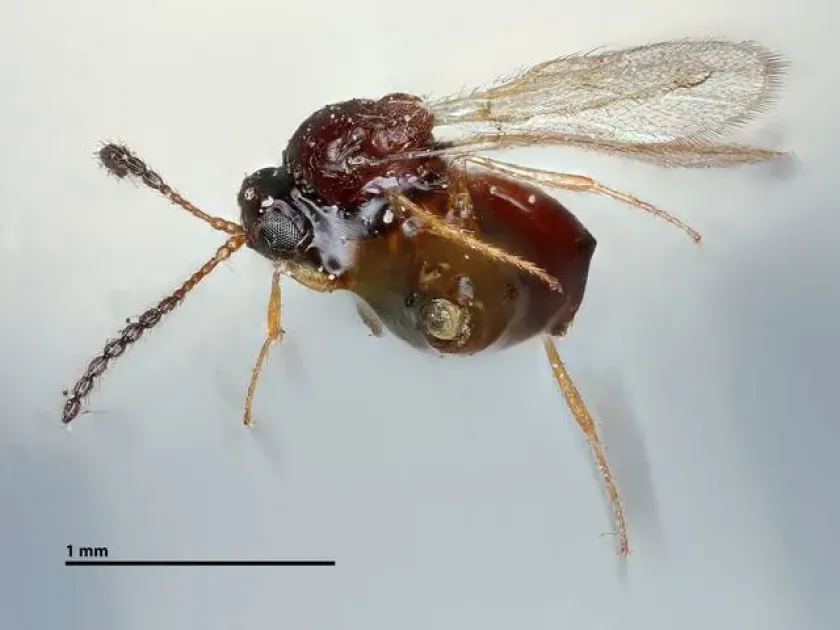
Description
How to identify
Rhoptromeris is a genus of parasitic wasps belonging to the family Figitidae, order Hymenoptera. These small insects play a critical role as natural biological control agents in various agricultural environments.
Adult Rhoptromeris are typically minute with dark, inconspicuous bodies. Their morphology is highly specialized, allowing them to locate and parasitize larvae of Diptera (flies) that develop within plant tissues.
The life cycle involves an endoparasitic strategy where the female wasp uses an ovipositor to locate the host hidden inside plant stalks or other substrates. This demonstrates a sophisticated level of host detection.
Inside the host larva, the Rhoptromeris larva feeds on non-vital organs initially to keep the host alive until the parasite reaches maturity. This biological adaptation ensures the parasite's development is synchronized with the host.
Upon completion of development, the adult wasp emerges from the host's puparium, thus completing a cycle that contributes significantly to regulating populations of harmful agricultural pests.
What it damages
Rhoptromeris itself does not feed on crops and therefore causes no direct damage to wheat, barley, or other cereals. However, it is fundamentally linked to the regulation of flies that do damage these crops.
The primary concern regarding this insect is its ecological role. When insecticide applications eliminate Rhoptromeris populations, the lack of natural control agents often leads to rapid outbreaks of primary cereal pests.
Its economic importance is linked to the concept of Integrated Pest Management (IPM). Farmers and agronomists value these insects for their ability to maintain pest levels below the economic injury threshold.
In cases where host fly populations are low, Rhoptromeris maintains its presence in the ecosystem, serving as a buffer against potential future outbreaks of harmful Diptera species.
Agricultural management must prioritize the protection of these wasps, as their absence necessitates higher inputs of synthetic pesticides, which is both economically and environmentally costly.
Control measures
Preservation of field margins and non-cropped areas is the most effective way to support Rhoptromeris populations. These habitats provide necessary shelter and alternative food sources for adults.
Farmers should avoid prophylactic chemical spraying, especially during the peak flight activity of parasitic wasps. Targeted applications based on threshold counts are always preferred over preventive measures.
Implementing a diverse crop rotation strategy minimizes the buildup of host flies, which in turn influences the density of Rhoptromeris, keeping the ecosystem in a sustainable balance.
The use of biological control agents and biopesticides should be considered to ensure that beneficial insects remain protected during the crop development cycle.
Field monitoring, using traps or sweep nets, allows for informed decision-making. By identifying the presence of entomophages like Rhoptromeris, agronomists can reduce unnecessary interventions.
Taxonomy
- Latin name
- Rhoptromeris
- Order
- Hymenoptera
- Family
- Figitidae
- EPPO code
- RHOTSP
Discussion
No discussions yet — be the first.