
Greenbug
Rhopalosiphum graminum
Description
How to identify
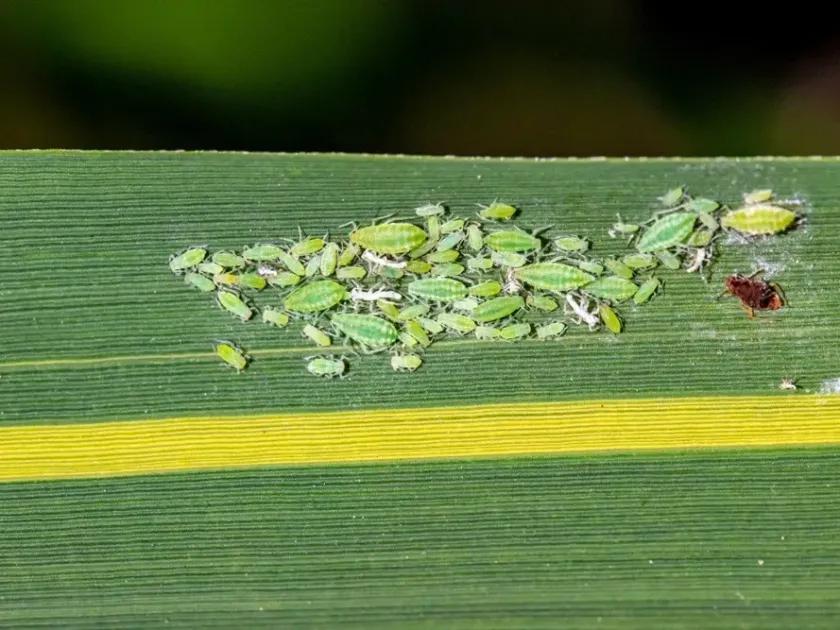
The Greenbug, scientifically known as Rhopalosiphum graminum, is a small aphid that causes significant damage to small grains. The adult is typically 1.3 to 2.1 mm long, with a distinct light green body.
A diagnostic feature of this species is a darker green stripe running down the middle of its back. The antennae are usually shorter than the body, and the cornicles (tubes on the abdomen) have dark tips.
These insects can exist in both winged and wingless forms. The winged form is responsible for long-distance dispersal and colonizing new fields during the growing season.
They reproduce rapidly via parthenogenesis, allowing populations to explode within weeks if environmental conditions are favorable for their development.
Understanding their morphology is essential for field scouting, as they are often found on the undersides of leaves, protected from direct sunlight and common natural predators.
What it damages
The Greenbug is a specialized pest of the Poaceae family. Its primary hosts include wheat, barley, oats, rye, and sorghum, making it a serious threat to global grain production.
They feed by piercing plant tissues and sucking out sap. During feeding, they inject toxic saliva into the plant, which causes localized yellowing or necrosis of the leaf tissue.
Heavy infestations can lead to complete plant death, especially in young seedlings. Even in mature plants, feeding reduces the number of grains per head and the weight of the kernels.
Besides direct feeding damage, they are highly efficient vectors for several plant viruses, such as the Barley Yellow Dwarf Virus (BYDV), which can cause severe yield losses.
The presence of large colonies disrupts the plant's ability to photosynthesize, resulting in weakened stalks that are more susceptible to lodging and secondary fungal infections.
When it appears
Greenbug activity typically begins in early spring, as temperatures rise above 10°C, when overwintering eggs hatch or individuals migrate from alternate hosts.
During the summer months, they thrive in warm, dry weather. High temperatures accelerate their reproductive cycle, allowing for several generations within a single month.
Peak infestation usually occurs during the booting and heading stages of cereal development, which are critical periods for grain fill and final yield determination.
In the autumn, as temperatures drop, the population shifts towards winter wheat, where they continue to feed and eventually lay eggs to survive the winter months.
Prolonged drought periods often exacerbate Greenbug outbreaks, as water-stressed plants provide less resistance and the pest population benefits from the absence of humidity-loving predators.
Signs of infestation
The first visual sign of a Greenbug infestation is the appearance of small, yellow-to-orange discolored spots on the leaves where they have been feeding.
As the feeding continues, these spots merge, and the affected leaves eventually turn brown, curl, and die. The entire plant may eventually become stunted and yellowish.
Sticky, shiny substance known as honeydew is often present on the leaves, which frequently leads to the development of sooty mold, a black fungus that further shades the leaf.
Increased ant activity around the base of the plants is a common indicator, as ants tend to the aphids to collect their sugar-rich honeydew secretions.
Field scouting often reveals patchy damage, where specific areas of the crop show severe chlorosis or dieback, marking the initial centers of aphid colony expansion.
Control measures
Integrated Pest Management (IPM) is crucial for controlling the Greenbug. This involves monitoring threshold levels before applying any chemical interventions to preserve beneficial insects.
Chemical control is effective using systemic insecticides that are absorbed by the plant and kill the aphids upon feeding. Proper timing of application is vital for success.
Biological control plays a significant role; natural enemies such as lady beetles, lacewings, and parasitic wasps can suppress populations effectively if left undisturbed by broad-spectrum chemicals.
Cultural practices, including planting resistant grain varieties and managing grassy weeds that act as alternate hosts, can significantly reduce the potential for severe infestations.
- Scout fields regularly during early vegetative stages.
- Use seed-applied systemic insecticides for early-season protection.
- Encourage natural predator habitats around crop perimeters.
- Practice proper crop rotation to break the pest's cycle.
Taxonomy
- Latin name
- Rhopalosiphum graminum
- Order
- Hemiptera (bugs, aphids, leafhoppers)
- Family
- Aphididae
- EPPO code
- RHOPGR
Discussion
No discussions yet — be the first.