
Chrysanthemum gall midge
Rhopalomyia chrysanthemi
Description
How to identify
The chrysanthemum gall midge (Rhopalomyia chrysanthemi) is a tiny fly belonging to the family Cecidomyiidae. The adult form is a fragile, mosquito-like insect with long legs and delicate wings, often difficult to spot in a garden.
Most of the insect's life cycle is spent in the larval stage, which remains hidden within the host plant's tissues, protected by a specialized plant growth known as a gall.
Adult midges are short-lived and focus primarily on mating and laying eggs on the tender, developing buds and leaves of chrysanthemum plants.
The taxonomic classification places this species within the order Diptera. Because they are highly host-specific, their presence is usually limited to chrysanthemums and closely related species.
Understanding their secretive lifestyle is key to recognizing their presence, as they do not feed on the surface like aphids or spider mites, making them harder to detect until the damage appears.
What it damages
The midge primarily attacks chrysanthemum plants, targeting the most rapidly growing parts such as terminal buds, young leaves, and succulent stems.
As the larvae feed, they secrete substances that cause the plant to produce a gall. This growth acts as a nursery and a source of constant food supply for the developing larva.
These galls disrupt the internal vascular system of the plant, preventing the proper flow of water and essential nutrients to the upper parts of the shoot.
Severe infestations lead to stunted growth, distorted stems, and a total failure of the plant to produce flowers, rendering it useless for decorative purposes.
In commercial greenhouse operations, this pest can cause significant economic losses by spreading rapidly between closely spaced pots if not managed immediately.
When it appears
The activity cycle of the chrysanthemum gall midge is highly dependent on temperature, usually beginning in late spring when the weather warms up significantly.
In greenhouses or climate-controlled environments, they can remain active throughout the year, producing multiple overlapping generations if conditions are favorable.
In outdoor settings, peak activity is typically observed during the summer months, with adults emerging to find new hosts as the plants grow.
As autumn approaches and temperatures drop, the larvae prepare for diapause or pupate in the soil, ready to survive the winter and start a new cycle in spring.
Scouting for early signs of infestation should begin as soon as new growth appears on the chrysanthemum plants in early spring.
Signs of infestation
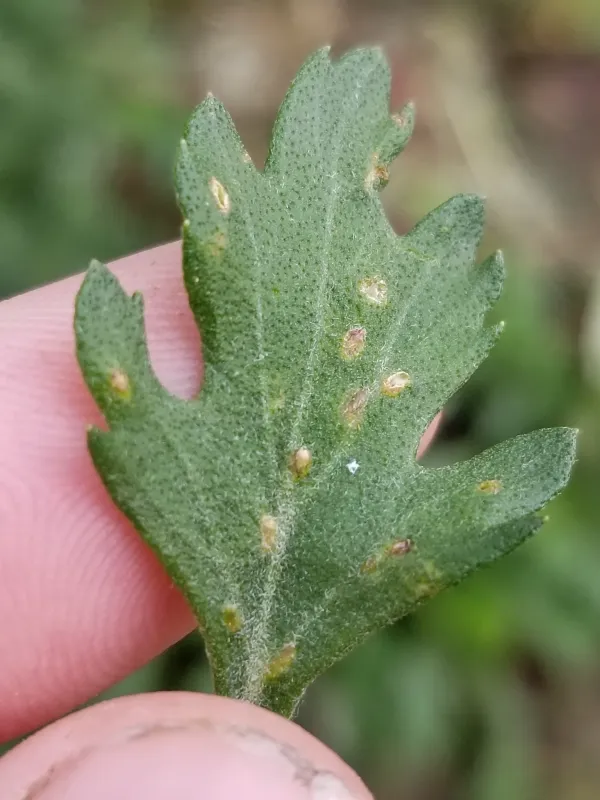
The most distinctive symptom of an infestation is the appearance of small, cone-shaped bumps or growths on the foliage and stems of the chrysanthemum.
These galls can be pale green initially, but often change to a reddish or brownish hue as the larvae inside mature, making them more noticeable.
- Cone-shaped galls appearing on leaves and stems.
- Distorted or curled foliage that does not unfurl correctly.
- Stunted or lopsided plant growth.
- Bending or twisting of stems.
- General decline in plant vigor and flower production.
If you break open one of these galls, you will find a tiny, legless, cream-colored larva inside, which is the cause of the structural malformation.
Control measures
Managing this pest is challenging because the larvae are safely encased within the galls, making them largely immune to simple topical insecticide sprays.
The most effective initial strategy is mechanical control: prune and destroy all infested plant parts as soon as you spot the galls to prevent further spread.
Systemic insecticides can be used to treat the plants, but these are most effective when timed with the emergence of adult midges, before they lay eggs on new tissues.
Practice good sanitation by removing and burning fallen plant debris at the end of the season to eliminate overwintering pupae from the soil.
Always inspect new chrysanthemum stock carefully before integrating them into your collection to avoid introducing the midge into a clean environment.
Taxonomy
- Latin name
- Rhopalomyia chrysanthemi
- Order
- Diptera (flies)
- Family
- Cecidomyiidae
- EPPO code
- DIARCH
Discussion
No discussions yet — be the first.