
Willow stem gall midge
Rabdophaga saliciperda
Description
How to identify
The willow stem gall midge (Rabdophaga saliciperda) is a small dipteran insect belonging to the Cecidomyiidae family, which specifically targets willow species.
Adult midges are delicate, fly-like insects that are typically active during the warm months, making them difficult to spot without careful observation.
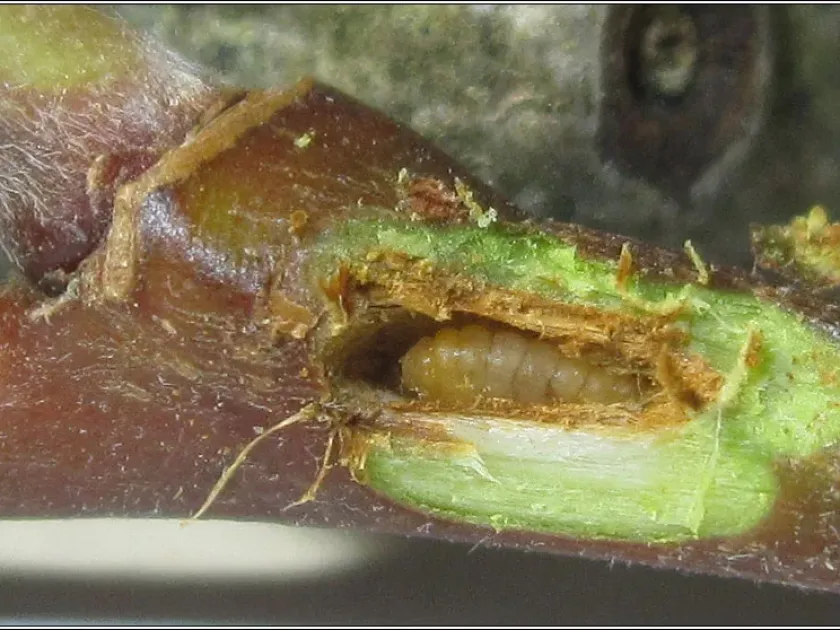
The larvae, which are the primary cause of damage, are legless, often reddish or yellowish, and develop entirely beneath the bark of the host plant.
The life cycle consists of complete metamorphosis: egg, larva, pupa, and adult, with each stage uniquely adapted to the host willow tree.
The insect thrives in environments where willow trees are planted closely, such as nurseries or ornamental landscapes, facilitating its rapid spread.
What it damages
The pest primarily infests various willow species, causing significant stress to the trees through its feeding activity on the bark and cambium layers.
As the larvae feed, they create tunnels in the tree's vascular tissue, which interferes with the flow of nutrients and moisture throughout the branches.
Over time, the affected areas develop noticeable bumps or galls, which eventually split open, exposing the inner wood to further decay and environmental stress.
Severe infestations weaken the structure of the branches, often leading to dieback, which reduces the aesthetic and overall biological value of the willow.
Open wounds caused by the larvae serve as entry points for secondary pathogens, including wood-decaying fungi, which can ultimately lead to tree mortality.
When it appears
Adult midges emerge in late spring or early summer, synchronized with the active growth period of the willow trees.
Females lay their eggs in bark fissures or wounds, ensuring the larvae have immediate access to the nutrient-rich cambium once they hatch.
The larvae remain active throughout the summer, tunneling and feeding beneath the bark, which allows them to grow in a protected environment.
The winter is typically spent in the larval stage, tucked deep within the bark, remaining dormant until the return of warmer temperatures.
Upon the arrival of spring, the larvae undergo pupation, and the cycle repeats as the new generation of adults emerges to mate.
Signs of infestation
The most visible signs of infestation are swollen, distorted areas or galls on the stems and branches, which stand out against healthy bark.
Small circular exit holes are often visible on the surface of the galls, indicating that the adult midges have emerged from the bark.
Bark splitting and localized necrosis are common, as the larval galleries disrupt the normal healing and growth processes of the tree stem.
If the bark is carefully peeled away, one can usually observe the larval tunnels and the larvae themselves, providing definitive proof of infestation.
- Distorted, lumpy swellings on stems.
- Exit holes on the bark surface.
- Cracked or peeling bark tissues.
- Premature yellowing or dieback of specific branches.
Control measures
Sanitation is the most effective control method: pruning and destroying infested branches before the adult midges emerge helps curb the population.
Chemical control using systemic insecticides can be applied during the flight period of adults to prevent the female midges from laying new eggs.
Maintaining tree vigor through proper irrigation and balanced fertilization can make willows more resilient to pest attacks.
Proactive monitoring in the early spring is essential, as spotting the first signs of swellings allows for immediate management actions.
Encouraging natural predators, such as parasitic wasps that target midge larvae, can provide a sustainable long-term biological control solution.
Taxonomy
- Latin name
- Rabdophaga saliciperda
- Order
- Diptera (flies)
- Family
- Cecidomyiidae
- EPPO code
- RHABSA
Discussion
No discussions yet — be the first.