
Willow marginal gall midge
Rabdophaga marginemtorquens
Description
How to identify
The willow marginal gall midge (Rabdophaga marginemtorquens) belongs to the order Diptera and the family Cecidomyiidae, commonly known as gall midges.
These are tiny, mosquito-like insects that are rarely seen by the casual observer due to their small size and cryptic habits during the adult stage.
The life cycle is closely synchronized with the growth of willow trees, ensuring the larvae have access to fresh tissues where they induce characteristic galls.
While the adults are short-lived, the larval stage is responsible for the formation of protective structures on the leaf margins.
The species is highly host-specific, primarily affecting members of the Salix genus, where it finds optimal conditions for larval development.
What it damages
The primary hosts are various willow species, where the midges target young, expanding leaves during the spring and summer months.
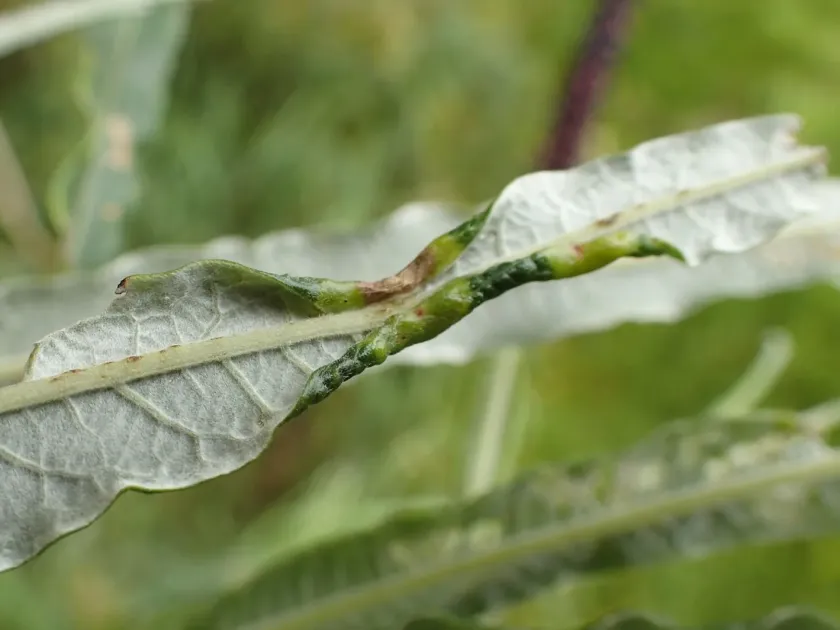
Larval feeding induces the leaves to roll their margins downwards, creating a tight, cylinder-like gall that provides shelter and food for the developing larvae.
High infestation levels lead to significant leaf deformation, which inhibits photosynthesis and weakens the overall vigor of the willow tree.
For ornamental willow cultivars, this damage is particularly problematic as it ruins the aesthetic appearance of the foliage and stunts new shoot growth.
While not lethal to mature trees, heavy and repeated infestations can lead to premature leaf drop and increased susceptibility to other pathogens.
When it appears
The pest's activity starts in early spring when the buds break, coinciding with the flight period of the adult midges.
The developmental cycle is relatively fast, allowing for several generations per season, meaning infestation can persist through the entire growing period.
Populations tend to peak in mid-summer when the rapid growth of new foliage provides abundant sites for egg-laying and larval development.
Overwintering occurs as pupae or larvae, often residing in the soil or within the leaf litter beneath the host tree until the following spring.
Monitoring should be most intense during the initial leaf expansion phase, as this is when the first generation initiates the cycle.
Signs of infestation
The most diagnostic sign is the tightly rolled leaf margin, which appears as a curled or twisted edge along the entire length of the leaf.
If you carefully unroll these margins, you will find small, yellow to orange larvae feeding inside the specialized tissue structures.
The tissues within and adjacent to the gall may show discoloration, appearing yellow, pale, or reddish compared to the healthy leaf area.
The overall appearance of the willow foliage becomes twisted, ragged, and sickly, often giving the tree a disheveled look.
- Tightly curled or rolled leaf margins.
- Presence of small larvae inside the gall structures.
- Discoloration (chlorosis or reddening) of leaf edges.
- Reduced growth of shoots during the peak summer period.
Control measures
Sanitation is a key control measure: raking and destroying fallen leaves in the autumn is crucial to reduce the overwintering population.
For small trees or young saplings, hand-picking and destroying infested leaves can effectively limit the midge population in early stages.
Systemic insecticides can be applied during the early vegetative stage if the infestation is severe enough to compromise the plant's health.
Promoting a healthy environment for natural predators, such as parasitic wasps, can provide long-term biological control in many settings.
Maintaining tree vigor through proper irrigation and fertilization helps the tree better withstand the stress caused by the gall midge activity.
Taxonomy
- Latin name
- Rabdophaga marginemtorquens
- Order
- Diptera (flies)
- Family
- Cecidomyiidae
- EPPO code
- RHABMA
Discussion
No discussions yet — be the first.