
Burmese python
Python bivittatus
Description
How to identify
The Burmese python (Python bivittatus) is a large snake species, belonging to the Pythonidae family, known for its significant length and mass.
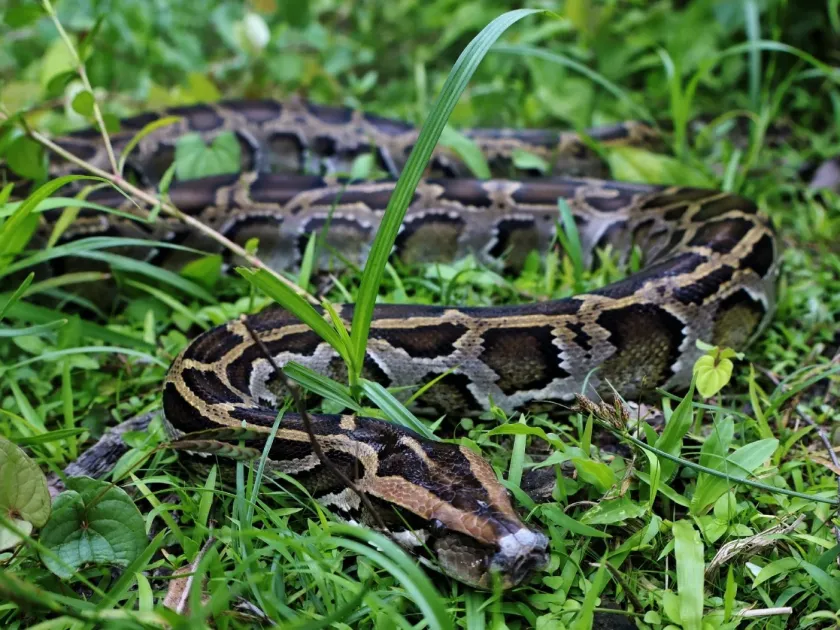
These snakes feature a distinctive dark, rectangular-blotched pattern on a brown or yellowish background, which acts as camouflage in their environment.
The head is wedge-shaped with a dark stripe running from the snout through the eye, making them easily distinguishable from other local species.
They possess specialized infrared-sensitive pits on their labial scales that allow them to sense the body heat of prey in complete darkness.
As strong swimmers and skilled climbers, these snakes can inhabit a wide range of environments, from wetlands to forests near agricultural lands.
What it damages
Although they do not feed on crops directly, Burmese pythons cause significant damage to the balance of agricultural ecosystems.
They are apex predators in invasive territories, drastically reducing the populations of small mammals that serve as natural control agents for crop pests.
On farms, these pythons prey on poultry, rabbits, and small livestock, resulting in direct economic losses for smallholders and commercial farms.
The disruption of the food chain leads to an ecological imbalance that may result in secondary infestations of pests that thrive without natural predators.
Their presence poses a persistent threat to domestic animals, forcing farmers to invest more in protective infrastructure and security measures.
When it appears
The activity level of Burmese pythons is highly seasonal, dictated by ambient temperatures as they are ectothermic organisms.
During the warmer months, pythons maintain a high metabolism and are most active in hunting for prey, which increases their encounter rate with livestock.
In cooler temperatures, their activity decreases significantly, and they often seek shelter in abandoned burrows or dense, protected vegetation.
Nocturnal activity is standard for this species, meaning most hunting events occur from dusk until dawn, coinciding with the peak hours of vulnerability for farm animals.
Reproductive cycles often occur in the spring, with female pythons demonstrating unique maternal care by incubating their eggs until they hatch.
Signs of infestation
A notable sign of a python presence is the sudden decline in sightings of local wildlife, particularly rabbits, rodents, and other small mammals.
Tracks left by large pythons, seen as smooth, wide trails in soft mud or dirt, are definitive evidence of their movement through an area.
Shed skins, known as sloughs, are frequently found near denning sites, indicating that a snake is a regular resident or frequent visitor to the location.
Repeated, unexplained losses of poultry or small livestock despite secure enclosures often point to the entry of a large predator like the Burmese python.
Observing the snake itself, especially in basking areas near water sources or field edges, is the most direct indicator of an active infestation.
Control measures
Effective management begins with habitat modification, such as removing tall grass, woodpiles, and debris that serve as hiding spots for snakes.
Installing wildlife-proof fencing, with the bottom edges buried or flush with the ground, helps keep pythons out of poultry houses and animal pens.
Trapping programs using live bait or sensory attractants are employed by professionals to remove individual pythons from sensitive agricultural areas.
Keeping livestock areas clean and free of grain spills minimizes the presence of rodents, thereby reducing the attractiveness of the farm to pythons.
Coordinating with local environmental authorities is essential to ensure that any python sightings are documented and managed according to wildlife safety protocols.
Taxonomy
- Latin name
- Python bivittatus
- Family
- Pythonidae
- EPPO code
- PYTNBI
Discussion
No discussions yet — be the first.