
Great shearwater
Puffinus gravis
Description
How to identify
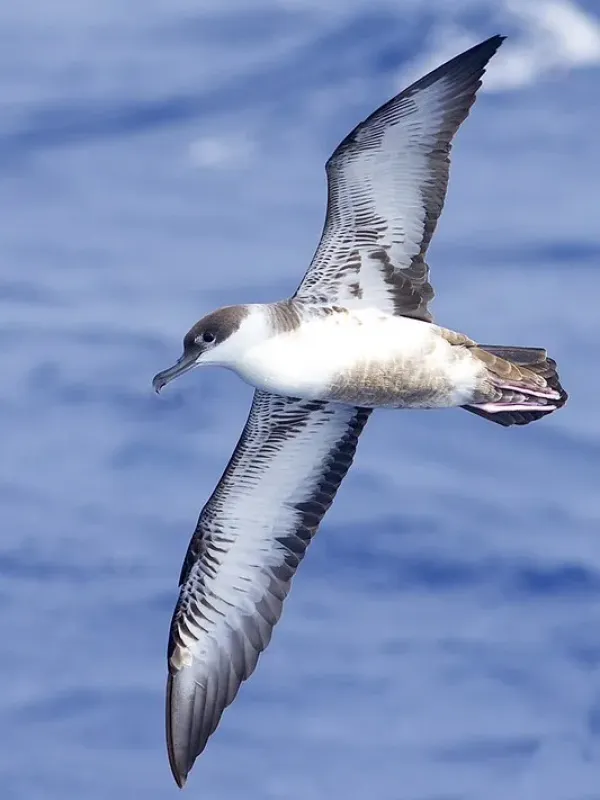
The Great shearwater (Ardenna gravis), formerly known as Puffinus gravis, is a large seabird belonging to the Procellariidae family.
It is characterized by dark-brown upperparts, a distinct white neck collar, and a prominent white rump patch visible during flight.
These birds are known for their spectacular long-distance migrations, traversing large sections of the Atlantic Ocean annually.
They nest in large colonies, typically creating burrows on remote oceanic islands such as the Tristan da Cunha group.
As a specialized marine species, their anatomy and behavior are entirely oriented towards life in the pelagic environment.
What it damages
The Great shearwater is strictly a marine bird and is not categorized as a pest for any agricultural or horticultural crops.
Its diet consists exclusively of fish, squid, and crustaceans captured at sea, meaning it has no interaction with terrestrial plant life.
There is no ecological or agricultural mechanism by which this species could cause damage to fields, plantations, or orchards.
Farmers and agronomists do not encounter this species in the context of crop production as it never enters agricultural landscapes.
The classification of this bird as a "pest" is factually incorrect and contradicts all existing ornithological and agricultural data.
Control measures
No pest control measures are applicable or necessary for the Great shearwater as it poses zero threat to agricultural productivity.
This species is protected under various international environmental laws aimed at preserving marine biodiversity and seabird habitats.
Conservation efforts focus on protecting nesting colonies on islands from invasive predators and environmental degradation.
Agriculture does not intersect with the life cycle of these birds, and therefore no mitigation strategies are required.
It is vital to distinguish between actual agricultural pests and non-related wildlife to maintain proper ecological management practices.
Taxonomy
- Latin name
- Puffinus gravis
- Family
- Procellariidae
- EPPO code
- PUFFGR
Discussion
No discussions yet — be the first.