
Mango gall midge
Procontarinia mangiferae
Description
How to identify
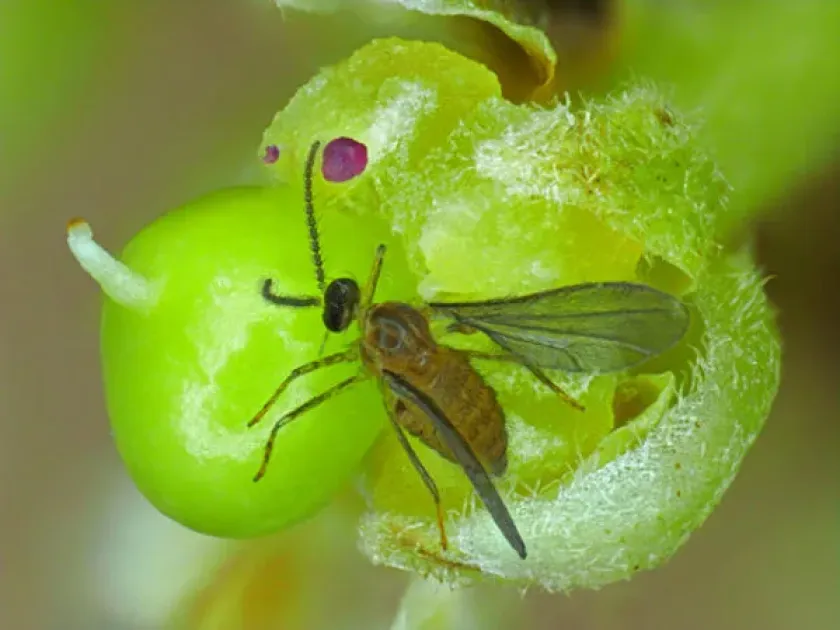
The mango gall midge Procontarinia mangiferae is a small dipteran insect belonging to the Cecidomyiidae family. Adults are delicate, tiny flies measuring approximately 1–2 mm, often appearing as small gnats.
The insect's life cycle is closely integrated with the phenology of mango trees. Females lay their eggs within the soft tissues of new foliage, developing buds, or flowers, which is where the subsequent larval stages feed.
Larvae are legless and typically off-white to yellow, concealed within galls. These galls are distinct pathological growths induced by the larvae, which serve as both protection and a source of nutrition.
Identification often requires careful inspection of the leaves. Because of their small size, adult midges are rarely seen in the field, making the identification of the characteristic leaf galls the primary diagnostic tool.
Understanding the taxonomy of Procontarinia mangiferae is essential for accurate pest assessment, as management strategies must target specific developmental stages hidden within plant structures.
What it damages
This pest is a major threat to Mangifera indica worldwide. In tropical regions, the gall midge can cause widespread damage to commercial mango orchards, particularly affecting nursery stock and young trees.
The feeding activity of larvae within the leaves disrupts normal development and photosynthesis. As the plant diverts energy to maintain the galls, overall growth rates are significantly reduced, leading to stunted plants.
Severe infestations cause leaves to yellow, curl, and abscise prematurely. This chronic leaf loss weakens the tree, making it susceptible to secondary stressors, including drought and other opportunistic pathogens.
When the midge attacks the inflorescences, it interferes with pollination and fruit set. This can lead to a significant reduction in fruit yield, as the flowers wither or fail to develop into healthy mangoes.
Damaged tissues provide an entry point for various fungi and bacteria, which can cause further necrosis and decay, potentially leading to the death of young shoots and entire inflorescence clusters.
When it appears
The incidence of mango gall midge is heavily dependent on the flushing cycles of the mango tree. Populations thrive when the tree produces fresh, young shoots that are highly susceptible to egg deposition.
Environmental conditions, particularly temperature and humidity, play a critical role in the rate of reproduction. Warm, humid climates allow for rapid generations, leading to explosive population growth in a short time.
In regions with a distinct rainy season, pest pressure often peaks as the moisture triggers uniform leaf growth across the orchard. This synchrony makes it easier for the midge to find suitable hosts.
Monitoring should be most intense during the transition from the vegetative to the reproductive stage. Observing the first appearance of new flushes is key to preventing early-season colonizations.
Agro-climatic data suggests that generations can overlap throughout the year if conditions remain warm, making continuous vigilance necessary for growers in tropical environments.
Signs of infestation
The earliest symptom is the appearance of small, circular raised spots on the leaf surface, known as galls. These vary in color from light yellow to reddish-brown as the larvae mature inside.
On the underside of the leaf, one can see small, protruding mounds. Dissecting these galls reveals the presence of one or more tiny larvae, which are the main cause of the localized tissue distortion.
Heavy infestation leads to a crinkled or distorted appearance of the leaves. Over time, these leaves become brittle, lose their deep green color, and may show signs of premature senescence.
Inflorescences show signs of infection when they stop expanding properly. The buds may become swollen or twisted, preventing the flowers from opening and eventually leading to their shriveling.
- Small gall spots scattered across leaves.
- Twisted and malformed young foliage.
- Early leaf drop and thinning canopy.
- Stunted and desiccated flower panicles.
- Overall poor plant vigor and slow branch elongation.
Control measures
Integrated pest management (IPM) for the mango gall midge begins with rigorous sanitation. Pruning and disposing of infested shoots removes the reservoir of larvae, significantly lowering the population density.
Promoting tree health through adequate irrigation and balanced fertilization strengthens the host's natural defenses, making it slightly more resilient to minor infestations.
Chemical control is often necessary for high-value crops. Systemic insecticides are the preferred choice, as they are absorbed by the plant tissues and reach the larvae inside the galls, where contact sprays would fail.
Biological control, utilizing native hymenopteran parasitoids, is encouraged in sustainable systems. These natural enemies can provide substantial suppression of midge populations if not disrupted by broad-spectrum chemicals.
Regular monitoring with sticky traps helps detect the migration of adult midges. Timing chemical applications to match the peak of adult activity before eggs are laid is the most effective approach.
Taxonomy
- Latin name
- Procontarinia mangiferae
- Order
- Diptera (flies)
- Family
- Cecidomyiidae
- EPPO code
- EROSIN
Discussion
No discussions yet — be the first.