
Apple sawfly
Pristiphora abbreviata
Description
How to identify
The apple sawfly, Pristiphora abbreviata, is a Hymenoptera insect belonging to the Tenthredinidae family. The adult form is a small, dark-bodied insect with two pairs of clear wings, resembling a tiny wasp or fly in appearance.
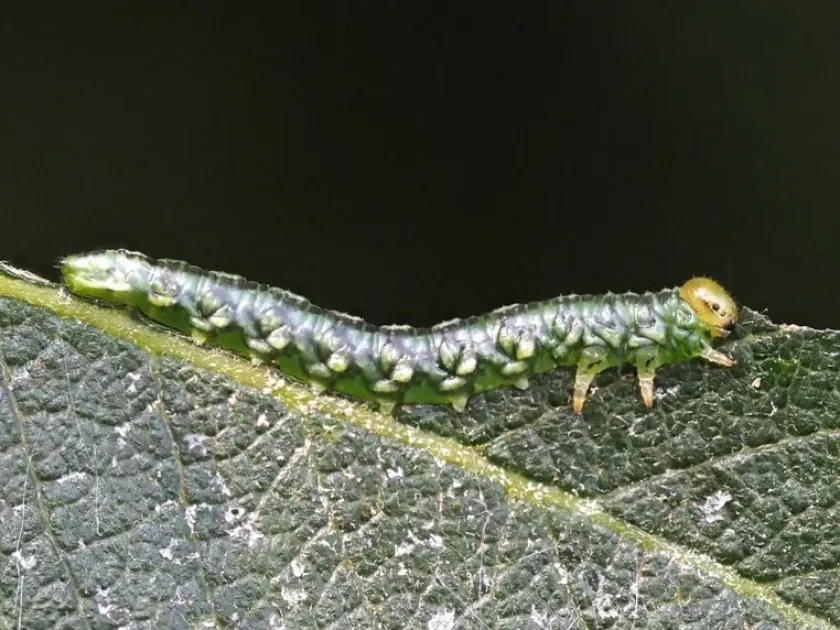
The destructive stage of this pest is the larva, commonly known as a false caterpillar. These larvae possess a distinct head capsule and multiple pairs of prolegs, which allow them to move effectively across the fruit surface to seek food.
The life cycle is univoltine, meaning there is only one generation per year. The insect overwinters in the soil as a prepupa inside a dense, soil-covered cocoon, typically at depths of 10 to 15 centimeters.
Spring emergence is synchronized with the apple tree blossoming period. After mating, females deposit eggs into the tissue of the buds or the base of the young fruit, where the larvae will later hatch.
The duration of the larval stage is influenced by ambient temperatures, which dictate the speed at which the larvae grow and move between different fruitlets within the tree canopy.
What it damages
The primary hosts of the apple sawfly are apple trees. The larvae are notorious for boring into developing fruitlets, consuming the internal tissues and seeds, which causes the fruit to cease development prematurely.
A single larva can destroy several fruitlets during its feeding cycle. This migration from one fruit to another leads to significant fruit drop and a drastic reduction in total yield during heavy infestation years.
Aside from direct consumption, the holes created by the larvae serve as entry points for rot-causing fungi and bacteria, leading to the rapid decay of both fallen and remaining fruit.
The pest is capable of damaging almost any variety of apple, with older trees and those in neglected orchards being particularly susceptible to heavy population build-ups over several seasons.
Even if some fruit survives the attack, the external scarring, often described as corky banding or deep pits, renders the produce unsuitable for commercial sale or long-term storage.
Signs of infestation
The most reliable sign of an infestation is the presence of brown, sawdust-like frass (excrement) around the entry holes on the young fruitlets. This is often accompanied by a distinct smell of decay.
Premature fruit drop in late spring is a classic indicator. If the dropped fruitlets are cut open, the characteristic larva with its dark head and pale body can be easily identified inside the core.
During the flowering period, slight blemishes or necrotized spots on the base of the buds or flowers can reveal where the female sawfly has oviposited her eggs.
Monitoring using white or yellow sticky traps in the orchard during the bloom can help detect the presence of adults before they lay eggs, allowing for better timing of control measures.
Heavy damage manifests as irregular, corky-skinned patches on the fruit surface, which become more pronounced as the apple matures and grows throughout the summer months.
Control measures
Effective management requires a multi-faceted approach. Cultural practices like autumn soil cultivation are essential to disturb the cocoons, exposing the overwintering prepupae to cold and predators.
The prompt collection and removal of fallen fruit is a critical sanitation measure. By removing dropped fruit daily, you can prevent larvae from exiting and retreating into the soil to pupate.
Chemical control is most effective when applied during the transition from full bloom to fruit set. Products should be chosen based on their efficacy against sawflies and their safety profile for beneficial pollinators.
Biological alternatives, such as the use of specific nematodes applied to the soil, can help reduce the overwintering population without relying heavily on synthetic pesticides.
- Maintain a clean orchard floor by removing debris and weeds.
- Use pheromone traps to time the application of contact insecticides.
- Encourage natural enemies like birds and parasitic wasps within the orchard ecosystem.
Taxonomy
- Latin name
- Pristiphora abbreviata
- Order
- Hymenoptera
- Family
- Tenthredinidae
- EPPO code
- PRISAR
Discussion
No discussions yet — be the first.