
Lewis beetle
Popillia lewisi
Description
How to identify
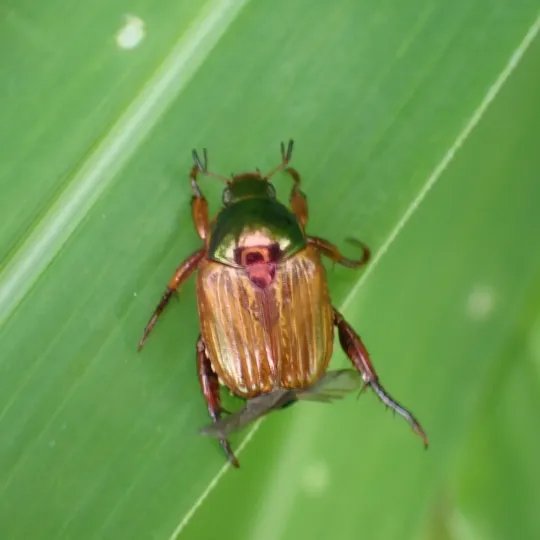
The Lewis beetle (lat. Popillia lewisi) is a member of the Scarabaeidae family, within the order Coleoptera. It is a medium-sized insect with a morphological structure similar to other species of the genus Popillia.
The adult beetle is characterized by an oval body shape and a distinct metallic luster, typically ranging from bronze to green. A key diagnostic feature is the presence of white hair patches on the posterior end of the abdomen.
The larval stage, or white grub, is C-shaped with a brownish head and well-developed thoracic legs. These larvae live underground, where they feed on organic matter and plant roots, passing through several larval instars.
The life cycle involves complete metamorphosis. The development timeline is highly dependent on environmental factors, particularly soil temperature and humidity, which determine the timing of the insect's emergence.
Accurate species identification often requires a detailed examination of male genitalia, as visual characteristics can be very similar to those of other closely related scarab species in the region.
What it damages
This beetle is a notable polyphagous pest capable of damaging a wide range of agricultural crops, ornamental plants, and forest trees. Its diet includes both monocotyledonous and dicotyledonous species.
The greatest damage is caused by adult beetles, which feed aggressively on leaves, flowers, and young fruits. Large populations can completely skeletonize foliage, leaving only the veins behind.
The larvae, living in the soil, cause significant harm to the root systems. By severing roots, they deprive plants of water and nutrients, resulting in stunting, wilting, and, in severe cases, plant death.
The pest poses a significant threat to horticulture and berry production. Damage to reproductive structures directly impacts yield and reduces the commercial quality of the produce.
Due to its high adaptability, the Lewis beetle is viewed as a potentially serious invasive threat, capable of colonizing new areas and causing significant economic losses in agricultural sectors.
When it appears
Adult emergence of the Lewis beetle typically occurs during the summer months. This period is critical for the insect as it involves mating and egg-laying activities in the soil.
Beetles are most active during daylight hours, particularly in warm, sunny weather. They are frequently found clustered on host plants, which facilitates easy detection during monitoring.
The typical development cycle is completed within one year. The insect overwinters as a larva deep in the soil, protected from freezing temperatures by the thermal mass of the earth.
In spring, rising soil temperatures trigger the larvae to migrate toward the surface to feed, eventually leading to pupation and the emergence of the next adult generation.
Systematic monitoring using traps and field surveys from late spring through mid-summer is essential for detecting early signs of infestation and initiating control measures.
Signs of infestation
The primary visual sign of infestation is skeletonized foliage, where the soft tissues of leaves are consumed by adults, leaving only a complex network of veins.
The presence of adults can be confirmed by inspecting flowers and plant tops, where they tend to gather. They are often easy to spot and may drop to the ground when disturbed.
Wilting of young plants or seedlings during the day, despite adequate watering, is a strong indicator of larval activity on the roots below the soil surface.
Excavating the soil around the rhizosphere of damaged plants often reveals the presence of C-shaped larvae, confirming the cause of the poor plant condition.
An accumulation of frass on the soil surface or under plant canopies is another indicator of high beetle density in the immediate area.
Control measures
Managing the Lewis beetle requires an integrated pest management (IPM) strategy that combines several control methods to reduce the population effectively and safely.
- Cultural control: Deep plowing in autumn to disturb and destroy overwintering larvae in the soil.
- Chemical control: Application of insecticides during peak adult emergence periods to prevent damage and egg-laying.
- Pheromone traps: Used for monitoring populations and capturing adult beetles in specific areas.
- Biological control: Utilizing entomopathogenic nematodes or fungi to target larvae in the soil.
Chemical applications should be timed carefully based on scouting results to maximize efficiency while adhering to pre-harvest intervals and protecting beneficial insects.
Phytosanitary measures are critical to prevent the accidental transport of larvae or eggs in soil or nursery stock to non-infested regions.
Taxonomy
- Latin name
- Popillia lewisi
- Order
- Coleoptera (beetles)
- Family
- Scarabaeidae
- EPPO code
- POPILE
Discussion
No discussions yet — be the first.