
Japanese beetle
Popillia japonica
Description
How to identify
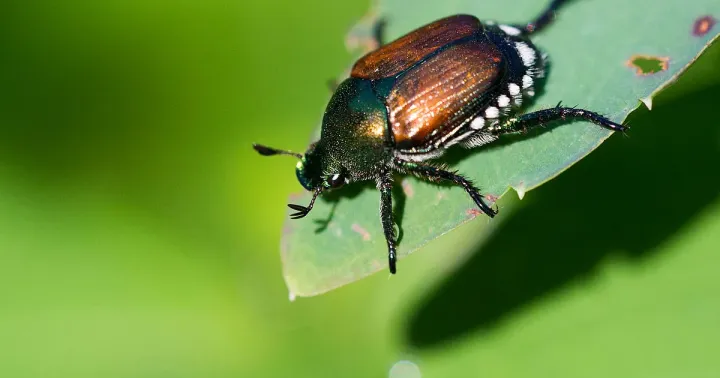
The Japanese beetle (Popillia japonica) belongs to the order Coleoptera and the family Scarabaeidae. Adult beetles are roughly 10–12 mm long and possess a metallic sheen, featuring copper-brown elytra and a brilliant green head and thorax.
A key identifying feature is the presence of five tufts of white hairs on each side of the abdomen and a pair of larger white tufts on the final abdominal segment, which are easily visible when viewed from the side.
The larvae, often called grubs, are white, C-shaped creatures with a brown head. They live underground, feeding primarily on the root systems of various plants, making them difficult to detect during their developmental stages.
These beetles are highly mobile and display gregarious behavior, often clustering in large numbers on host plants. They release aggregation pheromones that attract other beetles to the same plant, leading to intense localized infestations.
As a significant invasive pest in many parts of the world, Popillia japonica is subject to quarantine regulations to prevent its spread into new agricultural and urban areas.
What it damages
Adult Japanese beetles are extreme polyphages, feeding on over 300 species of plants, including roses, grapes, apples, peaches, corn, and various turf grasses. They feed on leaves, flowers, and fruits alike.
The damage caused by adults is primarily skeletonization, where the tissue between the leaf veins is consumed, leaving only a delicate lace-like network behind. This reduces the plant's ability to photosynthesize effectively.
The larvae cause significant damage to turf grass by feeding on the roots. This severs the connection between the grass and the soil, causing the turf to turn yellow, wither, and detach easily from the ground.
High beetle populations can strip a tree or shrub of its entire foliage within a few days. This stress weakens the plants, making them more susceptible to diseases and reducing their overall vigor and fruit production.
In commercial nurseries, the combined impact of larval root damage and adult foliar damage can lead to the complete loss of plant inventory, resulting in severe economic losses for growers.
When it appears
The life cycle of the Japanese beetle is typically completed in one year. Larvae overwinter in the soil at depths of 20–30 cm, moving deeper to avoid freezing temperatures and migrating back toward the root zone as the soil warms in spring.
Pupation occurs in late spring or early summer. Adult emergence begins in June and continues through September, with peak activity typically observed during the warm months of July and August.
After emerging, adults spend several weeks feeding and mating. Females periodically burrow into moist soil, such as lawns, pastures, or golf courses, to lay their eggs in small batches.
The egg stage lasts about two weeks, followed by the hatch of first-instar larvae. These larvae spend the remainder of the summer and early autumn feeding on organic matter and roots until the onset of cooler weather.
Development is highly dependent on soil moisture; droughts during the egg-laying and hatching periods can lead to significantly higher larval mortality and reduced population levels in the subsequent year.
Signs of infestation
The most prominent sign of an adult infestation is skeletonized foliage, where leaves appear to have only a skeleton of veins remaining. This damage is highly distinctive and usually occurs in clusters.
Floral damage is another common indicator, characterized by petals being shredded or consumed entirely. The beetles often congregate inside the blooms, leading to rapid destruction of the plant's aesthetic appeal.
Yellowing, thinning turf is a primary indicator of larval activity. If the grass can be pulled up like a piece of carpet, it is a clear sign that grubs have destroyed the root system underneath.
Increased foraging by birds, such as starlings or robins, on lawns may indicate a grub infestation, as they dig into the soil to feed on the developing larvae just beneath the surface.
The visual presence of the beetles themselves—often clustered in large groups and emitting a low buzzing sound—is an unmistakable sign of a heavy infestation in your garden or orchard.
Control measures
Chemical control strategies include the application of systemic or contact insecticides during the adult flight period to reduce foliar damage and egg-laying populations.
Biological control methods are highly effective, utilizing entomopathogenic nematodes or the bacterium Bacillus popilliae (milky spore disease) to target and kill larvae within the soil profile.
Cultural practices, such as maintaining a drier lawn surface during peak egg-laying periods, can significantly deter female beetles from selecting your property as an oviposition site.
Pheromone traps are useful for monitoring and mass-trapping adults, but they should be placed far away from sensitive plants to prevent drawing more beetles toward the areas you wish to protect.
Physical barriers like fine-mesh netting can provide essential protection for high-value plants or shrubs during the peak weeks of beetle activity, ensuring the foliage and fruits remain intact.
Taxonomy
- Latin name
- Popillia japonica
- Order
- Coleoptera (beetles)
- Family
- Scarabaeidae
- EPPO code
- POPIJA
Discussion
No discussions yet — be the first.