
Willow leaf sawfly
Pontania femoralis
Description
How to identify
The willow leaf sawfly, scientifically known as Pontania femoralis, is an insect belonging to the order Hymenoptera and the family Tenthredinidae. Adult sawflies are small, wasp-like insects that typically emerge in early spring to begin their life cycle.
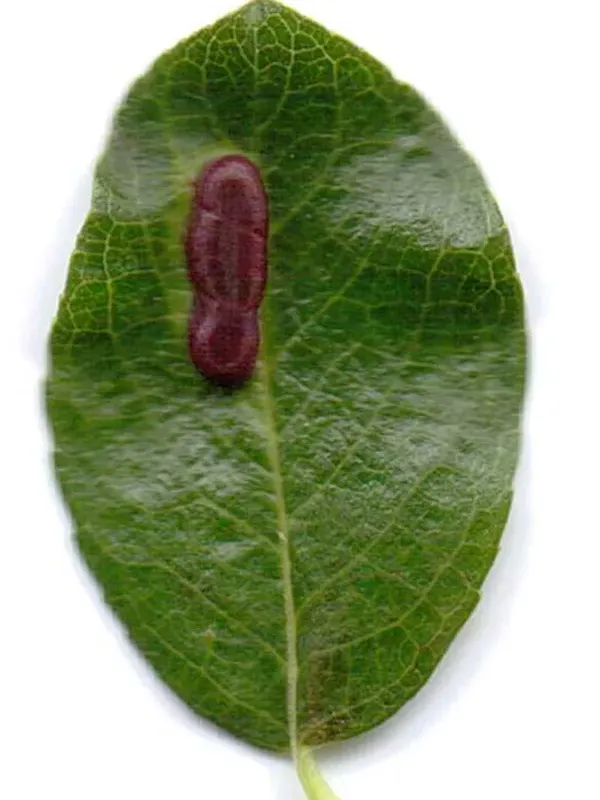
The defining characteristic of this species is its ability to induce the formation of galls on willow leaves. During egg-laying, the female deposits an egg into the leaf tissue, which triggers the plant to develop a protective swollen structure around the larva.
Inside these galls, the larvae develop, feeding on the specialized plant tissue provided by the host. The larvae are typically legless or have abdominal prolegs, often pale in color, adapted for an enclosed life inside the plant tissue.
The development cycle is synchronized with the phenology of willow trees. As soon as young leaves appear in the spring, the adult sawflies mate and begin the process of inducing galls, ensuring their offspring have a constant food source.
The life cycle usually involves one or two generations per season. Pupation occurs in the soil or under debris, where the insect remains in a cocoon to survive unfavorable conditions before emerging again in the next season.
What it damages
This pest exclusively targets various species of the genus Salix (willows). It can infest wild willow populations as well as ornamental trees planted in urban landscapes, parks, and along riverbanks.
The damage caused by Pontania femoralis is primarily physiological. By forming galls, the insect disrupts the normal photosynthetic activity of the leaf, as the plant spends energy creating gall tissue instead of producing sugar.
High infestation levels lead to heavy foliage damage, causing the leaves to yellow, dry out, and fall prematurely. This results in severe aesthetic degradation of the willow tree, which is a major concern for landscape maintenance.
For young or newly planted trees, constant defoliation and tissue damage can hinder overall growth, leading to stunted shoots and reduced vigor, making the tree more susceptible to other environmental stressors.
Furthermore, these gall-ridden leaves create an ideal environment for secondary bacterial and fungal pathogens, which can colonize the damaged tissues and lead to more serious, systemic tree health issues.
Signs of infestation
The most prominent indicator of an infestation is the presence of galls. These appear as small, spherical, or elongated swellings on the leaves, often clustered along the midrib or veins, varying in color from light green to red.
As the larvae grow, the galls become more pronounced. In some cases, the leaf lamina may become deformed or curl around the gall, making the entire branch look sickly or distorted to an observant gardener.
Small exit holes on the surface of the galls signify that the larvae have matured and exited to pupate in the soil. These empty galls may eventually turn brown or black as the leaf tissue dies off.
Early season detection is crucial. If you notice early leaf distortion in late spring, inspecting the undersides or the midribs of the leaves for small bumps will confirm the presence of Pontania femoralis.
In cases of severe infestation, the tree's canopy may look sparse and mottled, with a high density of necrotic or distorted leaves, significantly detracting from the ornamental value of the willow.
Control measures
Management of the willow leaf sawfly requires a combination of monitoring and intervention. It is most effective to address the issue before the larvae exit the galls to pupate in the soil.
Mechanical removal is a highly effective control measure for smaller plants. Simply pruning off the branches or leaves containing galls can significantly reduce the pest population in your immediate area.
Systemic insecticides are recommended for larger infestations. These chemicals are absorbed by the plant and reach the larvae inside the galls, providing effective control that contact sprays might miss.
Cultural practices, such as raking and destroying fallen leaves in the autumn, are essential. Since the pupae overwinter in the soil or plant debris, reducing this habitat helps lower the number of emerging adults next spring.
- Apply horticultural oils early in the season to discourage egg-laying.
- Encourage natural predators like parasitoid wasps in the garden.
- Maintain healthy tree vigor through proper watering and soil management.
Taxonomy
- Latin name
- Pontania femoralis
- Order
- Hymenoptera
- Family
- Tenthredinidae
- EPPO code
- PONTFE
Discussion
No discussions yet — be the first.