
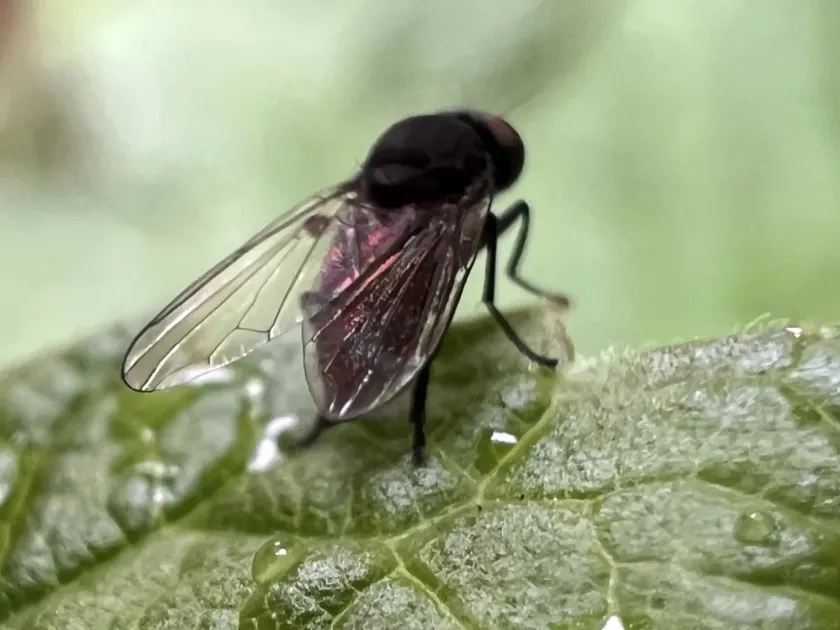
Black flat-footed fly
Platypeza atra
Description
How to identify
The black flat-footed fly (Platypeza atra) is a species of dipteran insect belonging to the family Platypezidae, commonly known as the flat-footed flies. These insects are small and generally characterized by a dark, often black coloration.
A key morphological feature of females in this family is the presence of flattened and expanded hind tarsi, which assist in identifying the species. They possess a robust yet compact body structure typical of the lower Brachycera suborder.
Their biological cycle includes complete metamorphosis: egg, larva, pupa, and adult. The larvae often feature a flattened body shape with lateral extensions, allowing them to remain firmly attached to the hymenium of fungal fruiting bodies.
Adult flies are highly active and are frequently attracted to sites where basidiomycete fungi occur, whether in natural forest habitats or in controlled cultivation environments.
Professional identification requires careful observation of wing venation and the distinct tarsal structures of females, distinguishing them from common sciarid or phorid flies often found in mushroom houses.
What it damages
The primary damage is caused by the larvae, which feed on the fruiting bodies of mushrooms. In commercial mushroom production, this leads to significant yield losses as infested mushrooms become unmarketable.
Larvae bore extensive tunnels throughout the stalks and caps of the mushrooms, destroying the internal structure. This not only ruins the appearance but also leads to premature decomposition and decay of the produce.
These pests often act as vectors for various bacterial and fungal pathogens. By damaging the surface of the mushroom, they create entry points for secondary infections that can rapidly spoil an entire batch of crops.
The economic impact is severe, as even light infestations necessitate strict culling of mushrooms to meet quality standards. In large-scale operations, a failure to manage the population can result in total crop failure for a given cycle.
Infested mushrooms often become watery, discolored, and soft, making them highly susceptible to secondary mold growth, which complicates the sanitation process after the harvest.
When it appears
In controlled environments such as mushroom farms, Platypeza atra can be active year-round if temperatures are maintained in an optimal range. They are highly responsive to the stable climate of indoor cultivation.
In natural settings, the activity of the flies peaks during humid periods and mild temperatures. The moisture level in the environment is the most critical factor for successful egg-laying and larval survival.
The lifecycle duration is temperature-dependent, typically occurring faster in warmer conditions. Under favorable conditions, multiple generations can occur during a single season.
Monitoring for adult flies should be conducted continuously, especially before and during the mushroom pinning stage, as early intervention is essential to prevent the buildup of a damaging population.
Activity peaks are frequently observed following humidity-increasing activities like misting or watering the substrates, which attract adult flies looking for suitable sites for oviposition.
Signs of infestation
The first sign of an infestation is the appearance of tiny holes on the surface of the mushroom cap or stalk. These entry points are often surrounded by small amounts of fungal debris or "frass" left by the larvae.
Inside the mushroom, clear evidence of damage is found in the form of meandering tunnels filled with larval excrement. These areas usually show significant tissue breakdown and discoloration.
The presence of adult flies on the surface of substrate blocks, particularly in dark and humid corners of the cultivation room, is a strong indicator of an existing infestation.
Developmental issues such as stunted growth, deformed caps, or irregular fruiting patterns often signal that larvae are consuming the inner tissues of the developing mushroom.
A foul, putrid odor in the growing chamber often indicates advanced decay caused by larvae, suggesting that the infestation has reached a critical stage and requires immediate sanitization.
Control measures
Strict sanitation is the foundation of management. It is crucial to remove all spent substrate and harvested mushroom debris promptly, as these provide ideal breeding grounds for the flies.
Installing fine-mesh screens on all ventilation and air intake systems effectively blocks adult flies from entering the cultivation facility from the outside.
Yellow sticky traps are highly effective for monitoring the population density of adult flies and providing a physical method to reduce their numbers within the growing rooms.
Biological control options, such as the use of entomopathogenic nematodes or specialized microbial-based insecticides, can be applied to suppress populations while remaining safe for the mushroom crop.
- Complete disinfection of rooms between cropping cycles.
- Maintaining room hermeticity to exclude pests.
- Regular use of yellow sticky cards to monitor fly activity.
- Careful removal of all infested mushrooms including roots/base.
- Optimizing air exchange to reduce excessive humidity spots.
Taxonomy
- Latin name
- Platypeza atra
- Order
- Diptera (flies)
- Family
- Platypezidae
- EPPO code
- CLYHAT
Discussion
No discussions yet — be the first.