
Flat-footed flies
Platypeza
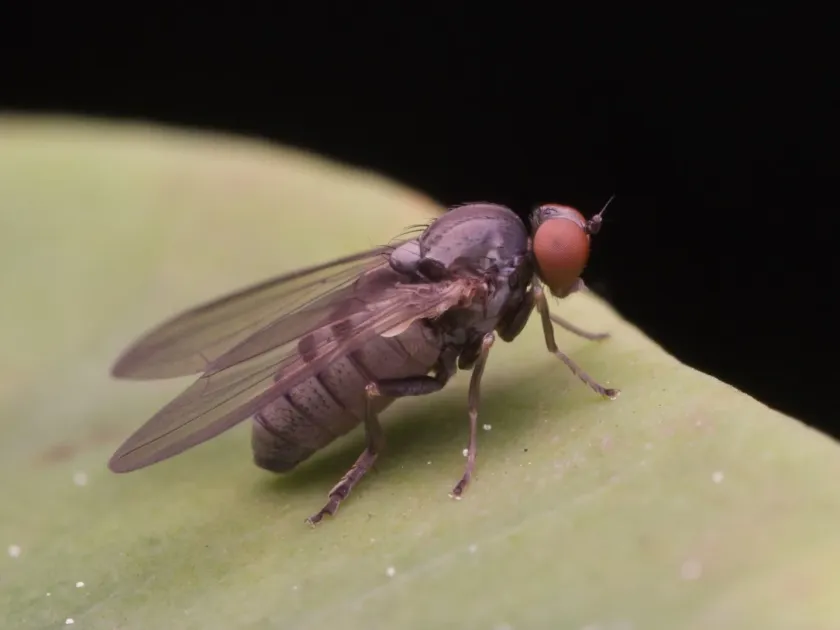
Description
How to identify
Flat-footed flies (genus Platypeza) are members of the family Platypezidae. They are named for the distinctive enlarged and flattened tarsi on the hind legs of the males.
These flies are generally small, often dark in color, and have a somewhat elusive behavior, making them difficult to spot in dense mushroom beds.
The larvae are typically maggot-like, with specialized mouthparts designed to chew through the soft tissue of fungal fruiting bodies.
They belong to the order Diptera, which explains their complex metamorphosis involving egg, larval, pupal, and adult stages.
Identification at the species level usually requires careful examination of the genitalia, as many species within the genus appear visually identical.
What it damages
The primary damage is caused by the larvae, which bore into the caps and stalks of mushrooms, creating tunnels that render the produce inedible.
In commercial mushroom production, they attack primordial growth, causing significant yield losses and quality degradation.
The tunnels created by the larvae promote the development of secondary bacterial rot, which spreads through the mushroom block.
As the larvae feed, the structural integrity of the mushroom is compromised, leading to premature softening and darkening of the tissue.
A severe infestation can ruin an entire harvest, as the presence of larvae and their waste is unacceptable in commercial quality standards.
When it appears
In natural environments, these flies are most active during the mushroom growing season, spanning from late spring to autumn.
Within indoor farming facilities, they can maintain a continuous breeding cycle if the temperature and humidity remain constant throughout the year.
The flies favor high-humidity environments, which is common in professional mushroom cultivation houses.
Adults are most active during low-light conditions, such as dusk or on overcast days, often avoiding direct light.
The generation time can be quite short, leading to overlapping life stages and rapid population growth under favorable conditions.
Signs of infestation
The earliest symptom is the appearance of tiny pinholes on the surface of the mushroom cap, often near the gills or stalk.
Slicing open an infected mushroom reveals extensive tunneling, often filled with frass, which is the waste product of the feeding larvae.
A noticeable presence of small dark flies flying near the mushroom beds is a clear indicator of an established pest population.
Premature wilting or localized rot patches on young mushrooms are often associated with hidden larval feeding underneath the surface.
A faint, putrid smell emanating from the mushroom bed often suggests that secondary infections have set in due to larval damage.
Control measures
Integrated pest management (IPM) is essential for controlling flat-footed flies, focusing primarily on prevention and physical barriers.
Sanitation is the most critical factor; all crop residues must be removed and destroyed to break the fly's life cycle.
Installing fine-mesh screens on all vents and doors prevents adult flies from entering the cultivation facility from the outside.
- Steam sterilization of the substrate before inoculation to ensure no eggs or larvae are present.
- Regular use of yellow sticky traps to monitor adult fly activity and prevent mass mating.
- Strict temperature control to disrupt the optimal conditions for larval development.
Chemical control is rarely the first choice due to the sensitivity of mushrooms to pesticides; emphasis remains on biological and environmental management.
Taxonomy
- Latin name
- Platypeza
- Order
- Diptera (flies)
- Family
- Platypezidae
- EPPO code
- PLPZSP
Discussion
No discussions yet — be the first.