
Platygaster
Platygaster obscurus
Description
How to identify
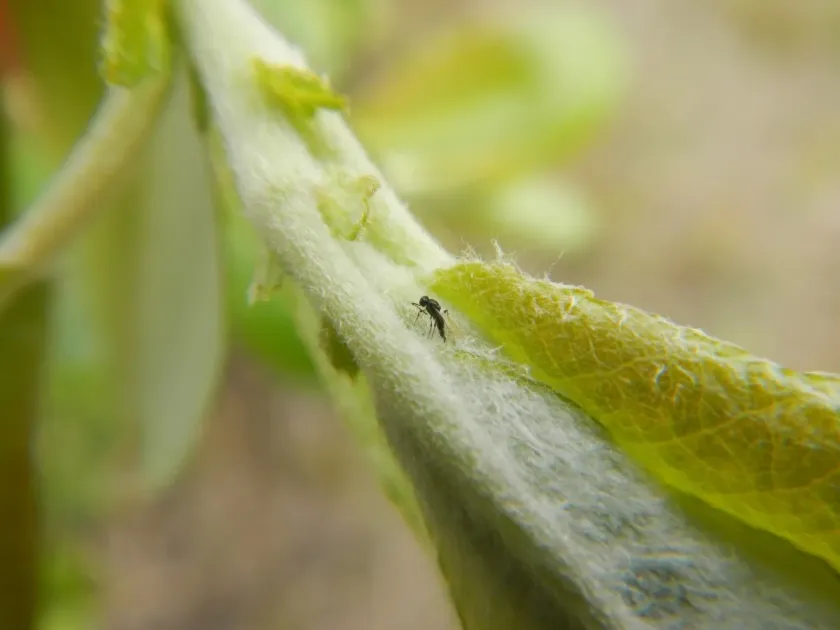
Platygaster obscurus is a tiny wasp belonging to the family Platygastridae. These insects are extremely small, typically measuring between 1 and 2 millimeters in body length, and are known for their dark, often black coloration.
The morphological features of these wasps include a simplified wing venation pattern and specialized antennae, which are essential for navigating the environment and locating hosts within dense vegetation.
As a parasitoid, the adult female searches for the larvae of gall midges. Once a host is located, the female uses her ovipositor to lay eggs inside or on the body of the target larva.
The larvae of Platygaster develop endoparasitically, meaning they consume the host from the inside, which eventually leads to the death of the pest and the emergence of a new generation of wasps.
Identifying this species in the field often requires microscopic examination, as their size and appearance make them difficult to distinguish from other micro-hymenoptera without proper training.
What it damages
It is crucial to emphasize that Platygaster obscurus does not damage crops. It is not a phytophagous insect and does not consume plant tissues, sap, or harvested grains.
Instead, it serves as a natural enemy to several agricultural pests, most notably those belonging to the gall midge family (Cecidomyiidae) that affect wheat, barley, and other cereals.
The presence of this insect in a field is an indicator of a balanced ecosystem where natural regulatory mechanisms are at work. Its activity significantly reduces the pest population density.
Misinterpreting the presence of these wasps as a threat and applying broad-spectrum insecticides can result in the destruction of this beneficial agent, leading to an uncontrollable outbreak of primary pests.
Therefore, farmers should view this species as an ally in crop protection, providing significant economic savings by preventing yield losses through natural biological regulation.
When it appears
The activity of Platygaster obscurus is strictly synchronized with the life cycle of its hosts. Adults typically appear during the spring, coinciding with the tillering and stem elongation stages of cereal crops.
Development is temperature-dependent, with the potential for one or two generations per year depending on local climatic conditions and the availability of suitable host larvae.
Overwintering occurs at the pupal stage inside the host's puparium. This strategy allows the wasps to survive winter conditions within the field soil or plant debris until the next growing season.
As spring temperatures rise, adult wasps emerge from the soil to begin the search for new hosts, completing their cycle exactly when the threat from gall midges is most critical for the crops.
The peak activity period usually occurs during the early summer, effectively covering the most vulnerable development stages of the grain crops and maximizing the protective effect.
Control measures
The primary strategy regarding Platygaster obscurus is conservation and habitat management. Creating conditions that support the survival of these wasps is essential for sustainable agriculture.
Avoiding the use of broad-spectrum pesticides is the most effective way to protect these beneficial insects. When chemical intervention is necessary, selective products should be prioritized.
Maintaining non-crop areas, such as field borders or hedgerows, provides refuges for these wasps and other beneficial organisms, allowing them to recolonize fields after disturbances.
Farmers should implement Integrated Pest Management (IPM) practices, where the density of pests is monitored before deciding on any treatment, ensuring that natural predators have a chance to work.
- Minimize pesticide applications during peak wasp activity.
- Utilize selective insecticides that preserve parasitoid populations.
- Maintain field margins to foster biodiversity.
- Conduct regular monitoring to assess the efficacy of natural parasitism.
Taxonomy
- Latin name
- Platygaster obscurus
- Order
- Hymenoptera
- Family
- Platygastridae
- EPPO code
- PLAEOB
Discussion
No discussions yet — be the first.