
Platygaster iolas
Platygaster iolas
Description
How to identify
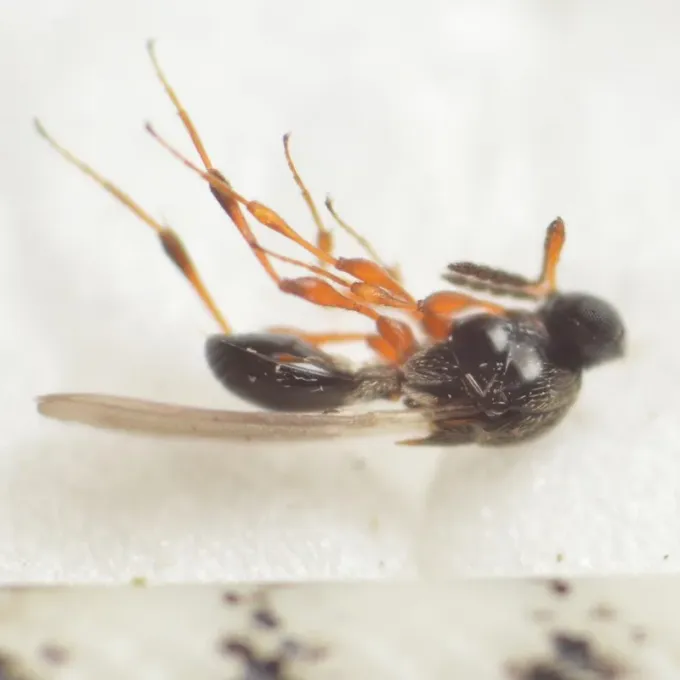
Platygaster iolas is a minute parasitic wasp belonging to the family Platygastridae within the order Hymenoptera.
This species is widely recognized in agricultural entomology as a specialized parasitoid that targets the larvae of various gall midges.
The adult wasp is small and black, possessing wings adapted for efficient movement across fields to locate its specific host insects.
Its biological cycle is strictly dependent on the presence of hosts, as the female lays eggs directly into the body of the midge larva.
Due to its behavior, it serves as a natural regulator of populations of several dipteran pests that affect small grains and grasses.
What it damages
Platygaster iolas does not directly damage crops; instead, it provides an essential ecosystem service by parasitizing harmful insects.
Its primary targets are larvae of gall midges that damage wheat, rye, and barley crops during their growth stages.
By infecting these larvae, the wasp prevents them from completing their development, thereby reducing damage to stems and developing grains.
An abundance of these wasps in a field indicates the presence of a pest population, which necessitates monitoring by farmers to ensure the balance remains in check.
The overall impact of this species is highly beneficial, as it serves as a natural form of biological pest control within agricultural environments.
When it appears
The seasonal activity of Platygaster iolas is synchronized with the life cycle of its gall midge hosts, typically during the spring and early summer.
Adult wasps emerge from their overwintering sites as temperatures rise and host larvae become available for oviposition.
The peak activity generally occurs during the heading stage of cereal crops, which is when the host insects are most susceptible to parasitization.
Environmental factors, such as ambient temperature and field humidity, play a critical role in determining the speed of development for each generation.
As the growing season concludes, the wasps transition into a dormant stage, surviving in soil or crop residue until the following year.
Signs of infestation
Detecting the presence of Platygaster iolas is challenging due to the insect's tiny size and elusive nature in the field environment.
The most reliable sign of their activity is the presence of infested host larvae, which can be confirmed through microscopic examination of collected samples.
Farmers often use yellow sticky traps or sweep nets to monitor for the presence of these parasitoids alongside their pest targets.
A successful parasitization can be observed when host larvae exhibit reduced activity or abnormal development patterns within the plant tissue.
Consistent population monitoring helps determine whether the natural parasitoid density is sufficient to manage the pest pressure naturally.
Control measures
The primary control strategy is to preserve the population of this beneficial parasitoid by avoiding harmful agricultural practices.
Integrated Pest Management (IPM) is crucial, as it minimizes the reliance on broad-spectrum insecticides that could wipe out beneficial wasp populations.
Field margins and hedgerows provide essential habitats for the wasps during periods when host insects are less available.
- Apply insecticides only when necessary and use selective formulations.
- Maintain non-crop vegetation to support parasitoid populations.
- Regularly monitor the ratio between pests and their natural enemies in the field.
Promoting the activity of native parasitoids like Platygaster iolas leads to more sustainable and cost-effective crop production in the long term.
Taxonomy
- Latin name
- Platygaster iolas
- Order
- Hymenoptera
- Family
- Platygastridae
- EPPO code
- PLAEIO
Discussion
No discussions yet — be the first.