
Platygaster
Platygaster hyllus
Description
How to identify
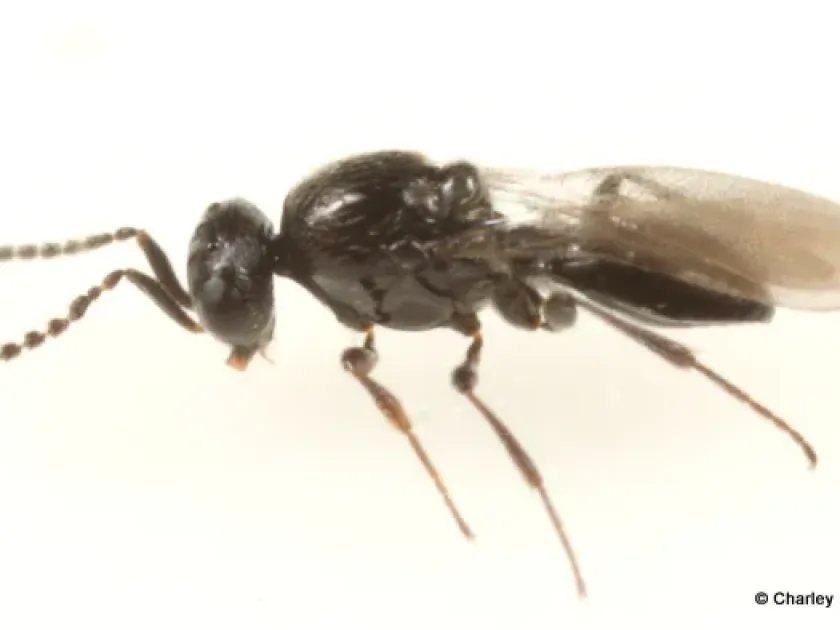
Platygaster is a genus of minute parasitic wasps belonging to the family Platygastridae. These insects are extremely small, typically measuring between 1 and 2 millimeters in length, which makes them very difficult to observe in field environments.
The species Platygaster hyllus is known for its role as a specialized parasitoid. They possess highly developed sensory organs on their antennae, which allow the females to locate their hosts with precision, even within dense agricultural foliage.
Adult wasps are generally black, shiny, and possess a specific wing venation characteristic of the group. Their body structure is evolutionarily optimized for efficiency in searching for host larvae on various cereal crops.
Identification of these wasps in the field usually requires the use of sweep nets and professional entomological expertise. They are often overlooked by farmers due to their microscopic size and non-aggressive behavior.
Understanding the presence of Platygaster is crucial for agronomists practicing integrated pest management, as these wasps act as essential natural allies in the biological regulation of pest populations.
What it damages
Platygaster wasps do not cause any direct damage to plant tissues. Instead, they act as beneficial parasitoids that attack the larvae of gall midges, which are primary pests of cereal crops such as wheat and barley.
Because they live at the expense of pest larvae, their absence in an agroecosystem often leads to an explosion of gall midge populations. Therefore, the "harm" caused by Platygaster is essentially the successful disruption of a pest's life cycle.
Without the presence of Platygaster and similar parasitoids, gall midge larvae would cause severe structural damage to cereal stems, leading to stunted growth, grain yield loss, and lodging.
In terms of agricultural economics, Platygaster serves as a free, natural pest control agent. Preserving their population is a strategy that helps to minimize the reliance on synthetic chemical insecticides.
Agronomists must carefully distinguish between primary pests and their natural enemies to avoid harming beneficial populations during routine field treatments.
When it appears
The seasonal occurrence of Platygaster is strictly synchronized with the phenology of their host insects and the growth stages of cereal crops. Adult activity peaks during the spring and summer months.
They typically overwinter in a larval stage, protected inside the body of the host or within the soil and plant debris. With the onset of warmer spring temperatures, the adults emerge to begin their cycle.
The period of highest activity coincides with the stem elongation and heading phases of cereals. During this time, the wasps are actively searching for hosts to oviposit their eggs.
The number of generations per season varies based on local climate conditions and the density of the host population. Usually, one or two generations occur annually in temperate zones.
As summer draws to a close, the insects prepare for diapause. This is a critical time when agricultural practices, such as tillage, can significantly influence the survival rate of the next year's population.
Signs of infestation
There are no direct external signs of damage caused by Platygaster on crops, as they do not feed on plant matter. In fact, a lack of pest symptoms in the presence of known pest threats often indicates active parasitoid work.
Microscopic examination of pest larvae sampled from field plants is the most reliable way to confirm the presence of Platygaster. Parasitized larvae can be identified by the internal developmental stages of the wasp.
Monitoring the overall health of the crop is the best diagnostic tool. If the impact of gall midges remains localized or suppressed, it serves as a sign that natural biological regulation is succeeding.
Visual signs on the plant, such as tiny exit holes in old stubble, might suggest that the wasps have successfully completed their life cycle and emerged.
It is important to remember that Platygaster is a silent worker. Its absence is a much more alarming sign for a farmer than its presence, as it implies a failure in natural pest control.
Control measures
There are no control measures designed to target Platygaster because it is a beneficial organism. Management strategies focus entirely on protecting and promoting their population to maximize biological control.
The most important requirement is to avoid the application of broad-spectrum insecticides during the peak activity periods of the wasps, as these chemicals are lethal to beneficial parasitoids.
Farmers are encouraged to use selective pest management products that target specific pests without harming the natural enemy complex inhabiting the crop fields.
Maintaining field margins and avoiding intensive soil disturbance can help preserve the overwintering habitats required for Platygaster survival.
- Restrict chemical treatments during crop heading phases.
- Prioritize biological and selective control methods.
- Use integrated monitoring to determine if intervention is necessary.
Taxonomy
- Latin name
- Platygaster hyllus
- Order
- Hymenoptera
- Family
- Platygastridae
- EPPO code
- PLAEHY
Discussion
No discussions yet — be the first.