
Hessian fly
Platygaster equestris
Description
How to identify
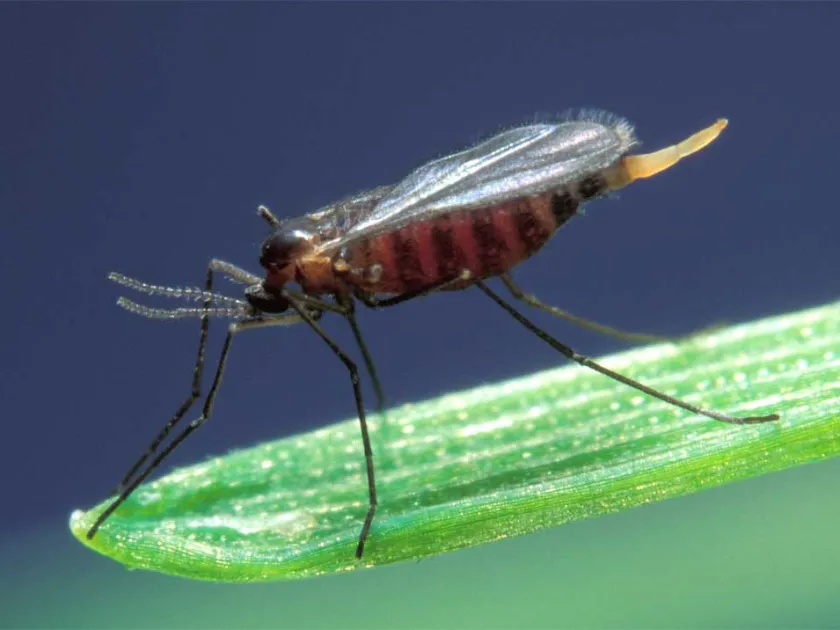
The Hessian fly (lat. Mayetiola destructor) is a member of the gall midge family, order Diptera. The adult fly is a small, dark-colored insect, roughly 3 mm long, resembling a mosquito in appearance.
Larvae are small, headless, and legless, transitioning from transparent white to a greenish color. The most diagnostic stage is the flaxseed-like puparium, which is dark brown and found tucked behind leaf sheaths.
The female lays clusters of tiny, reddish-orange eggs on the upper surface of cereal leaves. Depending on the environment, a single female can lay up to 200 eggs during her short lifespan.
The life cycle encompasses four distinct stages: egg, larva, puparium, and adult. The insect typically undergoes diapause during the pupal stage, waiting for favorable conditions to emerge.
High population densities can occur quickly in favorable conditions, making it a critical threat that requires constant vigilance during the spring and fall planting seasons.
What it damages
The primary hosts of the Hessian fly include wheat, barley, and rye. Oats are generally resistant and suffer little to no damage compared to the primary cereal crops.
Infestations typically occur during the tillering and jointing stages. Larvae feed by rasping the plant tissue and sucking nutrient-rich sap, which weakens the stem significantly.
Wild grasses, particularly couch grass, serve as alternative hosts, maintaining the Hessian fly population in areas between commercial cropping cycles.
Yield loss occurs because the damaged stems are stunted, fail to produce grains, or become susceptible to lodging, rendering them impossible to harvest effectively.
Severe infestations can lead to total crop failure, particularly in regions where monoculture practices provide a continuous food supply for successive generations of the insect.
Signs of infestation
Stunted plant growth is the most common sign of infestation. Plants may appear dark green initially, but leaves soon turn yellow and then brown as the larvae continue to feed.
Stems become weakened at the site of larval feeding, often resulting in sudden lodging before harvest. These stems exhibit a characteristic lack of vigor and structural integrity.
Heads on damaged plants are often poorly filled or fail to develop entirely. Grain quality suffers significantly, leading to light-weight, shriveled kernels that reduce market value.
Close examination of the stem base, beneath the leaf sheath, usually reveals the presence of white larvae or brown puparia. Their presence is the definitive confirmation of infestation.
In fields with high pressure, patches of withered plants are easily identifiable during scouting, contrasting sharply with the healthy green growth of unaffected areas.
Control measures
Crop rotation is the most effective preventative measure. Avoiding the planting of wheat after wheat significantly breaks the life cycle and reduces the local population of the pest.
Deep plowing following harvest helps bury crop residues, effectively trapping larvae and puparia deep in the soil and preventing adult emergence in the following season.
Volunteer wheat management is crucial, as these plants provide a bridge for the flies to survive. Controlling them via tillage or herbicides prevents early-season buildup.
Seed treatments using systemic insecticides provide early-season protection, safeguarding the seedlings during the critical initial phases of growth against adult egg-laying and larval feeding.
- Planting resistant wheat varieties suited for the region.
- Adhering to recommended fly-free planting dates.
- Destroying wild grasses and weeds surrounding the fields.
- Monitoring adult flight activity using specialized pheromone traps.
Taxonomy
- Latin name
- Platygaster equestris
- Order
- Hymenoptera
- Family
- Platygastridae
- EPPO code
- PLAEEQ
Discussion
No discussions yet — be the first.