
Fungus gnat
Plastosciara perniciosa
Description
How to identify
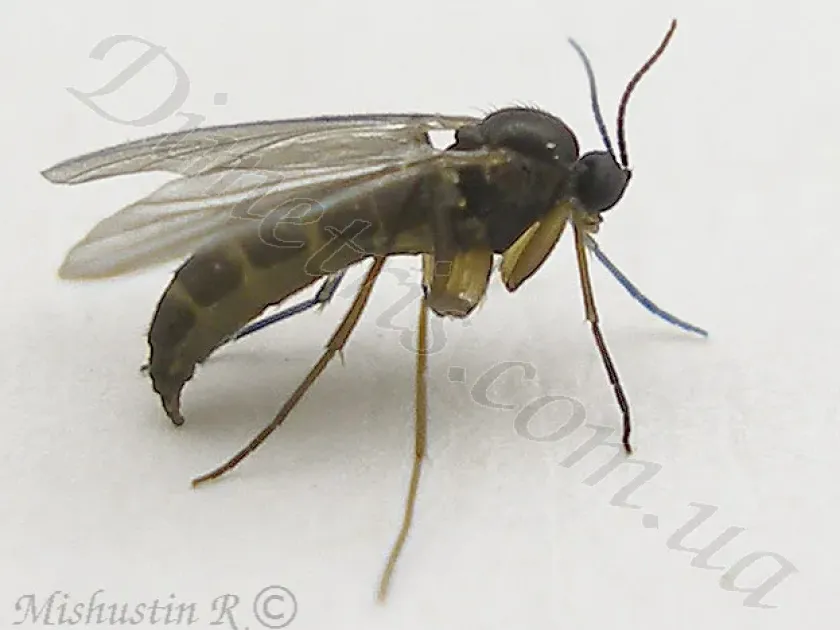
The fungus gnat (Plastosciara perniciosa) belongs to the Sciaridae family within the order Diptera. These are small insects, with adults resembling tiny black flies measuring between 2 and 5 millimeters in length.
Adult gnats are highly mobile, often seen performing short, jerky flights over the surface of the substrate. They possess dark-colored bodies and clear wings, while their mouthparts are poorly developed, meaning the adults do not feed on plant tissues.
The main threat comes from the larvae, which live within the moist soil substrate. They are characterized by a worm-like shape, a whitish or translucent body, and a distinct black head capsule, which serves as a primary identifying feature.
The insect's life cycle is highly dependent on temperature and humidity, typically ranging from 20 to 30 days. A single female can lay up to 200 eggs in soil crevices or organic matter, ensuring rapid population growth.
Development proceeds through egg, four larval instars, pupa, and adult stages. High air humidity and overwatered soil create optimal conditions for the mass emergence of new gnats, leading to a sudden surge in the pest population.
What it damages
This pest affects a wide range of agricultural and ornamental crops grown in greenhouses, nurseries, and indoor environments. Sciarids are particularly dangerous to young seedlings, cuttings, and transplants with delicate root systems.
Fungus gnat larvae feed on decomposing organic matter, decaying plant tissues, as well as living roots and root hairs. When population density is high, they are capable of completely destroying the root systems of young plants.
Plants requiring consistently moist substrates, such as African violets, pelargoniums, orchids, and vegetable seedlings, are most susceptible. Damage is caused both by direct root feeding and by facilitating the onset of secondary infections.
Pathogenic fungi and bacteria often penetrate the injured root areas, leading to root and crown rot. This significantly accelerates plant death, causing the foliage to wilt and yellow as the plant loses its ability to absorb essential nutrients.
In mature plants, sciarids cause stunted growth, reduced ornamental value, and weakened immunity. Even if a plant survives, its overall productivity declines, and the risk of secondary fungal diseases remains critically high throughout the growing season.
Signs of infestation
The first sign of infestation is the presence of dark, hovering flies around plant pots. They are most noticeable during watering or soil cultivation, when the insects swarm into the air from the surface of the substrate.
During a visual daytime inspection, larvae are difficult to spot as they prefer to hide deep within the soil. However, in cases of severe infestation, they may appear on the surface after heavy watering.
Plants begin to show sudden signs of stunted growth, leaves lose turgor and turn yellow despite proper watering schedules. This indicates that the roots have ceased functioning due to damage caused by the larvae.
Upon removing a plant from its pot, one may observe a damaged root system: roots appear brown and limp, often with a total absence of young, active feeder roots. In advanced cases, the base of the stem may become soft and water-soaked.
Another indirect sign is the appearance of mold or fungal growth on the soil surface, which often accompanies sciarid larval activity. The damp environment that favors fungal growth is also ideal for the reproduction of this pest.
Control measures
The primary control method is strict adherence to a proper watering regimen. Avoiding constant soil saturation by allowing the top layer of the substrate to dry out between waterings helps prevent larval survival in the upper soil profile.
Using yellow sticky traps is an effective way to manage adult populations. They significantly reduce the number of flying gnats, disrupting the egg-laying cycle and providing a way to monitor population density in greenhouses or rooms.
Biological control using entomopathogenic nematodes (such as Steinernema feltiae) is highly effective against soil-borne larvae. These nematodes actively seek out and destroy the pests while remaining perfectly safe for the plants.
Chemical control involves drenching the substrate with systemic or contact-stomach insecticides authorized for greenhouse use. It is critical to treat all plants in the area simultaneously to ensure the complete eradication of the infestation.
- Regularly remove plant debris from the soil surface.
- Always disinfect new potting soil before use.
- Use high-quality, sterile substrates for seed starting and propagation.
- Maintain cleanliness in greenhouses and perform regular preventive check-ups.
Taxonomy
- Latin name
- Plastosciara perniciosa
- Order
- Diptera (flies)
- Family
- Mycetophilidae
- EPPO code
- PLSRPE
Discussion
No discussions yet — be the first.