
Dynatosoma fuscicorne
Dynatosoma fuscicorne
Description
How to identify
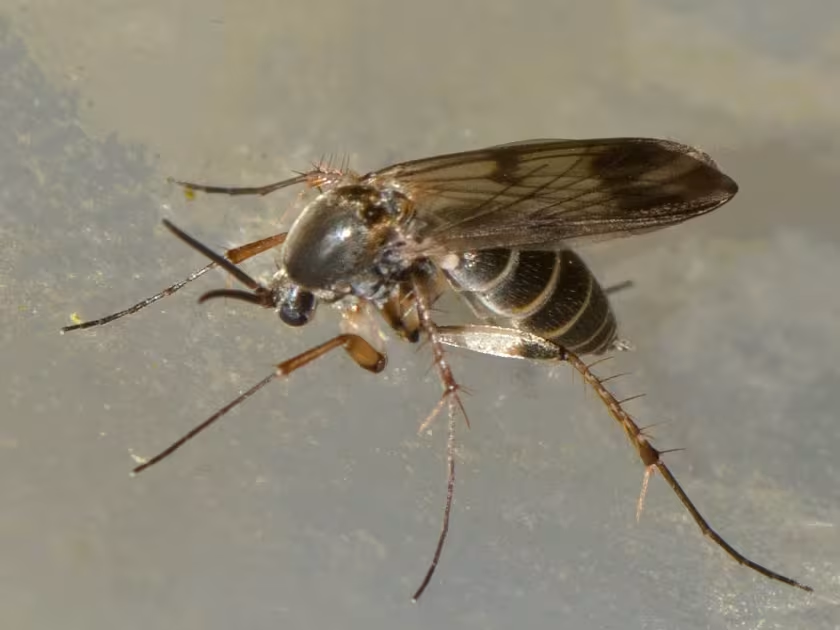
Dynatosoma fuscicorne is a species of fungus gnat belonging to the family Mycetophilidae, order Diptera. These small flies are often recognized by their slender bodies and distinctive dark antennae, which serve as a primary identification feature for the species.
The adult fly has delicate wings and long, thin legs, typical of the Mycetophilidae family. Specialists identify the species by examining the wing venation pattern and the specific coloration of the thoracic segments and head.
The larvae are small, legless, translucent-white maggots with a well-developed, dark head capsule. They possess chewing mouthparts designed to feed on fungal tissues, allowing them to penetrate and tunnel through the mushroom fruit body.
Life stages include eggs, several larval instars, pupae, and adults. Each stage is strictly dependent on moisture, as the larvae require a damp, nutrient-rich fungal substrate to survive and complete their development.
Understanding their morphology is crucial for integrated pest management in commercial mushroom facilities, where early detection of adult gnats can prevent large-scale infestation of the growing beds.
What it damages
This pest primarily attacks cultivated mushrooms, including button mushrooms (Agaricus) and oyster mushrooms (Pleurotus). The damage is caused by the larval stage, which feeds voraciously on both the mycelium and the fruit bodies.
Larvae create intricate networks of tunnels within the mushroom stipe and cap. This activity physically damages the fungal tissue, leading to structural collapse and making the product unsalable due to loss of quality.
Heavy infestations can result in complete crop failure. Besides the damage to the harvested product, the larvae consume the mycelium, which severely reduces the yield potential of the mushroom block for subsequent flushes.
The tunnels created by the larvae serve as entry points for secondary bacterial and fungal infections. These infections accelerate the decay process, resulting in slimy, foul-smelling mushrooms that are unfit for consumption.
Economic damage is exacerbated by the fact that infested mushrooms look healthy on the outside until the larvae have already caused significant internal damage, making the loss noticeable only during packaging or by the consumer.
When it appears
In indoor commercial cultivation systems, Dynatosoma fuscicorne can breed year-round due to the stable environmental conditions. Temperature and humidity levels are typically kept within the range that favors constant generation cycles.
Adult gnats are most active during the night and at twilight. They are highly mobile and tend to congregate near light sources or in humid corners of the mushroom houses, where they search for suitable substrates to deposit their eggs.
The lifecycle duration is temperature-dependent. In warmer environments, the development from egg to adult takes only a couple of weeks, allowing for rapid population explosions within a single production cycle of the crop.
Outside, the population peaks during the spring and autumn, coinciding with the natural growth of wild fungi. These natural populations act as a source of re-infestation for commercial mushroom facilities located near woodlands.
Monitoring for peak adult activity is essential. Knowing the seasonal patterns helps producers implement preventative measures before the population pressure in the mushroom houses becomes uncontrollable.
Signs of infestation
The most obvious sign of an infestation is the presence of adult gnats flying above the mushroom beds. These can be easily observed using yellow sticky traps placed near the growing blocks.
Visible boreholes on the surface of the mushroom caps indicate that larvae have entered the fruit body. If you cut the mushroom, you will see internal galleries, often filled with dark larval frass (excrement).
The mushrooms may appear softened or waterlogged. If the mycelium is heavily attacked, the surface of the substrate may show reduced growth or brown patches, indicating the destruction of the fungal network.
A persistent, musty, or rotting odor is a common sign of advanced infestation. This odor is caused by the secondary decomposition of damaged tissues, which are prone to bacterial soft rot.
When adult gnats are seen resting on the walls or structures of the mushroom house, it is a definitive sign that the population is established and reproducing, necessitating immediate management actions.
Control measures
The foundation of effective control is stringent sanitation. This includes cleaning and disinfecting the growing rooms between crops, as well as properly pasteurizing the substrate to kill all eggs and larvae.
Physical barriers, such as fine-mesh insect screening on ventilation inlets, are vital to prevent adult gnats from entering the mushroom house from the external environment.
Biological control agents, particularly entomopathogenic nematodes (like Steinernema feltiae), are highly effective. They are applied to the substrate to prey on the larvae without leaving toxic residues in the mushrooms.
Light traps (especially those using UV or yellow light) are useful for monitoring and suppressing the adult population. They should be strategically placed to maximize the capture of flying gnats.
Chemical control should be used as a last resort and strictly according to the pesticide labels, ensuring that no residues are present on the final product at the time of harvest to maintain food safety standards.
Taxonomy
- Latin name
- Dynatosoma fuscicorne
- Order
- Diptera (flies)
- Family
- Mycetophilidae
- EPPO code
- DYNTFU
Discussion
No discussions yet — be the first.