
Plastosciara
Plastosciara
Description
How to identify
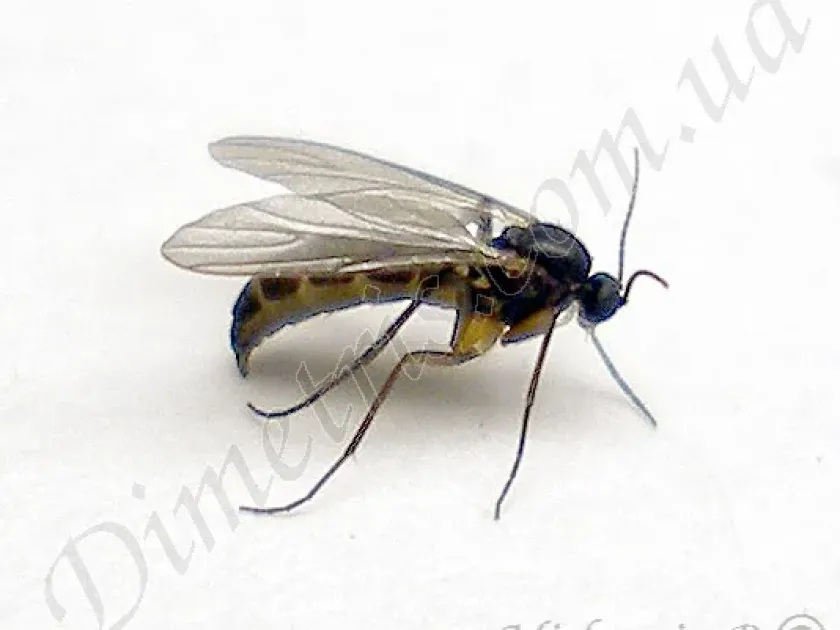
Plastosciara is a genus of insects within the Sciaridae family, commonly known as fungus gnats. These are small, dark-colored dipterans, typically measuring 2 to 4 mm in length, often found in damp environments.
The larvae of Plastosciara are legless, worm-like, and possess a translucent body with a distinct, shiny black head capsule. This morphological feature is a key identification mark for distinguishing them from other soil-dwelling larvae.
Adult gnats are characterized by their fragile appearance and weak flight patterns. They are frequently observed hovering near the soil surface, damp peat, or light sources, particularly in greenhouse environments.
Identification of the specific genus Plastosciara is often complex due to the morphological similarities among various fungus gnat species. Entomological identification usually relies on the dissection and analysis of adult genital structures.
The life cycle of these insects is highly dependent on environmental conditions. High humidity levels and organic-rich substrates provide the perfect conditions for rapid reproduction and larval development throughout the year.
What it damages
While adult gnats are relatively harmless, the larvae are destructive pests. They feed primarily on decaying organic matter but readily attack the delicate root systems of young seedlings and greenhouse plants when organic food sources are limited.
Seedlings affected by Plastosciara larvae often show stunted growth, yellowing foliage, and sudden wilting. Severe infestations can result in the complete destruction of the root system, causing the plant to collapse and die rapidly.
In mushroom cultivation, Plastosciara is a major concern. The larvae tunnel into the stalks and caps of growing mushrooms, which renders the produce unmarketable and introduces secondary bacterial infections that cause rot.
These insects also act as vectors for various plant pathogens. By moving through the soil and between plants, they spread spores of fungi such as Pythium and Fusarium, causing severe disease outbreaks in crops.
The economic impact of Plastosciara is significant in nurseries and commercial greenhouses, where a single infestation can compromise an entire batch of propagation material or a whole crop cycle of mushrooms.
When it appears
Plastosciara is a perennial pest in indoor cultivation settings. Because greenhouses and indoor spaces provide stable, warm, and humid conditions, these insects do not undergo seasonal dormancy and can breed year-round.
The most active period for population growth coincides with the intensive cultivation of seedlings during spring and autumn. High moisture levels in soil trays during these times accelerate the development of the larvae.
In outdoor conditions, adult gnats are active from late spring through early autumn. They are frequently introduced into controlled environments via infested potting soils, compost, or contaminated plant material brought from outdoors.
Excessive irrigation and poor drainage systems in greenhouses are the primary drivers of localized outbreaks. Moist conditions are strictly required for the survival and pupation of these insects.
Under optimal temperature conditions (20–25°C), the generation cycle of the pest can be completed in approximately 3 to 4 weeks, leading to an exponential increase in population size in a short period.
Signs of infestation
The presence of adult fungus gnats flying in erratic patterns around the base of pots or above the soil surface is the most immediate indicator of an infestation. They are easily disturbed and quickly retreat back into the vegetation or soil.
Fine, translucent larvae can often be seen by slightly disturbing the top layer of the substrate. In high-density populations, larvae may also be visible on the undersides of leaves that touch moist soil.
Plants exhibiting unexplained yellowing or sudden decline in vigor often have root systems being attacked by larvae. Checking the roots will reveal missing root hairs, necrotic patches, or deep tunnels caused by larval feeding.
In mushroom production, small boreholes on the surface of stalks or caps are clear signs of infestation. These holes are usually surrounded by darkened, decaying tissue caused by the larvae's feeding and associated bacterial rot.
Monitoring using yellow sticky cards is an effective way to detect the presence of adults before the infestation becomes critical. A sudden increase in the number of trapped flies suggests an urgent need for control measures.
Control measures
The most important cultural control method is managing soil moisture. Allowing the surface of the growing medium to dry out thoroughly between waterings is effective at inhibiting egg-laying and larval survival.
Preventive measures include the sterilization of all potting mixes and substrates using steam or heat before use. This eliminates potential eggs and larvae that may be present in imported peat or compost.
For chemical and biological control, products containing Bacillus thuringiensis israelensis or parasitic nematodes (Steinernema feltiae) can be applied to the soil. These effectively target the larvae without harming the plants.
In severe cases, systemic insecticides approved for the specific crop may be used as a soil drench. Always follow the manufacturer’s instructions regarding application frequency and safety intervals to ensure crop safety.
Good sanitation practices, such as removing fallen leaves, dead plant material, and mushroom debris, are essential. Eliminating these breeding sites significantly reduces the pressure of the pest population within the facility.
Taxonomy
- Latin name
- Plastosciara
- Order
- Diptera (flies)
- Family
- Mycetophilidae
- EPPO code
- PLSRSP
Discussion
No discussions yet — be the first.