
Walnut twig beetle
Pityophthorus juglandis
Description
How to identify
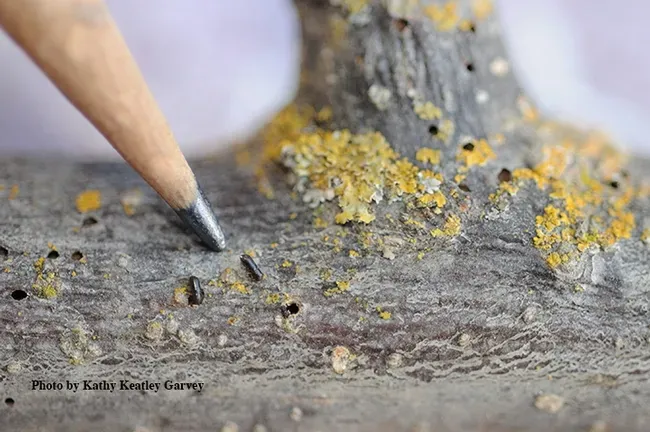
The walnut twig beetle (Pityophthorus juglandis) is a tiny bark beetle belonging to the Curculionidae family. These insects are exceptionally small, typically measuring between 1.5 and 2 millimeters in length.
Physically, they exhibit a cylindrical body shape with a dark brown or reddish-brown coloration, which helps them blend into the bark of their host trees.
The larvae are small, legless, and white with dark head capsules. They spend their entire development phase feeding within the cambium layer beneath the bark.
Adult beetles are highly mobile during the warm season, using their flight capabilities to locate suitable hosts and expand the population range.
This beetle is the primary vector for the fungus Geosmithia morbida, which is responsible for Thousand Cankers Disease, causing significant decline in walnut trees.
What it damages
The primary hosts of this beetle are species of the Juglans genus, most notably the black walnut (Juglans nigra) and the common walnut (Juglans regia).
Infestation typically starts on stressed trees, but as beetle populations grow, they are capable of successfully attacking and killing even healthy, mature trees.
The beetle drills galleries under the bark, which effectively disrupt the tree's vascular system, preventing the transport of water and nutrients to the branches.
Once the Geosmithia morbida fungus is introduced, it creates numerous small cankers in the bark, eventually causing severe dieback and total tree mortality.
Orchards face significant economic losses as infected trees lose their productive capacity and aesthetic value, often requiring complete removal to stop the spread.
When it appears
The life cycle is temperature-dependent. Activity begins in early spring, as temperatures consistently rise, triggering the emergence of overwintering adults.
The walnut twig beetle can complete multiple generations within a single growing season, leading to rapid population explosions under favorable conditions.
Peak flight and mating activity usually occur throughout the summer months, which is when the beetles are most active in dispersing to new hosts.
As autumn progresses, the beetles begin seeking protective shelter for overwintering, typically moving deep into the bark or tunnels within the branches.
Winter survival is high because the beetles and larvae remain insulated inside the wood, allowing them to withstand cold weather effectively until the next spring.
Signs of infestation
The initial signs of infestation are tiny entry holes in the bark of twigs and smaller branches, often difficult to spot without close inspection.
The presence of fine, sawdust-like frass on the bark surface or accumulating in branch crotches indicates that the beetles are actively excavating their galleries.
The most visible symptom is progressive branch dieback, starting from the tips and moving inward, resulting in yellowing and wilting leaves.
Small, dark-colored cankers may develop on the surface of the bark, which serve as localized spots of fungal infection caused by the vectoring of Geosmithia morbida.
Peeling back the bark in symptomatic areas reveals a chaotic network of larval galleries that crisscross the cambium, directly leading to the death of the tissue.
Control measures
The most effective strategy involves strict sanitation, which requires the removal and destruction of infested branches or entire trees to reduce the local population.
Keeping trees healthy through proper watering and fertilization practices is essential, as trees under stress are significantly more attractive to beetle attacks.
Chemical control can be challenging, as the beetles are protected by the bark for most of their lives, limiting the efficacy of traditional systemic insecticides.
- Prune and burn infested wood to destroy breeding sites.
- Implement pheromone-based monitoring to track population dynamics.
- Apply contact insecticides during the known flight periods of adult beetles.
Regulatory quarantine and avoiding the movement of untreated walnut wood are vital to prevent the long-distance spread of this destructive pest to new regions.
Taxonomy
- Latin name
- Pityophthorus juglandis
- Order
- Coleoptera (beetles)
- Family
- Curculionidae
- EPPO code
- PITOJU
Discussion
No discussions yet — be the first.