
Jagged ambush bug
Phymata crassipes
Description
How to identify
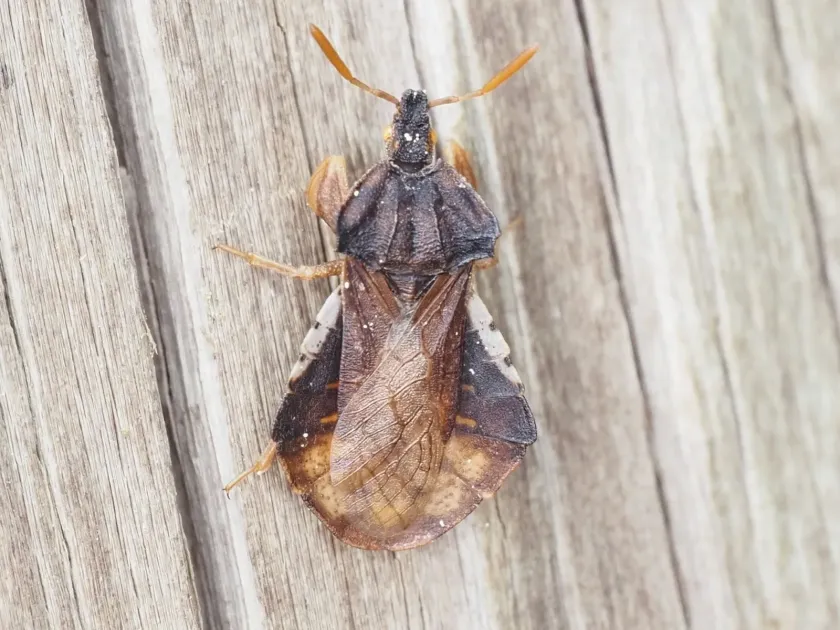
The jagged ambush bug (Phymata crassipes) is a member of the Phymatidae family, easily recognizable by its robust, raptorial forelegs that resemble crab claws, used for grasping prey.
Adult insects are typically 8–12 mm long, featuring cryptic coloration—often brownish, yellow, or green—which provides excellent camouflage among flowers and foliage.
The head possesses distinctive lateral projections, and the antennae are four-segmented, with the terminal segment often appearing thickened or club-shaped.
Unlike many other insects, the ambush bug is a sit-and-wait predator, remaining perfectly still for long periods to minimize detection by passing insects.
Due to their unique morphology and behavior, they are highly specialized hunters within the grassland and garden ecosystems.
What it damages
While primarily a predator of various pests like aphids, flies, and small beetles, the jagged ambush bug can inadvertently impact gardens by preying on pollinators.
Their predatory nature means they do not feed on plant sap or tissue; therefore, they cause no direct physiological damage to the host plants they inhabit.
The primary concern for farmers is the potential reduction of honeybee and hoverfly populations, which are essential for crop fruit set and pollination.
In high-density environments, their presence may suppress other beneficial insects, potentially leading to an imbalance in natural pest control dynamics.
However, in most cases, the positive effect of keeping smaller pest populations in check outweighs the occasional loss of pollinators.
When it appears
The lifecycle of the jagged ambush bug is closely synchronized with the flowering period of various plant species, typically occurring from late spring through early autumn.
They overwinter as adults, finding shelter in leaf litter, bark crevices, or dry grassy areas, and emerge as soon as temperatures become consistently favorable.
Mid-summer represents the peak of their activity, as this is when their food source (pollinating insects) is most abundant in the fields and gardens.
The nymphs go through several molting stages, growing gradually while maintaining the same predatory habit as their adult counterparts.
By late autumn, their activity decreases significantly as they seek hibernation sites to survive the cold months.
Signs of infestation
Ambush bug presence is usually detected by carefully inspecting flower heads where these insects wait for prey to land.
A common sign of their activity is the discovery of empty, shriveled exoskeletons of small insects left behind on the petals after being drained of their fluids.
If you approach a plant, look for motionless, strangely shaped figures attached to the center of flowers, which rarely move unless directly disturbed.
The use of sweep nets in meadows or near field edges is the most reliable way to confirm their presence if you suspect a large population.
Since they cause no foliage damage, you will not find yellowing leaves, necrotic spots, or wilting associated with their presence.
Control measures
Control is rarely necessary for the jagged ambush bug, as they are considered beneficial predators that help manage smaller pest outbreaks.
If their population reaches a level that disrupts local pollinator services, prioritize mechanical control, such as gently removing them from flowers.
Avoid the use of broad-spectrum insecticides, which would eliminate these beneficial predators and potentially lead to secondary pest outbreaks.
Maintaining a high level of plant diversity in your garden encourages a balanced ecosystem where natural populations are kept in check.
- Avoid pesticide use during the primary flowering season.
- Promote habitat diversity to sustain balanced predator populations.
- Conduct visual monitoring rather than relying on chemical intervention.
Taxonomy
- Latin name
- Phymata crassipes
- Order
- Hemiptera (bugs, aphids, leafhoppers)
- Family
- Phymatidae
- EPPO code
- PYMACR
Discussion
No discussions yet — be the first.