
Ambush bug
Phymata
Description
How to identify
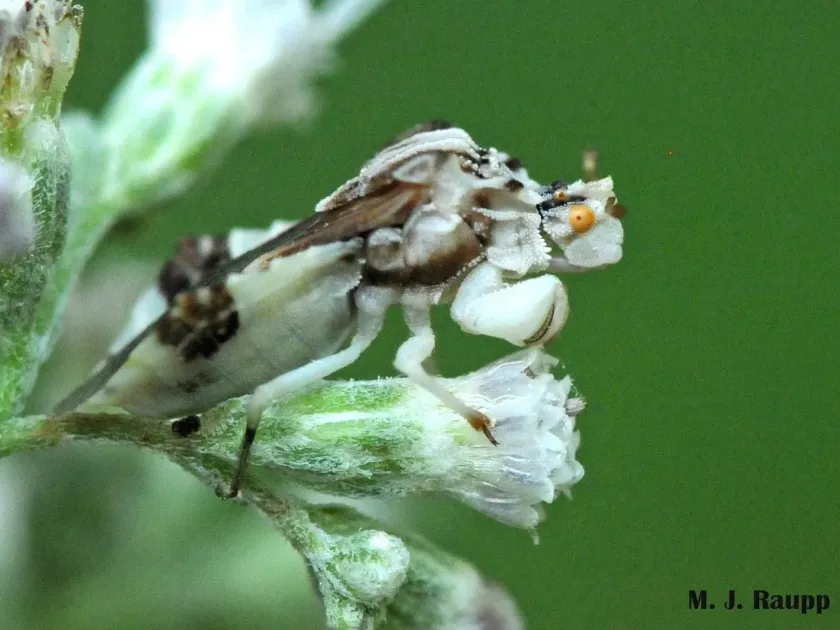
The ambush bug, scientifically known as Phymata, belongs to the Reduviidae family. These insects are easily recognized by their highly specialized front legs, which are thickened and resemble the raptorial forelegs of a praying mantis.
Adults typically measure between 6 and 12 millimeters in length. Their coloration is remarkably adaptive, ranging from yellow and green to brownish tones, allowing them to blend perfectly with the flowers where they hunt.
The head is elongated with a stout, curved rostrum (proboscis). When not hunting, the rostrum is tucked beneath the thorax, but it is extended rapidly to pierce prey when an unsuspecting insect lands within reach.
Taxonomically, they are members of the order Hemiptera. Unlike many of their relatives, they are strictly predatory and do not feed on plant tissues, making them neutral or even beneficial in some agricultural contexts.
The nymphs go through several molting stages, appearing as smaller, wingless versions of the adults. They exhibit hunting behaviors from an early stage, preying on tiny insects that inhabit the flower heads.
What it damages
Ambush bugs do not cause mechanical damage to plants. They are not pests that feed on foliage, stems, or fruits, and therefore do not require control for the sake of plant health.
Their primary "negative" impact in an agricultural setting is the predation of beneficial insects. Since they wait on flowers, they often catch pollinators like bees, hoverflies, and butterflies, which can reduce pollination efficiency.
While this impact is localized, it can be a concern in commercial orchards where high pollination rates are essential. However, the density of Phymata is rarely high enough to cause a significant loss in crop yield.
Conversely, their predatory nature makes them efficient controllers of other minor pests, such as aphids or small flies, that may land on flower clusters, providing a form of natural biological control.
In home gardens, their presence is often viewed as a natural balance of the ecosystem rather than an infestation, as they help regulate the population of various small insects.
When it appears
The life cycle of the Phymata is synchronized with the flowering season of various plants. Adults emerge in late spring or early summer, depending on local climate conditions and temperature.
Peak activity occurs during mid-summer, when the diversity and abundance of flowering plants provide ample hunting grounds for the bugs. This is when they are most easily observed on goldenrod, yarrow, and various orchard blossoms.
Reproduction typically takes place during the summer. Females lay eggs on plant stems or in crevices, providing a secure place for the next generation to develop through the autumn months.
They overwinter as eggs or sometimes as adults, finding shelter in leaf litter or under the bark of trees. This strategy ensures their survival through cold periods and allows for rapid re-emergence in the spring.
The timing of their appearance can fluctuate year to year based on the total degree days, which dictates the rate of their development from egg to adult.
Signs of infestation
The most common sign of an ambush bug's presence is simply spotting the insect camouflaged within a flower head. They often remain perfectly still for long periods, waiting for prey.
Another indicator is the discovery of empty insect husks left on the flower petals. When the bug finishes feeding, it often leaves the dried-out remains of its prey on the flower, which can be spotted by keen observers.
Since they do not cause wilting, leaf chlorosis, or necrotic spots, any damage found on the plant should be attributed to other pests, not the ambush bug.
Their behavior of remaining stationary while holding onto a flower bud is a distinct identification marker. They show very little fear of movement nearby until approached very closely.
In some cases, the presence of these bugs can be detected by the distinct scent they release when disturbed, which is characteristic of many predatory hemipterans.
Control measures
Management of ambush bugs is rarely necessary. Since they are not pests of crops, no chemical control program is recommended, as broad-spectrum insecticides would be detrimental to pollinators.
If you find that their presence is interfering with pollination in a specific area, manual removal is the most effective and safest method. Simply pick them off the flowers during the cool morning hours.
Cultural practices, such as maintaining weed-free borders around the field or garden, can reduce the number of potential hiding spots and landing sites for these predators.
Encouraging natural enemies, such as insectivorous birds, can help keep their populations in check without the use of toxic chemicals that could harm the ecosystem.
In large-scale operations, monitoring pollination levels is more critical than monitoring for ambush bugs. If pollination rates are sufficient, their presence should be considered a normal part of the local biodiversity.
Taxonomy
- Latin name
- Phymata
- Order
- Hemiptera (bugs, aphids, leafhoppers)
- Family
- Phymatidae
- EPPO code
- PYMASP
Discussion
No discussions yet — be the first.