
Olive bark beetle
Phloeotribus puncticollis
Description
How to identify
The Olive bark beetle (Phloeotribus puncticollis) is a small beetle belonging to the weevil family, specifically the subfamily Scolytinae (bark beetles). Adults typically measure about 2–2.5 mm in length and have a cylindrical, dark brown to black body.
The beetle's body surface is covered in small pits, which is the source of its specific epithet puncticollis. The head is usually retracted under the pronotum, a common diagnostic feature for this group.
The larvae are legless, white or cream-colored with a distinct dark head capsule. They develop within the inner bark or wood of thin twigs, creating specialized galleries.
This pest is a highly specialized inhabitant of olive groves, demonstrating strong adaptation to Mediterranean climatic conditions.
Adult beetles are capable of sustained flight, allowing them to disperse quickly across orchards in search of suitable trees for feeding and reproduction.
What it damages
The primary host for this pest is the European olive (Olea europaea). Occasionally, it may attack other Oleaceae species such as ash or privet if they are present in the immediate vicinity.
Adult beetles cause damage by boring into young shoots and fruit-bearing twigs. They typically attack the base of leaf petioles or buds, leading to the weakening and eventual death of the affected parts.
Larvae develop beneath the bark of weakened or diseased branches. Massive infestation can disrupt sap flow, leading to the death of entire skeletal branches of the tree.
Significant damage occurs in young nursery trees, where infestation of the main trunk or primary branches can result in the total loss of the plant's productivity.
High population densities can cause premature leaf drop and reduce the tree's overall immune system, making it susceptible to secondary pathogens.
When it appears
The Olive bark beetle has several generations per year, depending on the regional temperature regime. Under favorable conditions, development can occur almost continuously throughout the warmer months.
Active adult flight is typically observed during the spring (March-May), when adults migrate from overwintering sites to young olive twigs for supplemental feeding.
During the summer months, adults lay eggs in specially prepared maternal galleries. Larvae feed and develop within the wood throughout the warm season.
In autumn, the next generation emerges, causing further damage to shoots before migrating to overwinter under the bark of older branches or within the soil.
Temperature fluctuations significantly impact population dynamics; mild winters favor the survival of a larger number of individuals, increasing the risk of spring outbreaks.
Signs of infestation
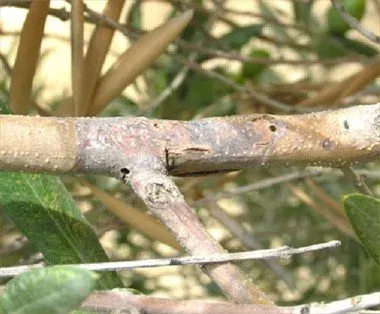
The first visible sign of infestation is the presence of small entry holes, often accompanied by "boring dust" (frass), on the surface of young branches and shoots.
Wilting and yellowing of leaves at the tips of shoots often indicate that the beetle has bored into the petiole base or bud, disrupting nutrient transport.
Inspection of branches often reveals a characteristic network of galleries if the bark is carefully peeled away. Maternal galleries are usually oriented perpendicular to the branch axis.
Reduced crop yields and the dieback of fruit-bearing twigs are indirect signs of high pest activity within the tree canopy.
The presence of numerous dry, brittle branches in the olive canopy requires a thorough inspection to detect the presence of beetle larvae.
Control measures
The most critical control method is cultural: regular sanitary pruning and the timely removal of infested, dried branches where beetles overwinter.
Pruned branches must not be left in the orchard; they should be burned or disposed of immediately to prevent the emergence of new insect generations.
Biological control may include the use of natural predators and parasitoids, which help limit bark beetle population levels in natural ecosystems.
Chemical protection can be applied during the peak flight periods using authorized contact or stomach-action insecticides, although efficacy is often limited by the pest's hidden lifestyle.
- Regular monitoring of tree health using pheromone traps.
- Ensuring optimal orchard management to maintain overall tree vigor.
- Application of high-quality fertilizers to stimulate shoot regrowth following pest damage.
Taxonomy
- Latin name
- Phloeotribus puncticollis
- Order
- Coleoptera (beetles)
- Family
- Curculionidae
- EPPO code
- PHLBPU
Discussion
No discussions yet — be the first.