
Resplendent quetzal
Pharomachrus mocinno
Description
How to identify
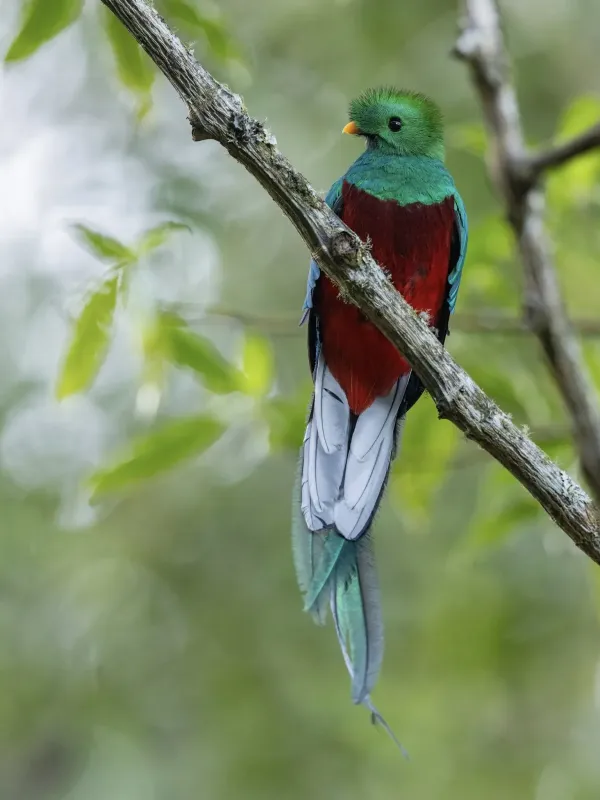
The Resplendent quetzal (Pharomachrus mocinno) is a stunning bird belonging to the Trogonidae family. Males are famous for their iridescent green plumage and elongated tail feathers that create a spectacular appearance in flight.
This species inhabits the cloud forests of Central America, ranging from Mexico to Panama. They prefer high-altitude environments where the air is moist and the vegetation is lush, providing both food and nesting sites.
The birds are characterized by their small, strong beaks, suitable for plucking fruits. Their feet, adapted for grasping branches, allow them to perch vertically or horizontally while searching for food in the canopy.
Systematically, they are classified under the order Trogoniformes. They exhibit distinct sexual dimorphism, with females lacking the dramatic tail streamers of the males and possessing more subdued brown and gray tones.
Resplendent quetzals are relatively sedentary birds, although they may perform seasonal migrations within their range in search of specific fruiting trees, particularly members of the Lauraceae family.
What it damages
The Resplendent quetzal is not an agricultural pest. It poses no threat to crops, orchards, or plantations, as it subsists exclusively on forest fruits and occasionally small insects or amphibians.
Its dietary habits are highly specialized towards wild laurel fruits. As these trees do not constitute agricultural commodities, the bird's feeding behavior is completely decoupled from human food production systems.
Agricultural monitoring programs do not include the quetzal as a damaging agent. Its ecological niche is strictly confined to preserved high-altitude forests where human intervention is minimal.
The presence of this bird is often viewed as a positive indicator of ecological integrity, as it requires large areas of intact forest to thrive and reproduce effectively.
Instead of requiring protection measures against it, the species itself requires protection from habitat loss and deforestation to prevent a decline in its population numbers.
Taxonomy
- Latin name
- Pharomachrus mocinno
- Family
- Trogonidae
- EPPO code
- PHMHMO
Discussion
No discussions yet — be the first.