
Phacopteron lentiginosum
Phacopteron lentiginosum
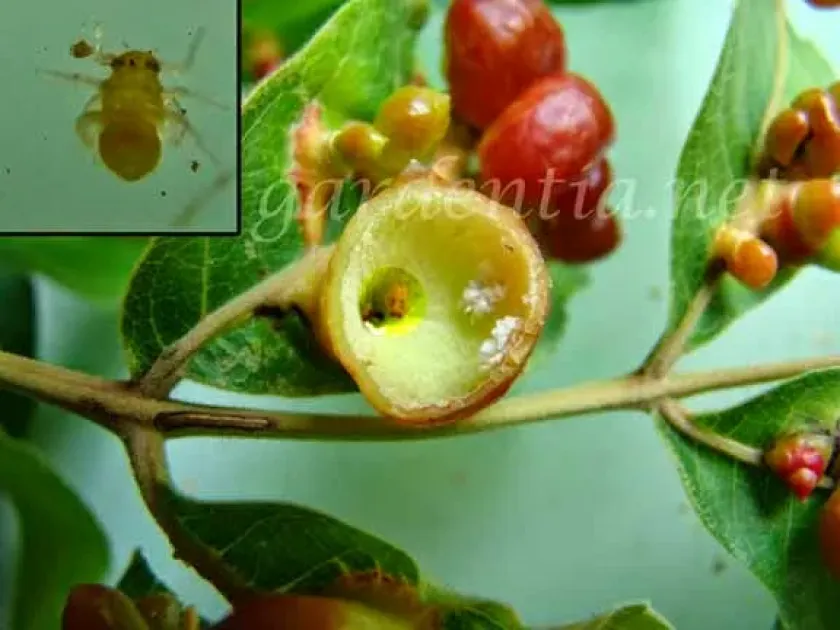
Description
How to identify
Phacopteron lentiginosum is a psyllid species belonging to the order Hemiptera, family Psyllidae. This small insect is closely associated with the lifecycle of specific woody plant species.
Adults exhibit typical psyllid morphology with well-developed jumping legs and transparent wings held roof-like over the body. Their coloration is often cryptic, helping them blend into the bark or foliage of the host plant.
The larvae go through several developmental stages, gradually acquiring the characteristics of adults. They are generally sedentary and are often found hidden inside the specific structures they induce on the host plant.
The species is highly specialized, meaning its distribution is strictly limited by the presence of its specific host plants. Field identification usually requires microscopic examination of the male genitalia.
Systematically, this species is an important subject for entomological studies, particularly regarding the complex mechanisms of gall formation induced by these insects.
What it damages
The primary hosts for Phacopteron lentiginosum are members of the Anacardiaceae family, specifically trees within the genus Garuga (e.g., Garuga pinnata).
The pest does not feed on the plant in the conventional way but stimulates the plant tissue to undergo pathological growth. This results in the formation of specific galls that serve as the larval feeding habitat.
Damage occurs on the leaf blades, where multiple outgrowths form. This disrupts normal photosynthesis and generally weakens the affected plant.
In cases of heavy infestation, the tree can lose a significant portion of its photosynthetic area, which negatively impacts annual growth and overall environmental resilience.
The economic impact involves the potential reduction in the vigor of nursery stock or ornamental trees, where plant health and aesthetics are prioritized.
When it appears
The lifecycle of Phacopteron lentiginosum is tightly synchronized with the phenology of the host plant. Adults become active during the emergence of new leaves and buds.
Eggs are deposited directly onto young plant tissues. Soon after hatching, the larvae begin feeding, which triggers the initiation of gall formation.
Multiple generations may occur throughout the season, with the most noticeable symptoms appearing during periods of intense spring and summer growth.
Overwintering typically occurs in the adult stage, usually in bark crevices or other sheltered areas on the plant or in the leaf litter nearby.
Depending on regional climatic conditions, the timing of pest emergence can vary significantly based on the onset of spring warmth.
Signs of infestation
The most prominent sign of infestation is the presence of characteristic galls, which appear as swellings or abnormal outgrowths on the leaf blades. The shape is highly specific to the psyllid species.
- Development of chlorotic spots at the site of feeding punctures.
- Curling and severe deformation of young leaves.
- Internal chambers within the galls containing larvae.
- Premature dropping of heavily infested foliage.
- Decline in the overall aesthetic appeal and vigor of the tree.
Confirming the presence of this specific species requires opening the gall and inspecting the larvae at the appropriate developmental stage.
Control measures
Controlling psyllids is challenging because the larvae are protected inside the gall tissue, making topical contact insecticides largely ineffective.
The preferred method of control is the use of systemic insecticides that are absorbed by the plant and translocated to the tissues where larvae are feeding.
Good agricultural practices are vital: timely pruning and proper disposal of heavily infested shoots help reduce the population for the following season.
In forest and park management, encouraging natural enemies such as predatory bugs, lady beetles, and parasitic wasps is a sustainable long-term strategy.
Monitoring adult populations with yellow sticky traps after the winter dormancy period helps determine the optimal window for targeted protection measures.
Taxonomy
- Latin name
- Phacopteron lentiginosum
- Order
- Hemiptera (bugs, aphids, leafhoppers)
- Family
- Phacopteronidae
- EPPO code
- PHCPLE
Discussion
No discussions yet — be the first.