
Pergamasus longicornis
Pergamasus longicornis
Description
How to identify
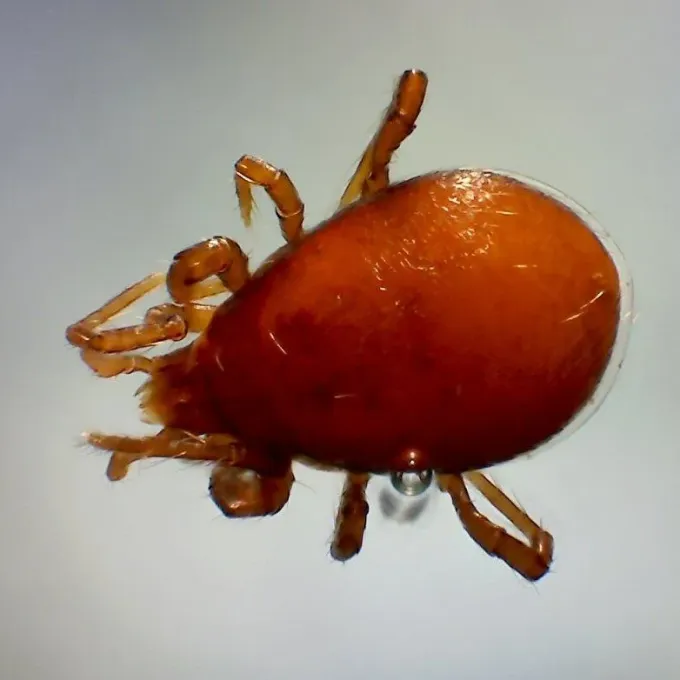
Pergamasus longicornis belongs to the order Mesostigmata and the family Parasitidae. These are soil-dwelling predatory mites with a characteristic brown, sclerotized body and long legs, typical for the family.
The adult stage is equipped with specialized chelicerae adapted for catching and holding small prey within the soil matrix. They possess long sensory setae that help them navigate in dark, humid environments.
Their life cycle includes the egg, larva, protonymph, deutonymph, and adult stages. All developmental stages occur primarily in the top layer of the soil or organic debris.
These mites are essentially nocturnal and avoid direct sunlight. They are highly active in the presence of moisture and thrive in environments rich in decomposing organic matter.
While often categorized as predators of small invertebrates, they are adaptable organisms whose population density can fluctuate significantly depending on the local ecosystem balance.
What it damages
Primarily feeding on collembolans and sciarid larvae, Pergamasus longicornis can become a problem in greenhouses when natural prey is scarce or their population density explodes.
In such cases, they may switch to feeding on young plant roots and root hairs, leading to stunted growth, wilting, and overall weakness of vegetable seedlings.
Root damage serves as an entry point for various soil-borne pathogens, including fungi and bacteria, which can cause severe root rot infections in sensitive crops.
Mass infestations are typically observed in organic-rich substrates that are kept constantly wet, providing an ideal habitat and feeding ground for the mites.
Furthermore, their constant movement across the substrate aids in the spreading of fungal spores, potentially worsening disease outbreaks throughout the nursery.
When it appears
The activity of these mites is strictly temperature and moisture-dependent. The optimal conditions for their reproduction range from +15°C to +22°C.
In greenhouse settings, they can remain active and reproduce throughout the year, provided that the substrate moisture and food source are consistently available.
In open fields, population peaks are usually recorded during the spring and autumn months, characterized by moderate temperatures and sufficient soil moisture.
Winter survival is achieved by moving to deeper soil layers or nesting within dense plant debris, which protects the mites from freezing temperatures.
Rapid population turnover allows the species to recover quickly from unfavorable weather conditions, especially in protected or temperate climates.
Signs of infestation
A primary indicator of a high population is the inexplicable failure of seed germination or the sudden death of young seedlings without visible foliar damage.
Microscopic inspection of the root system often reveals small necrotic lesions, which are characteristic signs of mite feeding on tender root tissues.
Direct observation is possible after heavy watering, as the mites tend to surface due to the temporary saturation of the substrate pores.
Persistent issues with root rot, despite standard fungicidal treatments, may indicate that soil mites are the underlying vector or cause of the plant stress.
The use of soil baits, such as damp organic material, is an effective way to trap and identify the presence of these mites within a cultivation area.
Control measures
The most important control measure is managing soil moisture. Avoiding over-irrigation prevents the creation of the damp environment these mites require for rapid development.
Thermal treatment (steaming) of soil or substrates before planting is the most reliable method for eradicating overwintering populations and eggs.
Biological control using entomopathogenic fungi, such as Beauveria bassiana, is effective at reducing population levels without harming the crop.
- Ensure proper drainage in pots and greenhouse beds.
- Remove excess plant debris and organic waste.
- Implement strict sanitation protocols for greenhouse equipment.
Chemical intervention should be a last resort, as broad-spectrum acaricides can destroy beneficial soil fauna and disrupt the natural balance of the ecosystem.
Taxonomy
- Latin name
- Pergamasus longicornis
- Order
- Mites
- Family
- Parasitidae
- EPPO code
- PERULO
Discussion
No discussions yet — be the first.