
Eugamasus mites
Eugamasus
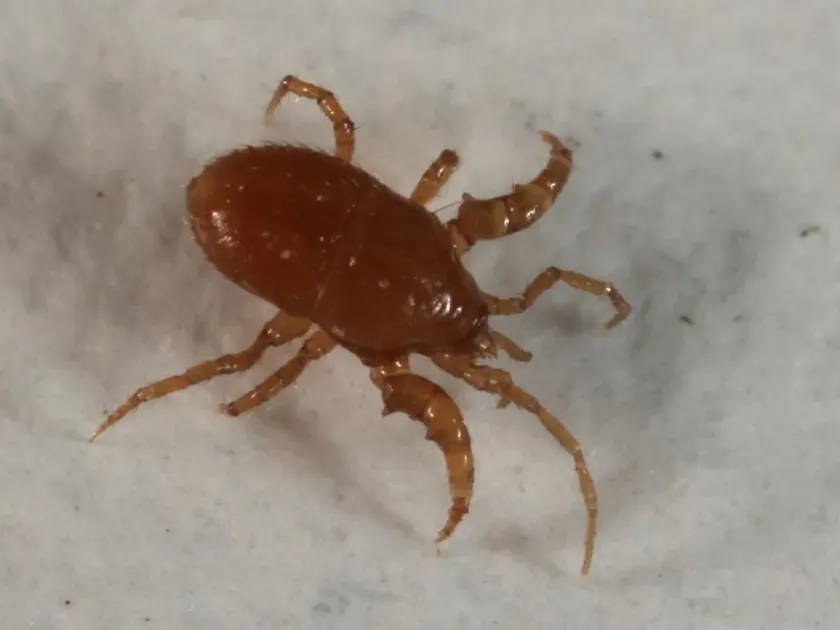
Description
How to identify
Eugamasus mites belong to the Parasitidae family within the order Parasitiformes. These are primarily free-living, predatory soil-dwelling mites that thrive in habitats rich in organic matter, such as manure, leaf litter, and moist soil environments.
They are characterized by an oval, flattened body shape and relatively long, agile legs that allow them to move quickly through the substrate. Their color typically ranges from pale yellow to reddish-brown, depending on their maturity and feeding status.
As predators, they play a crucial role in the soil food web by feeding on smaller soil organisms, including nematodes, collembolans, and larvae of dipterous insects, contributing to soil ecosystem health.
Their life cycle includes eggs, larvae, and two nymphal stages before reaching adulthood. The rate of development is highly temperature and moisture-dependent, favoring humid environments typical of greenhouse production.
While they are not traditional agricultural pests, their presence in high densities often serves as a bio-indicator of poor soil management, specifically regarding excess moisture and accumulated organic decay.
What it damages
Eugamasus mites do not typically consume plant tissues directly. However, in conditions of extreme moisture saturation, their high population densities can cause mechanical irritation to the root collar of seedlings.
Feeding-related injuries are rare, but their high-frequency movement and aggregation around the base of plants can impede the roots' ability to absorb nutrients, resulting in stunting and reduced plant vigor.
The secondary effect of their massive presence involves the disruption of the soil microbiome, which can create a favorable environment for the proliferation of opportunistic plant pathogens and damping-off fungi.
In containerized crops or tray-grown seedlings, their population can explode if the soil medium remains perpetually wet, leading to an unsightly buildup of mites on the substrate surface.
Overall, they should be viewed as opportunistic organisms rather than obligate plant pests; however, their presence in significant numbers warrants a review of the irrigation and sanitation practices in the facility.
Signs of infestation
The primary sign of an Eugamasus infestation is the sudden appearance of numerous tiny, rapidly moving light-colored mites on the surface of potting soil or around the base of stems.
Observation through a hand lens reveals their agile, erratic movement on the surface of damp substrate, especially immediately after irrigation or misting events.
An increase in plant stress, visible as wilting or chlorosis of the lower foliage, combined with highly moist and organic-rich soil, is a strong indicator of high mite populations in the root zone.
Their activity is often concentrated in areas where the substrate surface is cool and damp, or where decaying organic debris is present, providing cover and food for the mite population.
Frequent emergence of mites from the soil to the surface during irrigation cycles acts as a visual warning signal for agronomists to evaluate the drainage and moisture content of the growing media.
Control measures
The most effective management strategy for Eugamasus mites is the optimization of irrigation schedules to ensure that the surface layer of the soil has sufficient time to dry out between watering.
Improving the drainage properties of the growing medium by adding perlite or other inorganic amendments reduces the humidity levels that these mites require for survival and reproduction.
Implementing rigorous sanitation practices, including the use of sterilized soil media and the removal of stagnant organic debris from greenhouse surfaces, effectively limits their development.
Mechanical cultivation or stirring of the topsoil layer between crop cycles promotes aeration and moisture evaporation, creating a less hospitable environment for mite colonization.
Chemical control is rarely recommended because it risks destroying beneficial soil fauna and is usually unnecessary if proper moisture and sanitation management are consistently applied throughout the growing season.
Taxonomy
- Latin name
- Eugamasus
- Order
- Mites
- Family
- Parasitidae
- EPPO code
- EUGASP
Discussion
No discussions yet — be the first.