
Pergamasus
Pergamasus
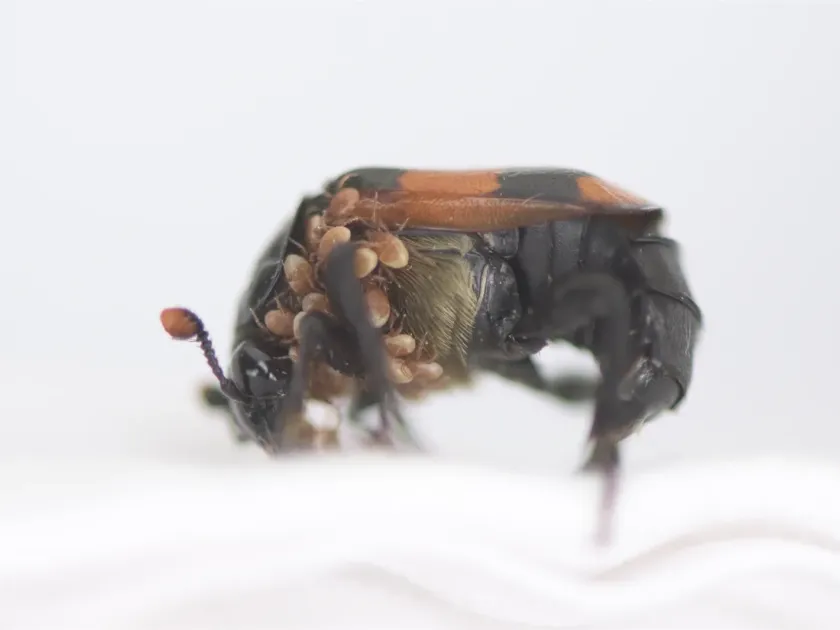
Description
How to identify
Pergamasus is a genus of predatory mites belonging to the family Parasitidae, order Mesostigmata. These organisms are predominantly soil-dwellers found in organic-rich substrates.
Adult mites are characterized by a yellowish-brown, elongated body and well-developed chelicerae adapted for hunting small soil invertebrates.
The life cycle encompasses egg, larva, protonymph, deutonymph, and adult stages. Development is highly sensitive to soil moisture and microhabitat stability.
Systematically, they are part of the soil microfauna, acting primarily as predators of nematodes and other small insects within the soil ecosystem.
Precise species identification requires expertise in acarology and the examination of reproductive structures under a microscope.
What it damages
Although Pergamasus mites are beneficial predators, they can become incidental pests in greenhouse conditions when their natural prey populations are exhausted.
In such cases, they may feed on young plant roots and delicate seedlings, causing structural damage that hinders plant development and uptake of nutrients.
This root damage facilitates secondary infections, allowing soil-borne pathogens such as fungi and bacteria to enter the plant tissue.
The economic impact is generally low, except in high-density greenhouse production where substrate conditions might favor unnatural mite behavior.
In outdoor field conditions, their impact on crops is negligible as they prefer to hunt their usual prey rather than feed on plant tissues.
When it appears
Pergamasus mites are most active during periods of high humidity and moderate temperatures, typically during spring and autumn cycles.
In greenhouses, where environments are controlled, they can maintain activity throughout the year if moisture levels in the growing media remain constant.
Drought is the primary limiting factor for their population growth, as they require moisture to survive and navigate through soil pores.
Increased population numbers are often observed following the heavy application of organic fertilizers, which supports a large prey population.
Adult mites overwinter in the deeper soil layers, where temperatures remain stable even during colder months, ensuring the survival of the species.
Signs of infestation
Infestation signs often manifest as stunted growth in seedlings without any visible symptoms on the aerial parts of the plants.
Close inspection of the potting soil with a magnifying lens may reveal small, fast-moving brown mites on the surface near the stem base.
Root system damage, such as necrotic tips or brown patches, is a common indicator, often misidentified as early stages of root rot disease.
High moisture areas, such as the edge of pots or irrigation lines, frequently show increased mite activity where condensation collects.
Unlike common spider mites, Pergamasus does not produce silk webbing and does not feed on leaf tissues, which helps in accurate diagnosis.
Control measures
The most effective management strategy involves adjusting irrigation practices to avoid waterlogged soil, making the habitat less suitable for the mites.
Sterilization of the growth medium before planting is a highly effective way to eliminate the mite population in containerized crop systems.
Biological controls, including the use of entomopathogenic fungi, can effectively reduce mite numbers without impacting plant health or safety.
- Maintain proper soil moisture levels to deter mite proliferation.
- Use heat-treated or sterile substrate mixtures.
- Ensure greenhouse sanitation by removing decaying organic debris.
- Monitor seedlings regularly for signs of stunted development.
Broad-spectrum insecticides are generally discouraged as they disrupt the beneficial soil ecosystem and may exacerbate other pest problems.
Taxonomy
- Latin name
- Pergamasus
- Order
- Mites
- Family
- Parasitidae
- EPPO code
- PERUSP
Discussion
No discussions yet — be the first.