
Rusty-margined guan
Penelope superciliaris
Description
How to identify
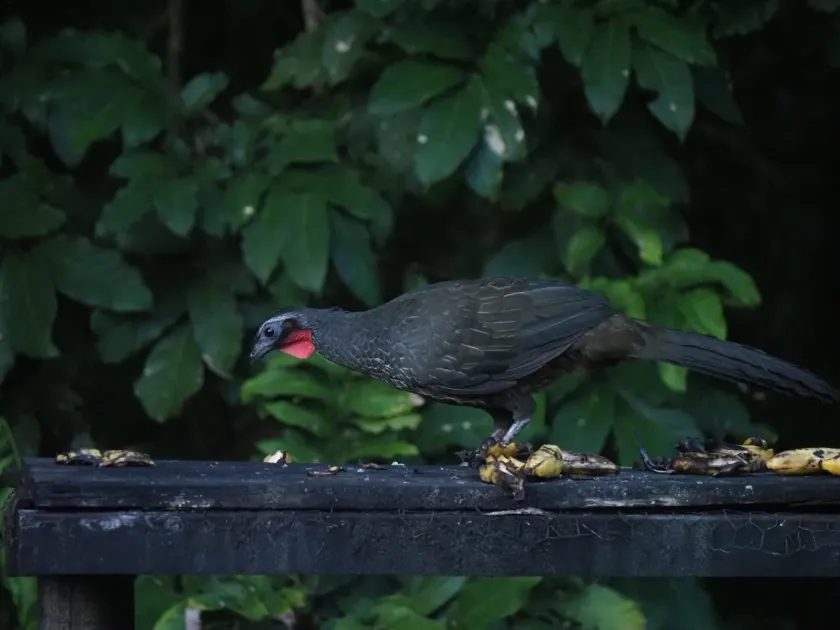
The rusty-margined guan is a bird species from the Cracidae family, naturally inhabiting forests and shrublands throughout South America.
Physically, it resembles a small turkey with a long tail, reaching approximately 65 centimeters in length, making it a visible presence on agricultural lands.
The plumage is primarily brown, distinguished by the characteristic rusty-red feathers along the flanks and rump, which gives the species its name.
These birds are highly adaptive, frequently moving from forest interiors to the fringes of farmlands and orchard areas in search of food.
As a member of the Galliformes order, they typically display social, group-oriented behavior, which increases the impact of their foraging on crops.
What it damages
Rusty-margined guans cause significant damage to fruit orchards by consuming ripe berries, various fruits, and tender buds on trees.
They represent a serious threat to coffee plantations, as they actively feed on coffee cherries, leading to substantial losses before harvest.
Additionally, they impact cereal crops by trampling plants and pecking at seeds during the milk stage or immediately after sowing.
In small-scale gardening, these birds can wipe out vegetable patches, feeding on young seedlings and developing produce alike.
Mechanical damage is also significant, as the weight of the birds often leads to broken branches, reducing the overall yield potential of the trees.
When it appears
Bird activity peaks during the ripening season of crops, when guans migrate from forests to accessible food sources in large numbers.
During drought periods, when natural forest food resources are scarce, guans become more dependent on irrigated farmlands and orchards.
While present throughout the year, the highest frequency of agricultural incursions aligns with the active fruiting phases of plantations.
The birds are most active during early morning and late afternoon, requiring farmers to increase monitoring during these times.
The breeding season also intensifies their foraging needs, driving groups to range further across agricultural plots to feed their offspring.
Signs of infestation
The most common sign of a guan presence is the discovery of partially eaten fruit featuring distinctive indentations from their powerful beaks.
Substantial amounts of droppings and molted feathers found under trees indicate where flocks have been feeding for extended periods.
Broken tips on young saplings or fruit-bearing branches act as a clear indicator of heavy birds having perched and fed on the plant.
Characteristic loud vocalizations made by the flock while feeding often serve as an early warning for nearby farm workers.
Footprints left in soft soil near the base of damaged plants further confirm the identity of the pest responsible for the crop damage.
Control measures
Visual deterrents, such as reflective tapes or predator decoys installed in tree canopies, are effective in discouraging bird visits.
Acoustic deterrent systems that broadcast predator calls or alarm signals can significantly reduce the attractiveness of the farm area.
Covering high-value crops with fine-mesh protective netting provides the most reliable barrier against physical access by the birds.
Maintaining a clean perimeter around fields, free from debris and excess vegetation, helps minimize favorable conditions for bird congregation.
- Regular inspection of orchards during the fruit-ripening phase.
- Use of bio-acoustic repulsion systems.
- Installation of scarecrows and motion-activated devices to deter flocks.
Taxonomy
- Latin name
- Penelope superciliaris
- Family
- Cracidae
- EPPO code
- PENESU
Discussion
No discussions yet — be the first.