
Great curassow
Crax rubra
Description
How to identify
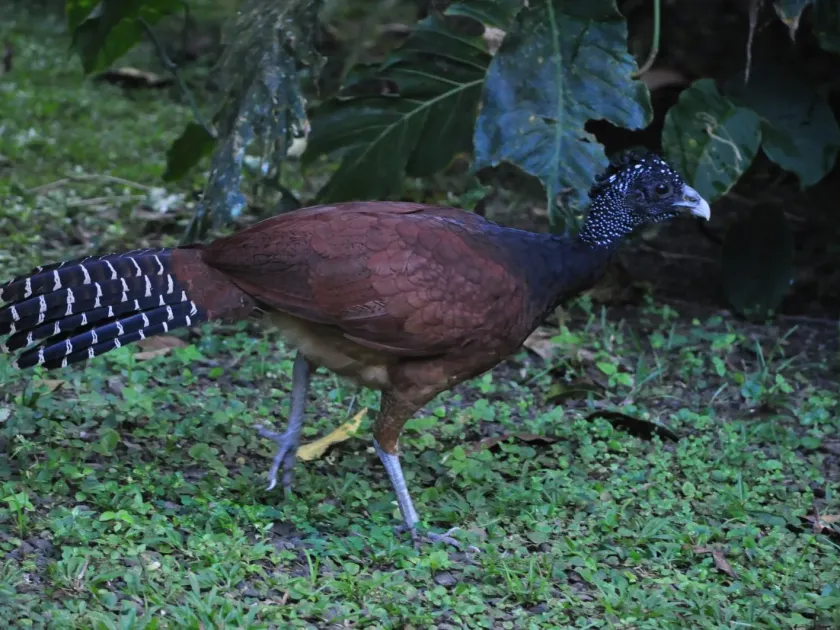
The Great curassow (Crax rubra) is a large, terrestrial bird species belonging to the Cracidae family within the Galliformes order. These birds are characterized by their substantial size, often weighing up to 4.5 kilograms, and a distinctive curly crest of feathers on their heads.
Males possess a striking glossy black plumage and a prominent yellow knob on their bills, making them visually distinct. Females, while similar in build, often exhibit more subdued, brownish or barred plumage, which serves as an effective camouflage within the dense forest floor.
Native to the tropical rainforests of Central and South America, these birds typically reside in forested areas. However, as agricultural land encroaches on their natural habitat, they often adapt by foraging on plantations located near forest edges.
Biologically, the Great curassow is well-adapted to both terrestrial movement and life in the lower forest canopy. This versatility enables them to exploit various food sources, making them opportunistic visitors to agricultural environments.
They are generally social birds, often seen in pairs or small groups. This group behavior is a key factor in their potential to cause rapid and noticeable damage to crops, especially during the early stages of plant growth or near the harvest period.
What it damages
The diet of the Great curassow consists of seeds, fruits, berries, and tender vegetation. When foraging in agricultural fields, they can be highly destructive, digging up seeds of corn, beans, and other crops shortly after they have been planted.
The consumption of seeds often results in poor stand establishment, forcing farmers to bear the additional costs of replanting. Furthermore, they are known to feed on young seedlings, which can lead to significant reductions in plant density across entire sections of a field.
Great curassows also cause damage to fruit trees and vegetable crops by pecking at fruits and buds. These injuries are not only destructive in themselves but also create entry points for secondary infections such as fungi, leading to further crop loss.
During the grain maturation phase, these birds can trample stalks and consume large quantities of grain. The mechanical damage caused by their heavy weight significantly impacts the yield quality and can lead to stalk lodging, complicating the harvesting process.
The level of damage is heavily dependent on the proximity of the farmland to preserved forest patches. Areas where natural food sources are scarce see a higher frequency of visits, resulting in a more pronounced impact on farm productivity.
When it appears
The period following planting is particularly critical, as seeds represent a high-energy food source. During this phase, curassows frequently visit newly sown fields, requiring diligent monitoring to prevent early-stage crop failure.
The second peak of damage occurs as crops reach maturation. As fruits and grains ripen, the birds move out of the forest to feed, attracted by the abundant and easily accessible nutrients present on the plantations.
Seasonality is also strongly influenced by local rainfall patterns and the availability of forest forage. Extended periods of drought often lead to increased pressure on agricultural lands as the birds search for supplemental food sources.
Reproductive cycles can also influence their nutritional needs. During the chick-rearing season, the demand for high-protein and high-energy food increases, which can lead to more frequent and intense foraging activity by adult birds on nearby fields.
Agrotechnical surveillance should be intensified in the weeks preceding harvest, as this is when the potential for large-scale economic losses due to bird predation is at its highest.
Signs of infestation
The most reliable sign of a Great curassow presence is the discovery of large, distinct footprints on moist soil in or around the fields. These tracks are significantly larger than those of most other birds and are hard to miss.
Evidence of foraging can often be found in the form of shallow holes or pits in the soil where seeds were planted. In these areas, discarded seed husks or partial remains of sprouts are common indicators of recent activity.
Damaged foliage and fruit show characteristic ragged edges caused by the bird's strong bill. Often, one can observe signs of pecking that lead to rapid desiccation or the onset of rot in the damaged produce.
The presence of droppings containing undigested seeds or plant material is a clear indicator that the birds have been utilizing the area for feeding. Finding these in clusters suggests a specific site is being used regularly.
Audible cues, such as the low-frequency booming calls characteristic of this species, are often heard at dawn or dusk. Recognizing these sounds allows farmers to confirm the presence of the birds in the vicinity before visual damage becomes obvious.
Control measures
Mechanical deterrents are highly effective against Great curassows. Devices such as propane-powered noise cannons, motion-activated ultrasonic sirens, and flashing reflective tapes can successfully deter them from entering fields.
Physical barriers, such as bird-proof netting, are the most reliable solution for protecting high-value crops like orchards or vegetable patches. While expensive to install, they provide near-total protection.
Applying chemical repellents or specialized coatings to seeds prior to planting can make the crop significantly less palatable to birds, reducing the likelihood of them uprooting young seedlings.
Managing the area around the field by clearing tall weeds and dense brush can eliminate natural hiding spots, making the environment less inviting for these cautious birds to remain near the crops.
- Deploying scarecrows or moving inflatable figures to create visual threats.
- Utilizing bioacoustic devices that broadcast the distress calls of the birds.
- Establishing buffer strips with less valuable forage to distract the flock.
Taxonomy
- Latin name
- Crax rubra
- Family
- Cracidae
- EPPO code
- CRAXRU
Discussion
No discussions yet — be the first.