
Pelagia noctiluca
Pelagia noctiluca
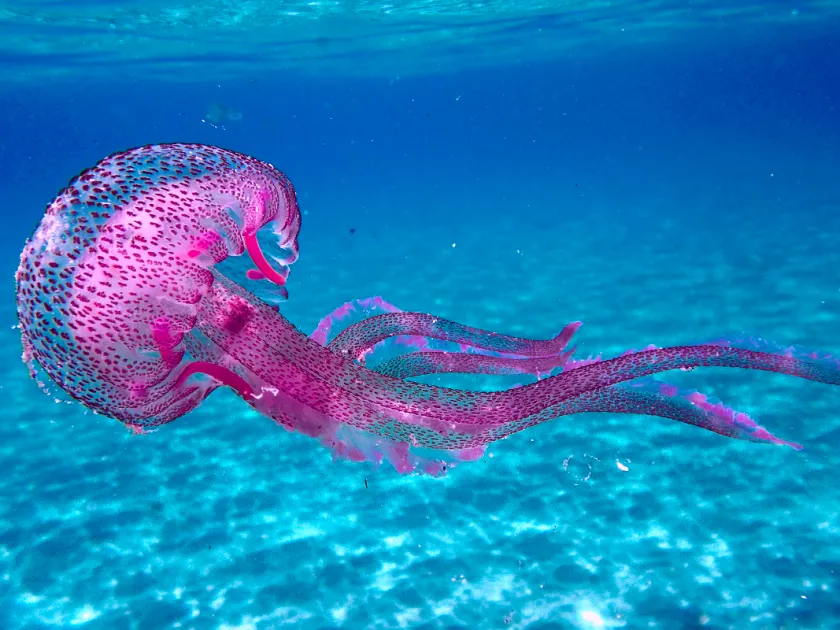
Description
How to identify
Pelagia noctiluca, commonly known as the mauve stinger, belongs to the phylum Cnidaria, class Scyphozoa, order Semaeostomeae, and family Pelagiidae. It is a highly recognizable jellyfish known for its stinging capabilities.
The bell typically reaches a diameter of 10–12 cm and is covered in warts containing stinging cells, while its long, trailing tentacles contain potent nematocysts used to capture prey.
Unlike many other scyphozoans, this species lacks a sedentary polyp stage. Its entire life cycle is holoplanktonic, meaning it stays in the water column throughout its life, making it highly dispersive.
The species exhibits bioluminescence, a chemical light production that occurs when the organism is disturbed, which serves as a defensive mechanism and a marker for its presence at night.
They are primarily found in warm, open-sea waters, but rising temperatures have enabled them to expand their range, frequently encroaching on coastal areas where aquaculture sites are situated.
What it damages
While Pelagia noctiluca does not consume terrestrial crops, it is a devastating pest for the mariculture industry, particularly for salmon and sea bream farms located in coastal waters.
The jellyfish enter net pens and inflict severe injuries on fish through contact with their nematocysts. This leads to gill necrosis, secondary infections, and, in severe cases, massive fish die-offs.
Even if the fish survive the initial stinging, the physiological stress significantly reduces their growth rate and immune response, leading to substantial economic losses for farmers.
The accumulation of jellyfish biomass within aquaculture infrastructure clogs water intake systems, disrupts oxygenation equipment, and damages filtration systems essential for fish health.
Decomposing jellyfish matter accumulated in pens leads to poor water quality, characterized by low dissolved oxygen and increased ammonia levels, which further threatens the surviving fish stocks.
When it appears
The seasonal appearance of Pelagia noctiluca is largely driven by thermal trends in the ocean. They typically bloom during late spring and summer when water temperatures reach optimal levels.
Climate change has extended the favorable period for these jellyfish, leading to earlier and more frequent blooms that overlap with critical life stages of the cultivated fish species.
Hydrographic factors such as currents and wind patterns play a major role in concentrating these swarms in sheltered bays or lagoons, which are often the sites of intensive aquaculture operations.
Annual surveillance of sea temperature and current patterns is essential for predicting potential bloom intensities, allowing farmers to prepare mitigation strategies ahead of time.
In regions with anomalous temperature shifts, the jellyfish may persist longer than usual, posing a continuous threat to mariculture operations that require high-quality seawater.
Signs of infestation
The presence of Pelagia noctiluca is typically first identified by the visual observation of swarms in the vicinity of the floating pens or through the accumulation of jelly matter on intake filters.
Fish behavior serves as a critical indicator; affected fish often exhibit lethargy, reduced feeding activity, and increased surface swimming behavior to avoid the jellyfish stinging cells.
Examination of the fish gills and skin often reveals characteristic pale or inflamed lesions, which are localized tissue damage points caused by contact with the jellyfish tentacles.
A sudden decline in dissolved oxygen sensors in the farm area is a common indirect sign of a massive influx of Pelagia noctiluca, indicating an urgent need for protective intervention.
- Visual detection of jellyfish swarms
- Lethargy and loss of appetite in fish
- Characteristic lesions on skin and gills
- Abrupt drop in dissolved oxygen levels
Control measures
The deployment of air-bubble curtains around net pens is a common engineering solution that effectively creates a physical barrier to deter the jellyfish from entering the farming zone.
Fine-mesh screening and automated water intake filters are utilized to protect the internal systems of land-based hatcheries and processing units from debris and stinging cells.
Advanced monitoring programs use acoustic sensors and real-time oceanographic data to detect swarm movements, allowing farm managers to harvest or relocate fish before the swarm arrives.
In extreme cases, temporary submersions of net pens to deeper, cooler water levels where jellyfish are less prevalent can reduce exposure and mitigate mortality rates.
Staff training and personal protective equipment are mandatory in high-risk zones to prevent human injury from the potent stingers, ensuring safe operations during bloom events.
Taxonomy
- Latin name
- Pelagia noctiluca
- Family
- Pelagiidae
- EPPO code
- PELGNO
Discussion
No discussions yet — be the first.