
Compass jellyfish
Chrysaora hysoscella
Description
How to identify
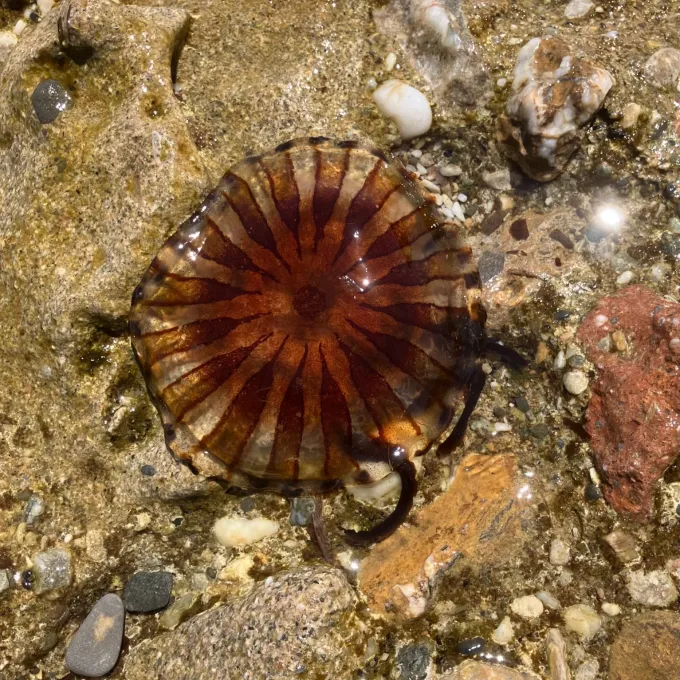
The Compass jellyfish (Latin: Chrysaora hysoscella) is a scyphozoan species within the Pelagiidae family. It is easily identified by the distinct brown markings on its bell that resemble the points of a compass.
These jellyfish possess a semi-spherical bell reaching diameters of up to 30 centimeters. The pattern consists of 16 radial lines radiating from the central point towards the bell's margins.
The organism is equipped with four oral arms and numerous slender tentacles, which are armed with stinging cells (nematocysts) used to capture prey and defend against threats.
The life cycle involves an attached polyp stage living on the seabed and a free-swimming medusa stage. This dual-stage life cycle allows for both sexual and asexual reproduction, facilitating rapid population growth.
In an agricultural and aquaculture context, this jellyfish is considered a significant biological hazard due to its potential to disrupt farming operations in coastal waters.
What it damages
While not a pest in terrestrial agriculture, the Compass jellyfish is a major threat to marine aquaculture, specifically affecting fish cage operations and shellfish farms.
Jellyfish blooms can physically damage fish larvae and juvenile species via contact with stinging tentacles, causing severe physiological stress and increasing mortality rates.
High densities of these medusae can clog gill structures of farmed fish, leading to suffocation. Additionally, they compete for the same food sources, such as zooplankton, effectively reducing the carrying capacity of the farm site.
Water intake systems of aquaculture facilities are highly susceptible to clogging by these jellyfish, which leads to equipment failure, pump damage, and increased operational maintenance costs.
Furthermore, the mass decomposition of jellyfish after a bloom significantly alters water quality, potentially inducing localized hypoxia and toxicity in the surrounding culture environment.
When it appears
The bloom season for this species generally occurs during late spring and summer when sea temperatures reach levels conducive to the development of the medusa stage.
The transition from the benthic polyp phase to the swimming medusa phase is highly dependent on temperature, typically peaking between July and August in northern hemisphere waters.
Climate change is influencing the seasonal timing of these events, often leading to longer and more intense bloom periods that challenge conventional aquaculture planning.
As water temperatures decline in the autumn, the majority of the medusa population dies off, completing the seasonal cycle and returning to the polyp state for winter.
Aquaculture managers often use seasonal historical data to predict potential bloom timing and schedule harvest or maintenance activities to mitigate operational risks.
Signs of infestation
The most immediate sign of a jellyfish bloom is the visual detection of the distinct compass-shaped bell pattern floating in the immediate vicinity of the aquaculture cages.
The presence of excess mucous secretions on netting and infrastructure is a clear indicator that the jellyfish have been in contact with the farm's equipment.
A sudden decline in dissolved oxygen levels, detected through real-time sensors, can suggest an influx of biomass associated with jellyfish swarms consuming oxygen.
Behavioral changes in farmed fish, such as lethargy, erratic swimming, or visible lesions, indicate that the population is being stressed by the presence of stinging organisms.
A significant reduction in local water clarity combined with a rapid depletion of zooplankton stocks confirms that the jellyfish population is actively feeding in the area.
Control measures
Physical barrier systems, such as fine-mesh netting and exclusion curtains, are the primary methods for preventing the entry of jellyfish into sensitive aquaculture zones.
Air-bubble curtains (bubble barriers) have proven effective in creating turbulence that discourages jellyfish from approaching or entering fish pens.
Proactive monitoring and management allow operators to relocate mobile cage systems or harvest stocks early if high concentrations are detected in the vicinity.
Filtration technologies must be employed at water intake points to prevent jellyfish from entering pump stations, ensuring continuous operation of life support systems.
- Regular mechanical cleaning of netting to prevent build-up of jellyfish debris.
- Strategic site selection to avoid areas known for recurrent seasonal blooms.
- Integrated environmental management to limit nutrient runoff that fuels excessive jellyfish reproduction.
Taxonomy
- Latin name
- Chrysaora hysoscella
- Family
- Pelagiidae
- EPPO code
- CHYSHY
Discussion
No discussions yet — be the first.