
Sea nettle
Chrysaora quinquecirrha
Description
How to identify
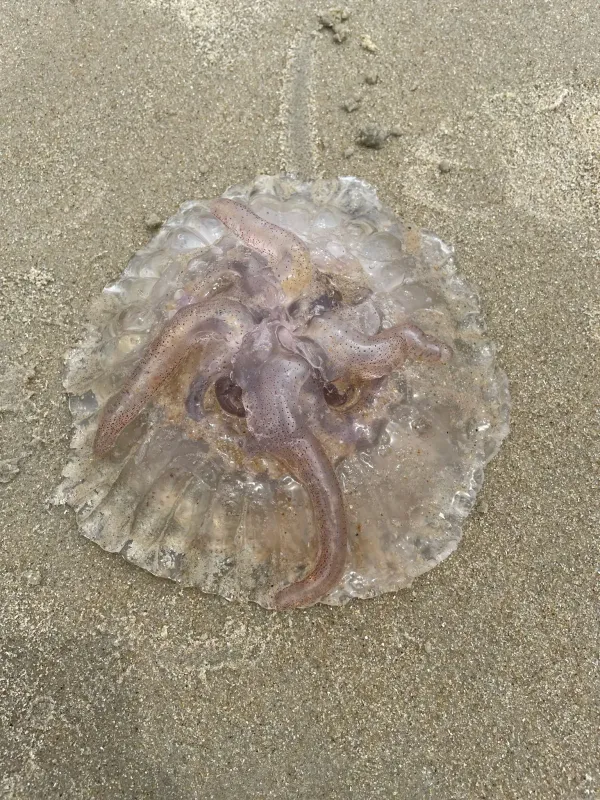
The Atlantic sea nettle (Chrysaora quinquecirrha) belongs to the phylum Cnidaria and the family Pelagiidae. It is a large scyphozoan jellyfish characterized by a dome-shaped bell, often displaying reddish-brown radial stripes.
This species is well-known for its long, trailing tentacles covered in nematocysts (stinging cells). These are used both for prey capture and as a defensive mechanism against potential threats in their aquatic environment.
The life cycle involves an alternation of generations, switching between a free-swimming medusa stage and a sessile polyp stage. The polyps are typically attached to hard substrates, where they can reproduce asexually.
As predators, they feed primarily on zooplankton, fish larvae, and small crustaceans. Under optimal environmental conditions, they can form massive blooms that dominate local estuarine and coastal ecosystems.
Identification is based on morphological markers such as the number of tentacles, bell color patterns, and size. Because of their sting, handling these organisms requires professional care and appropriate protective equipment.
What it damages
While not a pest in the traditional crop sense, the sea nettle is a major nuisance and economic threat to marine aquaculture facilities. It directly impacts fish health and facility operational efficiency.
When sea nettles come into contact with fish in net pens, their stinging cells release toxins. This causes severe skin lesions and gill damage in fish, leading to high mortality rates and increased susceptibility to secondary infections.
For operations focused on shellfish or crustacean farming, sea nettles compete for limited food resources. They actively predate on larvae, significantly reducing the recruitment and survival rates of commercially valuable species.
Large aggregations of sea nettles frequently clog intake screens and filtration systems at aquaculture sites. This obstruction disrupts water circulation and oxygen flow, which can be catastrophic for livestock.
Economic losses are compounded by the high cost of manual labor required for debris removal and the need for frequent replacement of equipment damaged by the physical mass and chemical properties of the jellyfish.
When it appears
The abundance of Chrysaora quinquecirrha is highly seasonal, dictated primarily by water temperature and salinity levels. Blooms typically reach their peak during the warmer summer and autumn months.
The life cycle is triggered by spring warming, which stimulates the release of ephyrae from the polyp colonies. These young jellyfish then grow rapidly, increasing their presence in coastal waters as the season progresses.
Winter dormancy occurs at the polyp stage, where the organisms remain attached to structures. Understanding the timing of this seasonal transition is essential for aquaculture managers to prepare protective measures.
Environmental factors such as nutrient runoff and climate change are extending the duration of bloom events. This requires farmers to maintain an extended period of vigilance compared to historical data.
Strategic planning based on local water quality monitoring allows operators to predict potential arrival times of jellyfish swarms and adjust their facility operations accordingly.
Control measures
Physical barriers are the most effective defense. Aquaculture facilities typically use fine-mesh exclusion nets and curtains to prevent jellyfish from entering rearing enclosures and damaging sensitive livestock.
Environmental monitoring systems, including salinity and temperature probes, act as an early warning network. This allows managers to shut down water intake systems before a bloom enters the facility infrastructure.
Air-bubble curtains have proven successful in some operations. By creating a rising curtain of bubbles, farms can generate a hydrodynamic barrier that effectively diverts jellyfish away from protected areas.
Managing the polyp stage is also crucial. Periodic mechanical cleaning of underwater structures and the application of anti-fouling coatings help to reduce the surface area available for new polyp colonization.
When physical intrusion occurs, controlled extraction using specialized nets is recommended. Care must be taken during removal to minimize stress to the farmed fish and to prevent the rupture of stinging cells into the water column.
Taxonomy
- Latin name
- Chrysaora quinquecirrha
- Family
- Pelagiidae
- EPPO code
- CHYSQU
Discussion
No discussions yet — be the first.