

Description
How to identify
The grain moth, scientifically known as Paralipsa gularis, is a member of the Pyralidae family. It is a significant pest of stored agricultural products worldwide.
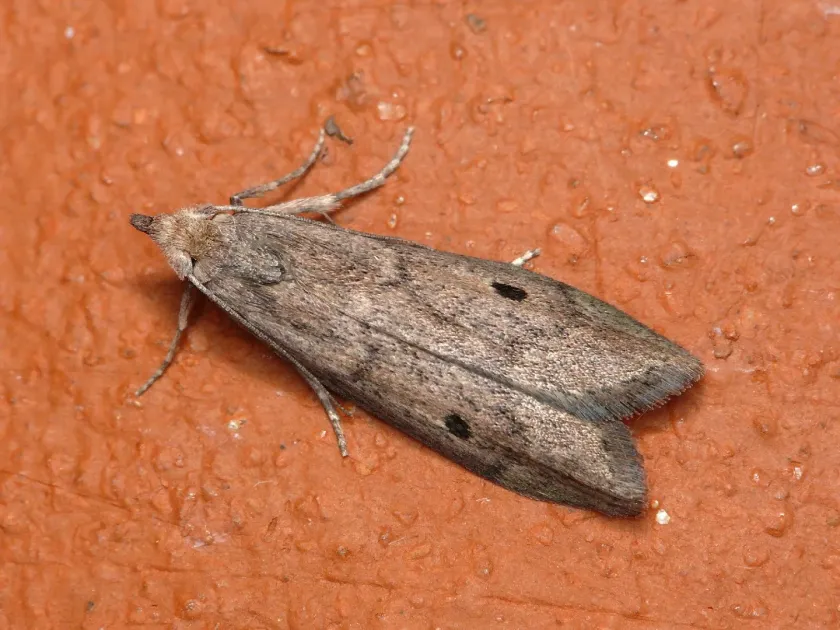
Adult moths have a wingspan of approximately 20–25 mm. The forewings are brownish-gray with dark spots and transverse lines, while the hindwings are paler with a delicate fringe.
The larvae, which cause the primary damage, grow to about 15–18 mm in length. They are typically dirty white or yellowish in color with a distinct brown head capsule.
The insect undergoes complete metamorphosis, including egg, larva, pupa, and adult stages, with the larval stage being the most destructive to food supplies.
Before pupation, larvae construct dense silk cocoons often incorporating food particles, which makes them resilient to external environmental conditions in warehouse settings.
What it damages
This pest infests a wide range of stored grains, including wheat, corn, rice, and barley, leading to substantial quantitative and qualitative losses.
Besides raw grains, the moth targets processed commodities such as flour, bran, cereals, various oilseeds, nuts, and dried fruits kept in storage.
The larvae feed primarily on the germ of the grain, which drastically reduces the seed germination potential and renders the batches unsuitable for planting purposes.
Infestation is characterized by the presence of silk webbing, feces, and larval skins, which destroy the aesthetic and commercial value of the affected food products.
Secondary damage often occurs when the moisture produced by larval activity encourages the growth of molds and fungi, further spoiling the stored commodities.
When it appears
In temperature-controlled storage facilities, the grain moth can reproduce throughout the year, completing several generations depending on the ambient conditions.
The ideal conditions for rapid development involve temperatures between 25°C and 28°C, which can shorten the life cycle to approximately 40–50 days.
In unheated warehouses, the moth slows its biological processes, with larvae often entering a dormant state or overwintering within protected crevices or product residues.
Outdoor or non-insulated activity typically peaks from late spring through early autumn, corresponding with warmer seasonal temperatures conducive to moth flight.
The duration of each generation is highly dependent on both temperature and the moisture content of the substrate, which directly impacts the larval growth rate.
Signs of infestation
The most prominent sign of an infestation is the presence of silk webbing that binds grain particles or flour together into clumps or sticky masses.
Visual detection of adult moths resting on walls or flying during dusk hours is a primary indicator of an active population within the storage area.
Examining the grain often reveals exit holes from larvae and a fine, powdery residue or frass mixed with the remaining food source.
A musty or sour smell emanating from a grain pile often signals extensive infestation and the onset of mold growth resulting from larval damage.
- Silk webbing on containers and pallets.
- Clumped grain or processed food products.
- Exit holes on kernel surfaces.
- Presence of small dark fecal pellets.
Control measures
Rigorous warehouse sanitation, including the removal of grain residues, dust, and debris, is the first and most critical line of defense against grain moths.
Professional fumigation of storage facilities with approved insecticides, such as phosphine-based products, is necessary to eradicate deep-seated populations.
Using sealed containers and maintaining proper temperature and moisture control in grain silos can effectively inhibit larval development and prevent infestations.
Pheromone traps are highly effective for monitoring adult moth populations and identifying the early stages of an infestation before it spreads to bulk storage.
Regular inspections and the use of integrated pest management (IPM) strategies ensure that any signs of the moth are addressed promptly to minimize economic losses.
Content graph
Connections · Grain moth
Most often together:
Marketplace
Products · 1
Biology
Taxonomy
- Latin name
- Paralipsa gularis
- Order
- Lepidoptera (butterflies)
- Family
- Pyralidae
- EPPO code
- APHMGU
Community
Discussion
No discussions yet — be the first.