
Maple bladder-gall midge
Paradiplosis tumifex
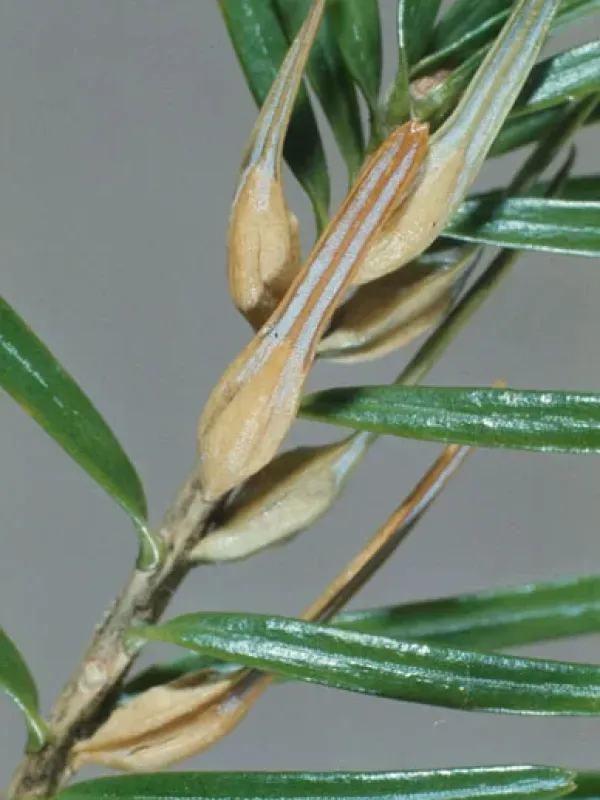
Description
How to identify
The maple bladder-gall midge (Paradiplosis tumifex) is a small fly belonging to the family Cecidomyiidae within the order Diptera. Adult midges are tiny, delicate, mosquito-like insects that are rarely seen by the naked eye.
The lifecycle of this pest is intricately linked to the budding and early development stages of maple trees. Adults emerge precisely when the leaf buds begin to open, allowing them to lay eggs on the newly emerging tissue.
The larvae are the stage responsible for the damage. They feed internally within the leaf, secreting biochemical substances that manipulate the host plant's growth pattern.
After their developmental period, the larvae emerge from the galls and drop to the soil, where they transition into the pupal stage to complete their life cycle.
Overwintering occurs in the soil as a pupa or larva inside a cocoon, meaning the environment around the tree plays a critical role in the insect's survival between seasons.
What it damages
This species is specifically known to infest maple trees, with sugar maples (Acer saccharum) being the most common host. The damage is restricted to the foliage, specifically the expanding leaves.
While the aesthetic impact of these galls is significant, they generally do not threaten the life of a mature, healthy tree. However, heavy infestations can reduce photosynthetic efficiency.
In ornamental settings, the primary concern is the loss of aesthetic value. A canopy covered in distorted, colorful galls is considered unsightly by landscape managers and property owners.
Severe cases may lead to premature leaf drop, which can stress the tree if it occurs repeatedly over several consecutive years.
For nursery production, the presence of galls can make saplings unsellable, resulting in direct financial losses for the grower due to reduced quality of the stock.
When it appears
The activity begins in early spring, synchronized with the bud break of the maple trees. This is the period when the foliage is most susceptible to gall formation.
Gall formation is most prominent throughout late spring and early summer. As the season progresses, the galls harden and become more conspicuous.
By mid-summer, the larvae typically vacate the galls, causing the growths to dry out and eventually turn brown and woody.
The remainder of the summer and the entire autumn/winter period are spent in the soil, awaiting the environmental cues of the following spring to resume activity.
Early spring monitoring is essential because this is the only window of opportunity to prevent the initial gall formation process through management actions.
Signs of infestation
The most visible sign of an infestation is the presence of bladder-like galls on the upper leaf surface. These structures are often bright green, pink, or red initially.
If you inspect the underside of the affected leaf, you will usually find a corresponding depression or opening through which the larvae eventually exit.
Deformation of the leaf blade is common. Depending on the density of the galls, the leaf may curl, cup, or show signs of stunted growth.
When the galls turn brown, they are often mistaken for fungal spots by casual observers, but a close look reveals the structural nature of the gall.
Large numbers of fallen, dried, and distorted leaves beneath the tree in mid-summer are a clear indicator of a significant infestation during the growing season.
Control measures
Management is often unnecessary for large, mature trees because the aesthetic damage rarely impacts overall tree health or long-term vigor.
If control is desired in nursery or landscape settings, systemic insecticides applied just as the buds begin to swell can effectively protect the developing leaves from midge colonization.
Cultural practices, such as raking and removing leaf litter, may help reduce the local population of the pest, although it is not a foolproof method for total eradication.
Healthy, well-irrigated, and fertilized trees are better equipped to tolerate the stress caused by midge infestations, emphasizing the importance of good overall tree care.
- Monitor bud development closely in early spring.
- Prune and dispose of heavily infested branches in smaller specimens.
- Avoid over-reliance on chemical controls for minor aesthetic issues.
Taxonomy
- Latin name
- Paradiplosis tumifex
- Order
- Diptera (flies)
- Family
- Cecidomyiidae
- EPPO code
- PAADTU
Discussion
No discussions yet — be the first.