
Spruce sawfly
Pachynematus ocreatus
Description
How to identify
The Spruce sawfly (Pachynematus ocreatus) belongs to the order Hymenoptera, family Tenthredinidae. These insects are characterized by a life cycle involving complete metamorphosis, typically found in many temperate conifer forests.
Adult sawflies resemble small wasps or flies. Females use a saw-like ovipositor to cut slits in the needles of host trees, where they deposit their eggs. This stage is crucial for understanding the timing of population outbreaks.
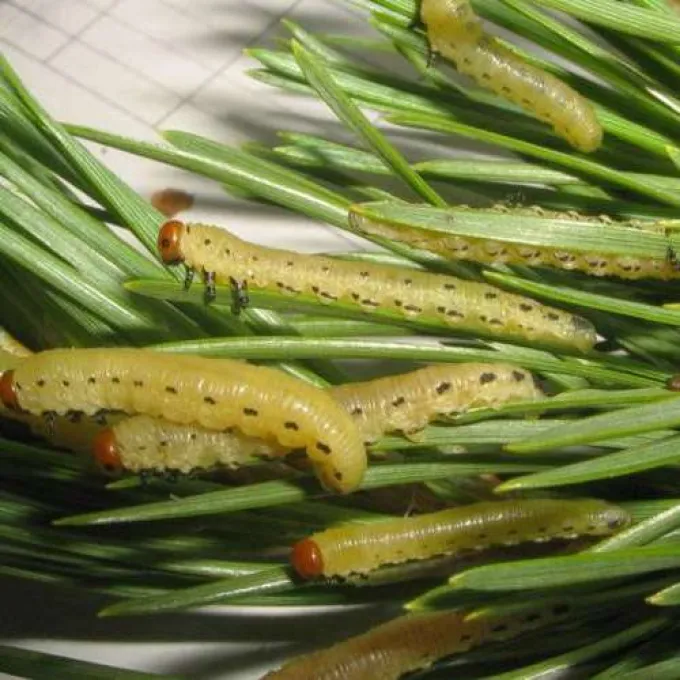
The larvae, often called false caterpillars, are the primary life stage causing damage. They usually possess a distinct head capsule and several pairs of prolegs, allowing them to cling to and crawl along spruce needles.
The pupal stage is passed within a tough, protective cocoon, usually buried in the soil or needle litter beneath the spruce canopy. This allows them to survive seasonal temperature fluctuations effectively.
Development is highly synchronized with the tree's budding phase, ensuring that young larvae emerge precisely when the new, tender growth is available as a food source.
What it damages
The Spruce sawfly primarily feeds on various species of the genus Picea. Both ornamental landscape trees and forest nursery plantations are susceptible to its feeding activity.
Larvae consume the needles, often starting from the margins or skeletonizing them. This feeding pattern creates a characteristic appearance where needles appear nibbled or are completely stripped from the twig.
Heavy infestations lead to significant defoliation, which severely disrupts the tree's ability to photosynthesize. This stress weakens the tree, making it highly susceptible to secondary attacks by borers or pathogens.
In mature trees, repeated annual damage can lead to crown thinning and permanent branch dieback, significantly impacting the tree's overall aesthetic and ecological health.
In extreme cases, young trees may suffer complete needle loss, leading to stunted growth or eventual mortality if the infestation is not managed timely.
When it appears
Adult emergence typically occurs in the late spring, coinciding with the flushing of new spruce buds. This timing is essential for the survival of the neonate larvae.
The larval feeding period generally spans through early to mid-summer. This is the time when visual symptoms of the infestation become most apparent to property owners.
The life cycle is typically univoltine, meaning there is one generation per year, though microclimatic conditions can sometimes influence the developmental rate.
By late summer, mature larvae drop to the forest floor to spin their overwintering cocoons, entering a state of diapause that protects them through the winter months.
The population remains dormant in the soil or organic layer until the rising temperatures and longer daylengths of the following spring trigger the next cycle.
Signs of infestation
The presence of frass (larval excrement) is often the first visible indicator. Small, dark, granular pellets accumulate on branches or in the webbing produced by the larvae.
Chlorotic or yellowing needles that eventually turn brown and fall prematurely are clear signals. Affected shoots often look ragged, missing significant portions of their foliage.
Searching the undersides of the needles, especially near the transition between new and old growth, often reveals the presence of the greenish, cryptic larvae.
Sparse, transparent-looking crowns in previously healthy spruce trees serve as a late-stage warning sign of a significant infestation that has been occurring for several weeks.
An accumulation of needle debris at the base of the tree is another indicator of heavy feeding activity occurring in the upper canopy layers.
Control measures
Effective management begins with regular monitoring during the late spring and early summer. Early detection allows for more precise and less intrusive intervention.
For ornamental or specimen trees, physical removal of larval colonies by hand or high-pressure water sprays can be sufficient to control localized infestations.
- Application of environmentally safe bio-insecticides containing Bacillus thuringiensis to target early-instar larvae specifically.
- Use of registered systemic insecticides as a soil drench or trunk injection for large, high-value landscape trees.
- Autumn cultivation of the soil around the drip line to expose and destroy overwintering cocoons in the topsoil.
Maintaining tree vigor through proper watering and fertilization practices enhances the spruce's natural ability to withstand pest pressure.
Promoting a healthy ecosystem by installing bird boxes or planting native flora that supports predatory insects can help provide natural biological control of sawfly populations.
Taxonomy
- Latin name
- Pachynematus ocreatus
- Order
- Hymenoptera
- Family
- Tenthredinidae
- EPPO code
- PCNEOC
Discussion
No discussions yet — be the first.