

Description
How to identify
The Acacia seed beetle (Pachymerus acaciae) is a member of the seed beetle family (Bruchidae) within the order Coleoptera. It is a specialized pest known for its ability to infest the seeds of various plants, primarily those within the Acacia genus.
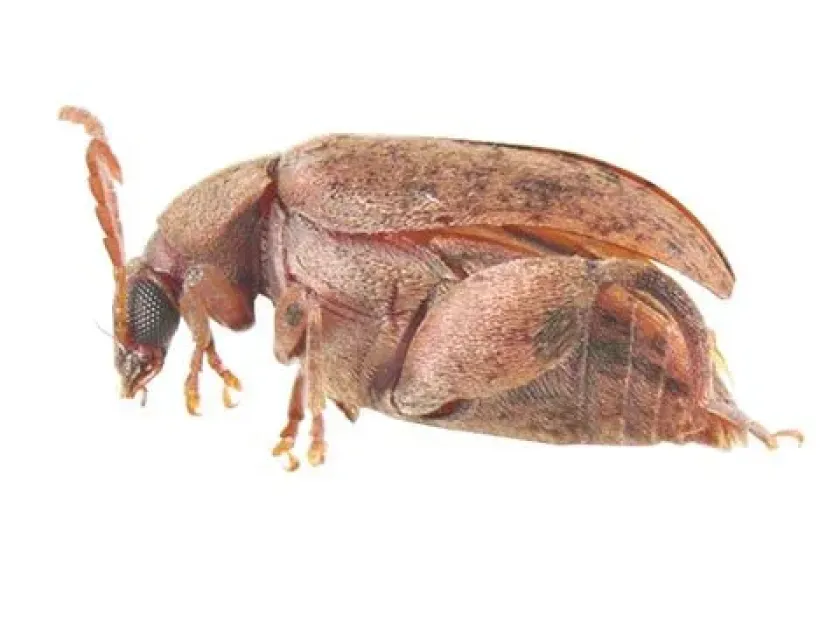
Adult beetles typically possess a robust, oval-shaped body with shortened elytra, which is a hallmark of the Bruchidae family. Their coloration often ranges from dark brown to black, providing camouflage against the seed coat surfaces they inhabit.
The larvae are whitish, C-shaped grubs with reduced legs, highly specialized for an endophagous lifestyle. They possess strong mandibles capable of boring through the tough outer layers of legume seeds to reach the nutrient-rich interior.
Adult beetles are capable of flight, which facilitates their dispersal across landscapes in search of suitable host plants during the pod maturation phase. They rely on specialized sensory organs to locate ripe seeds suitable for oviposition.
The species demonstrates high biological adaptation to its host environment, with its developmental cycle closely synchronized with the phenology of acacia trees and other host legumes.
What it damages
The primary hosts for this pest include seeds of Acacia spp. and other related legumes. When these seeds are harvested and stored, the beetle can cause devastating losses to stored product reserves if not properly managed.
The damage is almost entirely caused by the larvae, which hollow out the seed interior completely. This process destroys the embryo and starch reserves, effectively rendering the seed useless for germination or commercial processing.
In cases of severe infestation, the pest can ruin a significant percentage of stored stock. The presence of the beetle often leads to total crop failure for seed production purposes, requiring strict quality control in agricultural settings.
Infested seeds are highly susceptible to secondary contamination by molds and bacteria, which enter through the exit holes created by the beetles. This secondary infection decreases the quality of the product and can introduce harmful mycotoxins.
The economic impact involves not only the loss of raw material mass but also the cost of remediation, decontamination, and the loss of viability in valuable seed stocks.
When it appears
The activity period typically begins with warmer weather, as temperatures rise above 20 degrees Celsius. This onset of activity is highly correlated with the development and ripening of pods on host plants in the field.
In natural habitats, the pest may undergo several generations per season, depending on local climate conditions and the availability of pods. The synchronization between beetle activity and host development is a critical factor for population growth.
Within climate-controlled storage facilities, the Acacia seed beetle can potentially develop year-round, bypassing the natural seasonal diapause. This makes stored grains particularly vulnerable throughout the winter months.
Overwintering usually occurs as adults or mature larvae within infested seeds or in the crevices of storage structures. This hidden survival strategy makes the beetle difficult to eradicate once it establishes a foothold in a facility.
Peak abundance is often observed during and immediately after the harvest season, when beetles migrate from field crops into storage facilities alongside the gathered seed lots.
Signs of infestation
The most visible sign of an infestation is the presence of small, circular exit holes on the surface of the seeds. Each hole indicates that an adult beetle has successfully emerged from its pupal chamber.
Careful inspection of seed lots may reveal tiny, whitish or translucent eggs adhered to the pod or seed coat. These eggs are often overlooked without the use of a magnifying lens or microscope.
A noticeable reduction in the weight of the seed lot, combined with a hollow sound when handled, indicates significant larval feeding within the seed coat.
The presence of fine, powdery frass around containers or on the floor near stored grain is a hallmark of larval development, suggesting that the population density is likely quite high.
The sighting of adult beetles crawling on the surface of stored seeds or on the walls of the granary is an immediate indicator of a current, active infestation that requires professional attention.
Control measures
Effective management begins with strict climate control in storage. Keeping temperatures consistently below 10 degrees Celsius significantly inhibits larval development and prevents the rapid spread of the population.
Fumigation using phosphine-based products is the standard industry practice for eradicating active infestations, as the gas can penetrate deep into seed masses to kill larvae living inside the seeds.
Sanitation is paramount; regular cleaning of storage facilities to remove dust, debris, and infested seed remnants is necessary to disrupt the life cycle of the beetle and prevent re-infestation.
Biological control agents, such as specialized parasitic wasps or entomopathogenic fungi, are being explored as sustainable alternatives for managing populations in both field and warehouse settings.
- Implement pheromone monitoring to detect adult beetle activity early.
- Use airtight storage containers for high-value seed lots.
- Ensure rapid post-harvest processing to prevent field-to-storage transmission.
Content graph
Connections · Acacia seed beetle
Most often together:
Marketplace
Products · 1
Biology
Taxonomy
- Latin name
- Pachymerus acaciae
- Order
- Coleoptera (beetles)
- Family
- Bruchidae
- EPPO code
- PACMAC
Community
Discussion
No discussions yet — be the first.