
Agamemnon beetle
Oryctes agamemnon
Description
How to identify
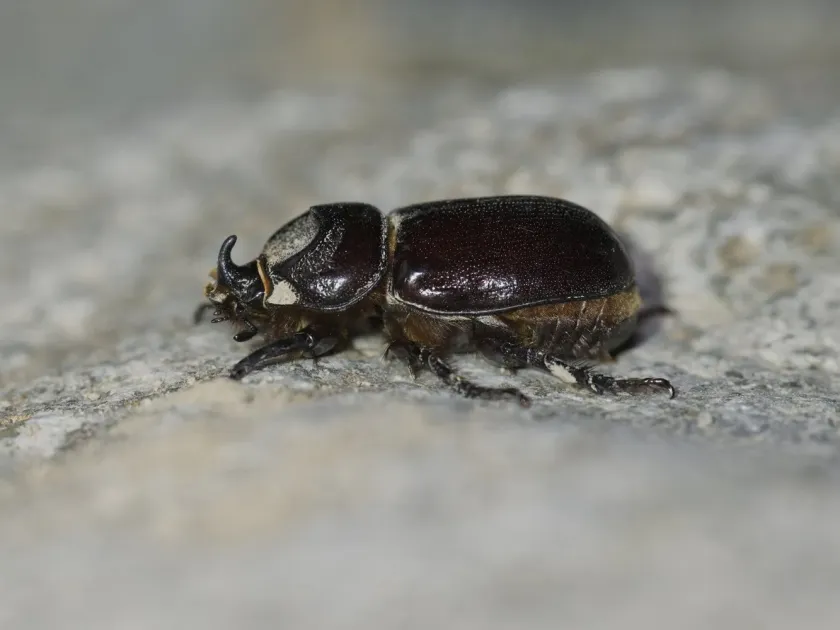
The Oryctes agamemnon, commonly known as the Agamemnon beetle, belongs to the family Scarabaeidae. This beetle is a serious pest of palm trees, particularly date palms, known for its destructive impact on plantations in arid regions.
Adult beetles are large and robust, typically possessing a dark brown or black exoskeleton. They are characterized by a prominent horn, which is more developed in males, used for competition and during the creation of tunnels in plant tissues.
The lifecycle consists of eggs, three larval stages, pupae, and adults. Larvae are typically found in decaying organic matter, such as dead palm stumps or piles of compost, where they feed and develop before pupating.
The insect is nocturnal, with adults being highly active after sunset. They are attracted to light, which makes light trapping an important part of the monitoring process in integrated pest management (IPM) programs.
Understanding their preference for weakened or decaying wood is essential. They often colonize neglected plantations where poor sanitation provides abundant breeding grounds for the larval stages.
What it damages
The primary host is the date palm (Phoenix dactylifera). Adult beetles are the main cause of damage as they bore into the crown and the base of the petioles of the palm, disrupting the growth of the tree.
By boring into the apical meristem (the growing point), the beetle can severely stunt the tree's growth or cause it to die entirely. When the growing point is damaged, the central leaves may emerge deformed or eventually collapse.
Larvae primarily thrive on organic matter, but high populations in the soil can lead to root damage for younger palm seedlings, as they may feed on roots when decaying material is depleted.
The tunnels created by the beetles act as entry points for various pathogens, including fungi and bacteria, which can lead to trunk rot and further weaken the tree's structural integrity.
Economic losses are significant in commercial plantations due to the cost of replacing dead trees and the long-term reduction in fruit yields caused by chronic damage to the palm's canopy.
Signs of infestation
Characteristic symptoms include circular holes at the base of the palm fronds or near the center of the crown. These entry holes are often accompanied by piles of frass (wood dust and excrement) left by the beetle.
Visual distortion of new leaves is a major indicator. If the beetle tunnels through the tightly packed leaf bases before they emerge, the leaves will appear shredded or have distinct symmetrical cuts once they unfurl.
Sudden wilting of the central leaf spear indicates that the beetles have likely reached and damaged the terminal growing point, a critical condition that requires immediate horticultural intervention.
Monitoring the presence of adults can be done by inspecting trees at night or checking areas around artificial light sources near the plantation, which often attract adult beetles.
Soil excavations near palm stumps or compost piles often reveal the presence of large, white, C-shaped larvae, confirming the beetle is actively breeding in the area.
Control measures
Cultural control is the first line of defense. This involves rigorous plantation sanitation, such as the removal and destruction of dead wood, stumps, and any decaying organic waste that could host larvae.
Light traps are highly recommended for capturing adult beetles at night. This practice helps reduce the number of breeding adults and provides data on peak activity times, which aids in timing other interventions.
Chemical control, including systemic insecticides, can be applied to the crown of the tree. However, this must be handled carefully to minimize residues in the harvested fruits and to protect beneficial insects.
Biological control, utilizing entomopathogenic fungi or specialized nematodes to target larvae in the soil, has shown promise in reducing the population in an environmentally friendly manner.
- Remove and burn all infested or dead palm material.
- Install light traps to manage adult beetle populations.
- Maintain orchard hygiene to limit breeding sites.
- Consider biological control agents for larval management.
Taxonomy
- Latin name
- Oryctes agamemnon
- Order
- Coleoptera (beetles)
- Family
- Scarabaeidae
- EPPO code
- ORYCAG
Discussion
No discussions yet — be the first.